
An Aging Jewish Feminist
The Blindness of Isaac and Rebecca: Seeing the Other
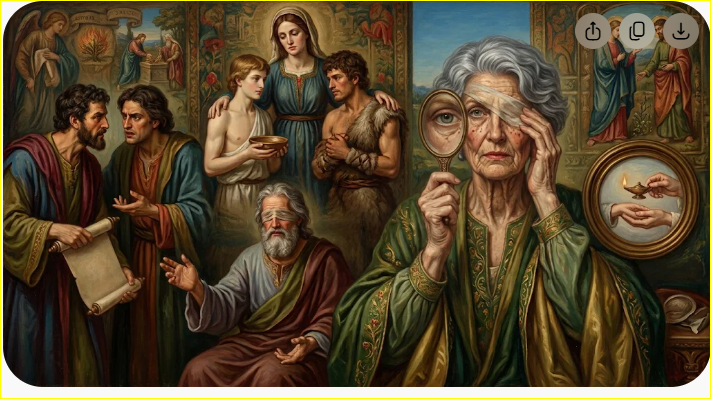
gemini image for Parshat Toledot in style of Dante Gabriel Rossetti (1828-1882)
This week I want to write about two seemingly different subjects: seeing and not seeing, and the two Rebeccas we encounter in the Torah readings of the past two weeks. One is very personal; the other is very political. But the more I thought about them, the more I realized that they are connected. Both raise questions about blindness: what we see, what we refuse to see, and how our choices can have consequences that extend far beyond our immediate intentions.
Part One: The Blindness of Isaac
This is a particularly personal subject for me because I am about to undergo cataract surgery. It is something I have put off for years. I will know after my examination with the surgeon when the operation can take place: either next Sunday or the following week. Either way, it is finally going to happen. And naturally, I began thinking about Isaac, whose blindness played such an important role in the story of his family.
In Genesis 27, we read that Isaac’s eyes had grown dim with age, so that he could no longer see. This physical blindness becomes the instrument through which Jacob, with the help of his mother Rebecca, deceives his father and obtains the blessing intended for his older brother Esau.
But was Isaac really blind only in the physical sense? Was he unaware of what was happening in his own household? He loved Esau, the son who regularly brought him the game he enjoyed eating. Rebecca, on the other hand, loved Jacob. How had this family reached a point where the parents were so divided in their affections that one could conspire with one son to deceive the other parent and deprive the favored son of his blessing?
Isaac’s famous response to Jacob, when he comes disguised as Esau, is particularly revealing:
“הַקֹּל קוֹל יַעֲקֹב וְהַיָּדַיִם יְדֵי עֵשָׂו”
“The voice is the voice of Jacob, but the hands are the hands of Esau” (Genesis 27:22).
Isaac recognizes something is wrong. He hears Jacob’s voice, but his hands feel like Esau’s. Did he suspect the deception? Did he choose not to pursue his suspicions? Perhaps he was so determined to bless Esau that he was willing to overlook what he might otherwise have recognized.
There is an intriguing mystical interpretation of Isaac’s blindness in the Zohar. In Zohar I, 168b, in connection with the soul of King David, Isaac is described as representing darkness. This is not necessarily darkness in the sense of evil, but rather the kabbalistic attribute of Gevurah: judgment, severity, restriction, and concealment. Elsewhere, the Zohar associates Abraham with light and Isaac with darkness (Zohar I, 141b).
The Zohar explains that David received years of life from Abraham, Jacob, and Joseph, but not from Isaac, because Isaac belonged to the side of darkness. In this mystical scheme, Isaac represents a force that restricts and conceals rather than illuminates.
Perhaps this offers another way of thinking about Isaac’s physical blindness. Was he unable to see because he was so enclosed within his own world of judgment and attachment? Or was his darkness a way of seeing something that others could not? Some later Hasidic interpretations, including those associated with the Lubavitcher Rebbe, suggest that Isaac saw in Esau a spiritual potential that others failed to recognize. He was not simply fooled by Esau’s hunting and cooking; he believed that Esau possessed qualities that could be elevated and transformed.
There is something moving about this interpretation. Esau was not simply a villain. He was a son who loved his father and cared for him. When he discovers that Jacob has taken his blessing, the Torah gives us one of its most painful descriptions of a human response:
וַיִּצְעַק צְעָקָה גְּדֹלָה וּמָרָה עַד־מְאֹד
“He cried out with an exceedingly great and bitter cry” (Genesis 27:34).
The Torah does not need to tell us explicitly that something terrible has happened. Esau’s cry tells us. Whatever we think about his character or his suitability to inherit the blessing, he has been betrayed by his own family.
And Isaac and Rebecca are both implicated in this tragedy. Isaac may have been blind to Esau’s shortcomings, while Rebecca may have been blind to the consequences of her determination to secure Jacob’s future. Their competing visions of what was best for their family ultimately tore it apart.
Part Two: The Two Rebeccas and the Consequences of Our Choices
Last week, in Parashat Chayei Sarah, we encountered a very different Rebecca from the one we meet in this week’s Parashat Toledot.
In Genesis 24, Rebecca is a remarkable young woman. She is generous, decisive, courageous, and independent. When Abraham’s servant asks her for water, she not only gives him a drink but volunteers to draw water for his camels as well. When her family asks whether she is willing to leave home and travel to an unknown future, she answers with two simple words:
“וַתֹּאמֶר אֵלֵךְ”
“And she said, ‘I will go'” (Genesis 24:58).
She takes initiative. She makes her own decision and embarks on an adventure. There is even a midrashic tradition suggesting that she was eager to escape the advances of her brutal father. Whatever her motivation, she emerges as a woman who is not afraid to act.
But in this week’s parasha, the same Rebecca makes a very different choice.
When she is pregnant with twins and experiences their struggle within her, she seeks God’s explanation. She receives the following oracle:
“וַיֹּאמֶר ה’ לָהּ שְׁנֵי גֹיִם בְּבִטְנֵךְ וּשְׁנֵי לְאֻמִּים מִמֵּעַיִךְ יִפָּרֵדוּ וּלְאֹם מִלְאֹם יֶאֱמָץ וְרַב יַעֲבֹד צָעִיר”
“Two nations are in your womb, two peoples shall issue from your body; one people shall be mightier than the other, and the older shall serve the younger” (Genesis 25:23).
Notice what God does not say. The oracle predicts that the older will serve the younger, but it does not instruct Rebecca to deceive her husband, disguise Jacob, or arrange for him to steal Esau’s blessing. It does not even explicitly tell her how this reversal will come about.
Rebecca supplies the method herself.
We know that Isaac favors Esau, while Rebecca favors Jacob. Esau is described as a hunter and a man of the field, while Jacob is an איש תם יושב אהלים, a quiet man who dwells in tents (Genesis 25:27). He is also a cook, as we discover in the famous story of the lentil stew (Genesis 25:29). But Jacob is hardly without guile. The trickster who takes advantage of his brother’s hunger is also the son whom Rebecca will later help deceive his father.
Why does Rebecca decide that she must intervene? Why doesn’t she tell Isaac about the prophecy? Nachmanides, commenting on Genesis 27, raises precisely this question. He suggests that Rebecca may have feared that Isaac would not accept the prophecy and would continue to favor Esau. Rather than trust her husband or allow events to unfold, she decides to take matters into her own hands.
Perhaps she believes she is fulfilling God’s will. Perhaps she believes that she knows better than Isaac what the future requires. But I am inclined to think that she acts on her own, and that this is a mistake.
The consequences are devastating. Esau is betrayed and cries out in anguish. Jacob has to flee for his life and is away from home for twenty years. Rebecca, who was so determined to secure Jacob’s future, never sees him again, as far as the biblical narrative tells us. The family is broken.
The Torah does not explicitly condemn Rebecca. It does not record her repentance or a divine rebuke. But perhaps the poignancy of Esau’s cry and the subsequent separation of mother and son constitute the Torah’s criticism. Rebecca may have achieved the outcome she wanted, but she could not control the consequences of the way she achieved it.
There is something particularly tragic about the contrast between the two Rebeccas. The young woman who once had the courage to say “I will go” and take responsibility for her own future becomes a mother who cannot trust others to make their own choices. Her initiative turns into manipulation. Her determination to protect one son comes at the expense of the other.
And this brings me to our own situation in Israel.
I am a citizen of two worlds. I come from the United States, with its Western, formerly liberal tradition, but I live in the Middle East, where politics and society are shaped by a different, more traditional and Mediterranean mindset. I find myself increasingly troubled by the way we demonize those who are different from us.
Following the recent election, we seem to be returning to the familiar politics of exclusion. The right demonizes Arabs, treating them as though their very presence in the political life of Israel is illegitimate. The left, in turn, demonizes Haredim, often describing them as parasites who contribute nothing to society.
I do not want to demonize Haredim. I have photographs of my Haredi grandparents on my wall. In their day, we did not even use the term in quite the same way. I imagine they would be appalled by the extent to which parts of today’s Haredi leadership have learned to take advantage of government coalitions, securing disproportionate benefits while resisting the obligations of shared citizenship, including military or other national service. There are real inequalities and serious questions of responsibility that cannot simply be brushed aside. Calling attention to them is not the same as condemning an entire community.
At the same time, I find it appalling that so few members of the new Knesset seem willing even to consider including Arab political partners in a governing coalition. There are Arab citizens and political representatives who are prepared to participate in the democratic life of the country, who recognize their responsibilities as citizens and who condemn our enemies. Why should they be automatically excluded, while parties that refuse to accept comparable obligations are welcomed as legitimate partners?
I am not suggesting that political differences are insignificant, or that every Arab party or every Haredi party is the same. But we need to distinguish between legitimate political criticism and the demonization of entire populations. We cannot demand that one group prove its loyalty and responsibility while exempting another from the same scrutiny.
There is a troubling biblical precedent for this kind of exclusion. In Malachi 1:2–3, God declares: “I have loved Jacob, but I have hated Esau.” The distinction between the two brothers becomes a theological justification for choosing one and rejecting the other. The book of Obadiah similarly condemns Edom for its violence against its brother Jacob. Over time, the distinction between the brothers becomes a powerful symbol of the division between those who belong and those who do not.
But I wonder whether we should still be thinking in these terms.
The twins began their lives together. They emerged from the same womb, struggling with one another even before they were born. They were different, and they had competing interests, but they were brothers. Must difference inevitably lead to exclusion? Must one brother’s future depend on the other’s humiliation?
In this sense, I find myself returning to Rebecca. She heard God’s prophecy and decided that she knew what had to be done. She was convinced of the destination and blinded herself to the human cost of the journey. Isaac, too, was blind: perhaps to Esau’s limitations, perhaps to the tensions within his own family, perhaps even to the deception unfolding before him.
Neither parent seems to have understood how much damage their choices would cause.
We are facing a similar test. We may be convinced that we know what kind of government Israel needs and which political forces should lead it. But are we so certain of our own righteousness that we cannot see the legitimate claims and interests of those who disagree with us? Are we willing to use exclusion and political maneuvering to achieve what we believe is the right outcome, without considering the consequences for the society we will all have to inhabit afterward?
Rebecca’s story reminds us that even when we believe we are acting for the greater good, we can cause lasting damage by refusing to see the other person. And Isaac’s story reminds us that blindness is not always physical. Sometimes we see exactly what is in front of us, but choose not to acknowledge it.
As I prepare to have my cataract finally removed, I hope that I will see the world more clearly. But physical sight is only one kind of vision. The more difficult challenge is to recognize our own blindness: our prejudices, our loyalties, our fears, and our unwillingness to acknowledge the humanity and legitimate claims of those on the other side.
Perhaps that is the real lesson of Isaac and Rebecca. It is not enough to see clearly what we want. We must also be willing to see what our choices will do to others.
And perhaps, before we decide who deserves the blessing, we should first learn to see both brothers.
Related Posts