


The Blindness of the West: When We Look with Only One Eye
Ireland, 1939 and Ireland, 2026. Two photographs separated by 87 years and by two completely different historical contexts. They do not prove that the situations are equivalent. But placed together, they leave an uncomfortable question: what do we choose to see at each moment, and what do we leave outside the frame?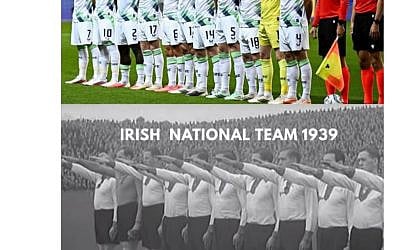
Some photographs need a great deal of explanation. Others, placed side by side, raise a question even before you know their history.
These two do exactly that.
Below, May 1939. The Irish national team is lined up in Bremen before Nazi Germany. The players raise their arms during the pre-match ceremony. That does not automatically make them Nazis. The gesture was part of the protocol accepted for that match.
But the date matters.
By then, the racial laws, the annexation of Austria, Kristallnacht and the occupation of Czechoslovakia had already taken place. Europe was not facing a regime about which it knew nothing.
Above, September 2026.
Another Irish national team, this time facing Israel. The players lower their heads during the Israeli anthem. There is no customary handshake, and they wear black armbands. This time the gesture is deliberate, visible and political.
Eighty-seven years separate the two photographs.
They do not prove that Ireland was Nazi in 1939. Nor do they, by themselves, prove that Ireland is antisemitic in 2026.
What do we choose to see, and what do we leave outside the frame?
No one should deny Palestinian suffering. I do not want to deny it either.
A Palestinian child is not Hamas. A Palestinian family should not have to carry the responsibility for the decisions of an armed organisation. The dead, the displaced and the destroyed homes are real, and they must be seen.
That is precisely why I find it so difficult to understand why such an elementary principle seems to be applied with far less clarity when we look in the other direction.
An Israeli government is not the whole of Israel. Israel is not all Israelis. And Israelis are not the Jews of the world.
It sounds obvious. Too often, it stops being so.
It begins with criticism of a government decision. Then the rejection spreads to Israel. Then to an Israeli institution. And far too often it ends up reaching a Jewish musician, a Jewish student, a Jewish association, or simply someone who has never voted in Israel and is nevertheless expected to explain what they think about Gaza because they are Jewish.
At that point we are no longer discussing a policy. We are transferring responsibility onto an identity.
Europe knows that mechanism far too well.
For centuries the accusations changed, but the accused kept reappearing. Jews were blamed for epidemics, economic crises, military defeats, capitalism, communism and every kind of conspiracy. Some of those accusations even contradicted one another. It never mattered very much. Prejudice does not need coherence. It needs someone to blame.
When something goes wrong, somehow the Jew ends up being blamed.
That does not mean that every criticism of Israel is antisemitic. Saying so would be absurd.
Israel can be criticised like any other state. Its governments can make mistakes, commit abuses and be held accountable for their decisions.
What should not happen is for political responsibility to be turned into collective responsibility.
And while we argue about all this, another part of the story is often lost.
We talk a great deal about what Israel should do to achieve peace. Fair enough. But far less often do we ask a very basic question:
With whom is Israel supposed to make that peace?
Hamas is not simply a political party with which Israel has a dispute over a border. Its 1988 founding charter contained explicit antisemitism and references to a struggle against Jews. In 2017 it formally changed that language and said that its conflict was with Zionism, not with Jews because of their religion. That difference exists and should be acknowledged. But Hamas still did not recognise the State of Israel.
Hezbollah has maintained its own military structure for decades, along with a confrontation with Israel that goes far beyond a dispute over a few kilometres of border.
And behind them stands Iran, whose regime has for decades financed and armed organisations fighting Israel. The language coming from those circles has not always stopped at calls for the disappearance of the Israeli state. At different times, Iranian, Hamas and Hezbollah representatives have used openly anti-Jewish language and, in some cases, exterminatory rhetoric.
They are not the same, and they do not share exactly the same doctrine. It would be unserious to compress them all into a single sentence. But it would be equally unserious to erase that part of their history and reduce the problem to an ordinary disagreement over where a border should be drawn.
Arguing about the existence or borders of a state is one thing. Turning a people or a religion into the enemy is something else entirely.
Buenos Aires should be enough to remind us of that.
The AMIA was not in Gaza. It was not in the West Bank. It was not even in Israel. It was a Jewish institution more than twelve thousand kilometres from Jerusalem.
When the target stops being the Israeli army or an Israeli ministry and becomes a Jewish institution on another continent, it becomes very difficult to keep describing everything as a territorial dispute.
Then came October 7, 2023.
There is no need to exaggerate it. What has been established is brutal enough: civilians murdered, kidnappings, torture, arson, sexual violence, children killed and mutilated, families attacked in their homes, young people hunted down and murdered at a music festival, and more than 250 people taken hostage into Gaza.
Was that, in legal terms, genocide?
The word has a specific meaning and requires proof of a specific intent to destroy, in whole or in part, a protected group. It should not simply be used as another word for atrocity.
But the reverse argument does not convince me either: that it was not genocide because Hamas lacked the capacity to exterminate millions.
Capacity and intent are two different things. An organisation can want something for which it does not have the means.
October 7 showed, at the very least, what happened during the hours when armed men gained virtually unrestricted access to Israeli civilian communities.
What would have happened if they had had the capacity to go much farther, and for much longer?
I cannot prove the answer. But I also do not understand why we should pretend the question does not exist.
And the problem reaches far beyond Israel.
There is also Islamist terrorism.
I say Islamist, not Muslim, because the distinction matters.
Violent Islamism has not killed only Jews and Christians. It has killed Yazidis and, above all, enormous numbers of Muslims.
Between 1979 and April 2024, 66,872 Islamist terrorist attacks and at least 249,941 deaths were recorded worldwide. According to the database that compiled the figures, 88.9 per cent of those deaths occurred in countries classified as Muslim-majority.
That alone should be enough to prevent the caricature of a war between ‘Islam’ and the West. It is not.
The problem is not an entire religion. The problem is an extremist current that turned religious violence into a political instrument and found enemies in New York, Madrid, London, Paris, Kabul, Baghdad, Tel Aviv and Buenos Aires.
And that brings me back to the question that, for me, lies at the centre of all this:
Who, exactly, is Israel supposed to sit down and negotiate with?
Israel and Hamas have negotiated many times, although indirectly. They have negotiated truces, prisoner exchanges, hostage releases and ceasefires. So negotiation is possible.
But negotiating a truce is not the same as building a peace.
To exchange hostages, it is enough for each side to possess something the other wants. Building a lasting peace requires much more: accepting that when the negotiation is over, the other side will still exist.
And that is where a question too often pushed aside comes back into view.
We ask what territory Israel should leave, what military operation it should stop, what concessions it should make and what risks it should accept. All of those are legitimate questions.
What concession turns an adversary that does not accept your existence into a neighbour prepared to live alongside you?
And another one: what guarantees can a society that has lived through October 7 reasonably demand before accepting that it will not happen again?
Saying that Israel must negotiate is easy. The difficult part is explaining with whom, under what conditions, and what value a peace agreement can have if one side still regards the disappearance of the other – or even its elimination – as an acceptable solution.
Peace needs a negotiating table. But it also needs two parties capable of imagining a future in which both still exist when they get up from it.
None of this erases Gaza. It should not.
The dead Palestinian child is real. The displaced family is real. The destroyed home is real.
But the civilians murdered on October 7 were real too, as were the hostages dragged from their homes. Hamas and Hezbollah still exist. So does the Iranian regime and its confrontation with Israel. And there is a history of Islamist terrorism that did not begin in Gaza.
There is also a much older history in which, whenever a society needs a simple culprit for a problem that is too complex, the Jew appears with disturbing ease.
That is where, for me, the real connection between those two photographs lies.
Not because Ireland in 1939 and Ireland in 2026 are the same. They are not. Nor because criticising Israel automatically makes someone antisemitic. It does not.
The connection lies in something more uncomfortable: our extraordinary ability to choose which part of reality we want to see, and which part we would rather leave outside the frame.
The West sees the Palestinian. It must.
But it should be able to see the Palestinian without erasing the Israeli. It should be able to condemn the decisions of an Israeli government without making the Jew in Berlin, Paris or Buenos Aires responsible for them. It should be able to defend the Palestinian who did not choose Hamas without asking the Israeli to forget what Hamas is and what happened on October 7.
And it should be able to condemn, at the same time, a bomb that kills a Palestinian child and an ideology that turns the deliberate murder of civilians into a political tool.
To me, that is what looking with both eyes means.
Perhaps the real blindness of the West is not that it cannot see.
Perhaps it is that, far too often, it decides which of its two eyes to keep open.