
CEO of Time to Stand Up for Israel
The Bloody Hands of Ramallah
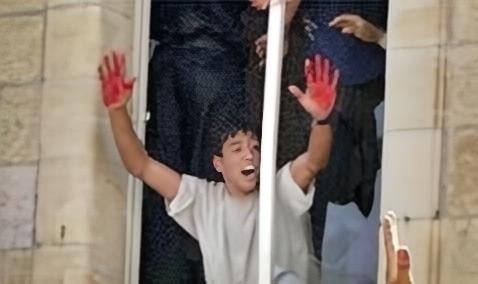
Photo Credits: wikipedia, common creative licence
The Bloody Hands of Ramallah
An article about the Ramallah lynching, the symbolism of bloodstained hands, and the danger of forgetting history.
On October 12, 2000, two Israeli reservists, Vadim Nurzhitz and Yossi Avrahami, entered Ramallah and never returned alive. What happened to them was not a battlefield confrontation between armed soldiers. It was a brutal lynching that exposed the darkest side of human behavior and left images that remain deeply embedded in Israel’s collective memory. Twenty six years later, the horror of that day deserves to be remembered, not only because two innocent men were murdered, but because of what their deaths revealed about hatred, the glorification of violence and the terrifying ease with which a crowd can abandon every trace of humanity.
The two reservists had accidentally entered Ramallah and were taken into custody by “Palestinian” Authority police. They were not attacking anyone. They were not engaged in combat. They were two men who had taken a wrong turn and found themselves surrounded by people who regarded their Israeli identity as sufficient reason to kill them. A crowd gathered outside the police station, demanding their blood. Eventually, attackers stormed the building, beating and stabbing the two men to death. Their bodies were mutilated and subjected to further violence. Some “Palestinian” police officers attempted to prevent the attack, while others participated in the killings. What should have been a place of protection became the scene of an atrocity.
And this raises an uncomfortable question that deserves to be asked. Who were these people? Were they all trained terrorists belonging to organized terrorist movements, or were some of them ordinary “Palestinian” civilians who, swept up in collective hatred, became murderers? The distinction matters because terrorism is not always carried out by men wearing uniforms or carrying membership cards. Sometimes it emerges from a crowd of people who have convinced themselves that murdering another human being is an act of righteousness. Aziz Salha, one of the perpetrators, had reportedly worked as an upholsterer and had not previously been politically active. Yet he participated in the killing and later described stabbing and strangling one of the victims. That is perhaps one of the most disturbing aspects of Ramallah. The capacity for extraordinary cruelty does not always announce itself in advance.
Accounts of the lynching describe horrific mutilation, including reports of organs being removed from the victims’ bodies. There have also been claims that one victim’s heart was torn out and eaten.
Two men were murdered, their bodies were desecrated, and people celebrated. There is no need to embellish the atrocity to understand its moral significance. What happened in Ramallah demonstrated what can occur when hatred becomes so normalized that human suffering is no longer met with horror, but with applause.
Perhaps the most unforgettable image of that day was not even the bodies themselves. It was the photograph of Aziz Salha standing at the window of the police station, raising his hands, covered in the blood of an Israeli victim, before a cheering crowd. Those hands became an enduring symbol of the Ramallah lynching. They represented not merely murder, but the public celebration of murder. Salha was subsequently convicted and sentenced to life imprisonment, yet he was released in 2011 as part of the Gilad Shalit prisoner exchange. For Israelis, the photograph remained a reminder of what had happened and of the terrible price paid by two families whose loved ones never returned home.
Now consider what has happened in the years since October 7, 2023. Red hands have appeared at demonstrations, cultural events and political gatherings, often presented as symbols of solidarity with “Palestinians” or demands for a ceasefire in Gaza. Some have been worn as pins by celebrities, while others have appeared on banners and placards. For many Israelis and Jews, the resemblance to the photograph from Ramallah is deeply disturbing. The original image was not an artistic expression of peace. It showed a murderer displaying the blood of his victim. Yet today, a similar visual symbol is displayed in public without many people understanding, or even considering, the historical associations it carries.
Everyone displaying red hands is consciously referring to Ramallah. When public figures, cultural institutions and people in positions of political responsibility use such imagery, they have an obligation to understand how it may be perceived. Ignorance is not necessarily malice, but refusing to listen when victims explain why a symbol is traumatic demonstrates a profound lack of empathy.
And this is where the story becomes larger than Ramallah itself. I see a disturbing pattern in the way Israeli suffering is so often pushed aside, minimized or disconnected from the wider historical narrative. The murder of Israeli civilians and soldiers becomes a footnote, while the experiences and grievances of others dominate public discussion. Of course “Palestinian” suffering deserves some recognition. But compassion cannot be selective. If the international community demands sensitivity toward “Palestinian” trauma, it must also recognize Israeli trauma. There should not be one standard for the suffering of “Palestinians” and another for the suffering of Israelis.
For me, the careless reuse of imagery resembling the bloody hands of Ramallah illustrates something even more troubling: the possibility of stripping a traumatic historical image of its original meaning and replacing it with an entirely different narrative. What was once associated with the celebration of murdered Israelis can become, in another context, an emblem of humanitarian concern. Whether that resemblance is intentional or accidental, the result can feel like another erasure of Israeli history. A nation’s memories should not become disposable simply because they are inconvenient to a contemporary political movement.
The events of October 7, 2023, made the memories of Ramallah even more painful. Once again, Israelis witnessed atrocities committed against their people. Once again, there were images of brutality, humiliation and celebrations of violence. The circumstances were different, but the moral questions were painfully familiar. What happens when hatred is taught so persistently that the suffering of another human being becomes a source of satisfaction? What happens when the murder of Israelis is excused, justified or celebrated because of their nationality? And what happens when the world becomes so consumed by political arguments that it forgets to condemn the most basic violations of human dignity.
On October 12, 2026, we remember Vadim Nurzhitz and Yossi Avrahami. Not as political symbols, not as anonymous soldiers in a decades-long conflict, but as two human beings whose lives were taken with unimaginable cruelty. Their families deserve remembrance, their suffering deserves recognition, and the truth of what happened deserves protection from distortion and indifference.
Twenty six years have passed, but the photograph of those bloody hands remains. It should remind the world of the danger of celebrating murder, the consequences of dehumanization and the moral obligation to remember victims even when their stories challenge popular narratives.
Those hands were covered in Israeli blood. The world should never forget whose blood it was.
May the memories of Vadim Nurzhitz and Yossi Avrahami be a blessing.
Related Topics
Related Posts