
Understanding Israel Beyond the Headlines
The Boiling Point
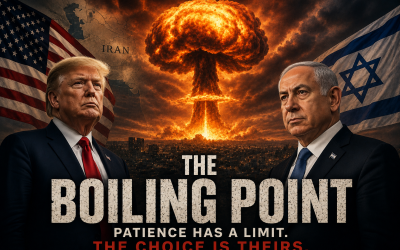 For years, the Iranian regime has tested the patience of the free world. It has armed proxies, funded terrorism, threatened its neighbors, and repeatedly escalated conflicts across the Middle East. Yet even now, President Donald Trump appears to be offering one final opportunity before a far more devastating phase begins.
This is not weakness. It is restraint.
Before bridges are destroyed, before power stations are targeted, and before military objectives become broader targets, Trump is giving the Iranian people one last chance. A genuine democracy understands that governments and citizens are not always the same. Just as Israel has repeatedly distinguished between the people of Lebanon and Hezbollah, Trump appears determined to distinguish between the Iranian people and the regime that rules them.
But there is a limit to every nation’s patience.
There comes a moment when repeated aggression, threats, and attacks bring even the most patient democracies to the edge.
The Iranians invented the game of chess. For centuries, Persia was known for strategy and patience. Donald Trump built his reputation on something different: negotiation.
Anyone who has read Donald Trump’s book The Art of the Deal understands a simple principle. Trump may negotiate longer than his opponents expect. He may leave the door open until the very last moment and keep his adversaries guessing. But when he decides that a deal must be reached, he pursues it relentlessly. His approach has always been the same: maintain leverage, keep options open, and push until a conclusion is reached.
The Iranian regime has repeatedly mistaken patience for weakness. It has assumed that every warning is merely rhetoric and that every opportunity for diplomacy can be ignored without consequence.
That assumption may prove to be its greatest mistake.
As President Trump has repeatedly argued, the United States is negotiating from a position of strength. The message from Washington is clear: America believes it holds the upper hand militarily, economically, and diplomatically.
The regime now faces a choice. It can continue down a path that has brought isolation and economic hardship, or it can choose a different future through negotiation. The opportunity remains open, but it will not remain open forever.
Part of what has brought Israel to this point is the nature of the conflict itself. Iran’s attacks have largely been aimed at Israeli population centers, with many missiles intercepted and others landing in open areas. Israel, by contrast, has focused its responses on military and regime-related targets.
Whether one agrees with every decision made by either side, the difference in approach helps explain the growing frustration inside Israel. Every missile launch reinforces the feeling that the conflict is not being resolved, only prolonged. And with each new escalation, the patience of the Israeli public is tested even further.
For nearly three years, Israelis have lived under a cloud of uncertainty. Wars, missile attacks, reserve duty call-ups, terror threats, and regional escalation have disrupted normal life. Families have postponed plans, businesses have endured instability, and millions have lived knowing that the next siren or military operation could be just days away.
This is why many Israelis view the Iranian issue differently than Americans. For Americans, it is a major foreign policy challenge. For Israelis, it directly affects daily life, personal security, and the future of their children.
Every signal coming from Washington is analyzed intensely in Israel. When President Trump signals diplomacy one day and military action the next, many Americans see a negotiating strategy. Many Israelis see uncertainty. They wonder whether flights will continue operating, whether schools will remain open, and whether another round of escalation is around the corner.
That is why the Israeli public increasingly wants resolution rather than management. They want stability. They want children to attend school without fear of rushing to shelters. They want businesses to invest in the future instead of preparing for the next emergency.
History teaches us that great powers can exercise patience for a long time, but not forever. The world remembers the final chapter of World War II, when Imperial Japan refused repeated opportunities to surrender. Only after the atomic bombs were dropped on Hiroshima and Nagasaki did the war finally come to an end. The lesson is not about weapons; it is about the consequences of ignoring every warning and every opportunity to change course.
Iran still has a choice. The door to negotiation remains open, but that window is narrowing. If Tehran wishes to avoid a path from which there may be no return, it should recognize reality before it is forced upon it. The time to raise the white flag of compromise is before the bear is unleashed, not after.
Israel has already reached its limit, and the United States appears to be moving closer with each new escalation. History teaches that once great powers lose patience, events can move with extraordinary speed.
Because once the boiling point is reached, what follows is rarely reversible.
Related Topics
Related Posts