


Middle East Forum Fellow/North Africa Risk Consultant
The Boulos Doctrine: A Risky Realist Turn in Libya
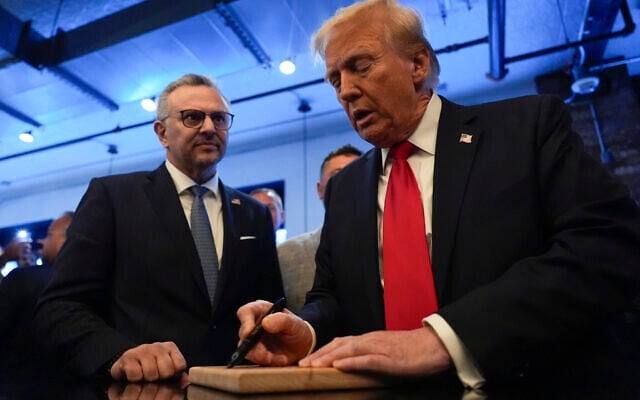
Donald Trump, right, signs autographs as Massad Boulos watches during a visit to Dearborn, Michigan on November 1, 2024. (AP/Julia Demaree Nikhinson)
Massad Boulos’s shuttle diplomacy between Tripoli and Benghazi, culminating in meetings on January 24–25, 2026, is being framed in Washington as pragmatic realism. In reality, it reflects a troubling acceptance of Libya’s prolonged dysfunction and risks locking the country into a managed form of instability that serves short-term interests while eroding any remaining path toward a sovereign, accountable state.
By moving between coordination meetings with the United Nations in Tripoli and direct engagement with the Libyan National Army leadership in Benghazi, the United States is signaling a decisive shift away from trust-based multilateralism. Yet this shift has not produced reform or cohesion. Instead, it has elevated de facto powerholders at the expense of institutions, reinforcing the logic that force and family networks matter more than legality or popular consent.
The meetings between Boulos and UN envoy Hanna Tetteh revealed a growing disconnect between rhetoric and practice. While Washington publicly affirms its support for the UN roadmap, elections, and the structured dialogue, its parallel diplomacy sends a different message to Libyan actors: legitimacy can be bypassed if one controls territory, weapons, or revenue streams. This contradiction weakens the UN process and rewards obstruction rather than compromise.
The reception of Boulos by Saddam Haftar at the Rajma headquarters underscores this shift. Treating military leadership as a primary political interlocutor normalizes the role of armed actors as permanent arbiters of Libya’s future. It reinforces the perception that Libya’s conflict will be managed through elite bargains rather than resolved through national reconciliation or institutional reconstruction.
Earlier efforts, including the Rome meeting that brought together figures linked to both eastern and western power centers, further entrenched this approach. By engaging heirs of rival political families outside formal frameworks, external actors have implicitly endorsed dynastic continuity as a substitute for democratic legitimacy. This is not a neutral acknowledgment of reality but an intervention that freezes Libya’s political evolution in its most distorted form.
The $20 billion oil and gas agreement signed in late January 2026 has been promoted as a stabilizing achievement. Yet anchoring Libya’s future to foreign capital insulated from national institutions risks creating an enclave economy disconnected from public accountability. Oil revenues that flow independently of a functioning state do not unify a country; they intensify competition, deepen corruption, and entrench armed protection rackets around strategic assets.
Beneath the surface of these deals, Libya’s economic foundations continue to deteriorate. The sharp devaluation of the dinar earlier this year is not a technical correction but evidence of institutional exhaustion. The Central Bank of Libya has been reduced to a mechanism for preventing social explosion through salary payments, while parallel spending, shadow currency circulation, and unchecked fiscal leakage hollow out what remains of the state’s authority.
Regional actors increasingly recognize the danger. Meetings in Tunis involving Egypt, Algeria, and Tunisia reflect genuine concern that Libya’s paralysis, combined with Sudan’s prolonged war, is creating a vast corridor of instability across North Africa. Yet regional diplomacy remains cautious and declarative, unable to impose meaningful pressure on Libyan elites who benefit from delay and division.
Within this context, renewed emphasis on elections as an exit strategy appears increasingly disconnected from reality. Elections cannot succeed in the absence of unified security, and unified security cannot emerge while militia economies and parallel chains of command are treated as unavoidable facts rather than obstacles to be dismantled. The repeated invocation of electoral timelines risks becoming a ritual that masks inaction rather than a pathway to resolution.
This moment requires clarity, particularly from Washington. The current approach does not stabilize Libya; it manages its decay. By prioritizing short-term calm, energy flows, and elite engagement over institutional reconstruction and popular legitimacy, the United States risks entrenching the very dynamics that made Libya ungovernable.
This is the warning. Realism that abandons state-building is not realism but abdication. Libya cannot be indefinitely managed as a resource and security problem without political cost. If the United States continues down this path, it will help create a permanently unstable state whose fragmentation will threaten regional security and undermine the very interests Washington seeks to protect.