Exploring Memory, War, and Survival
The Boy Everyone Called Calavera
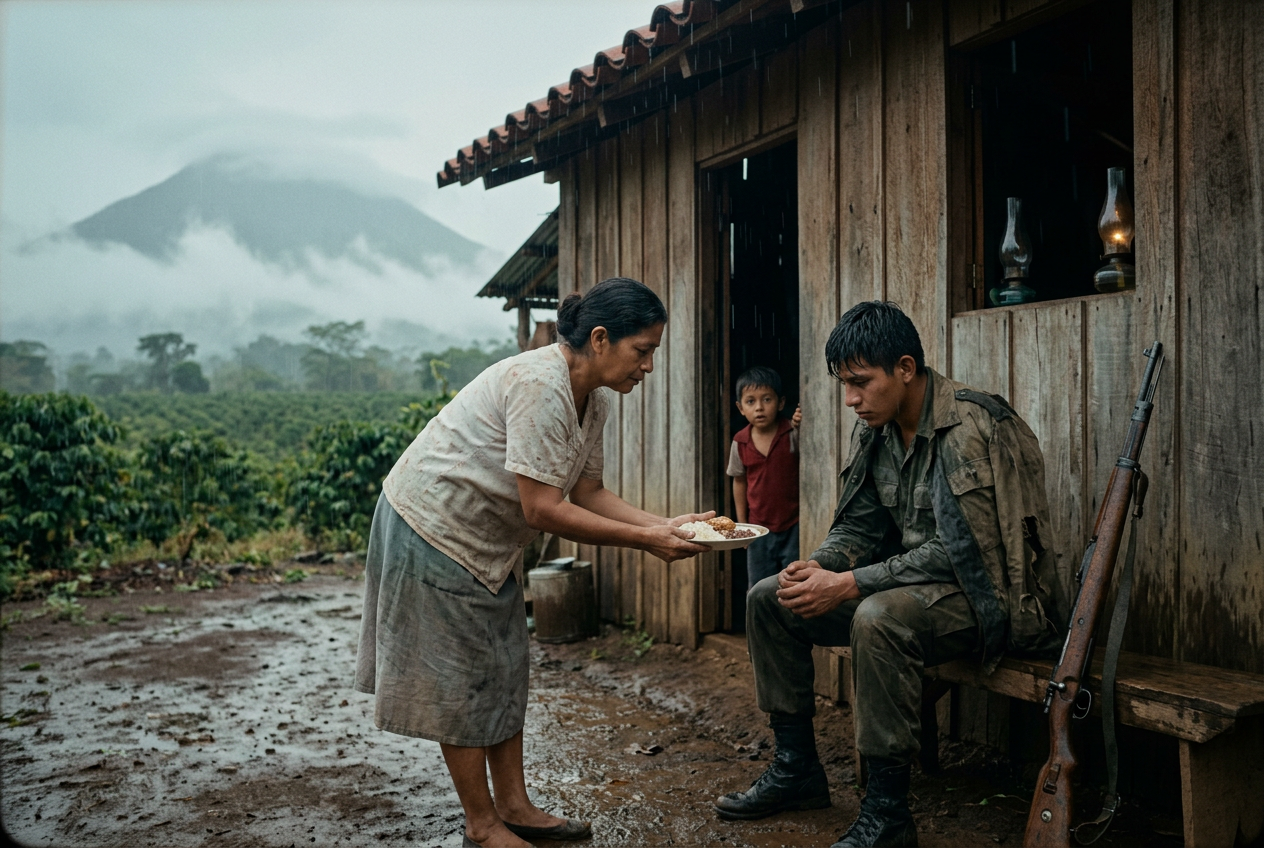
A Salvadoran mother offers a meal to a young soldier during the country's civil war. AI-generated illustration based on the author's recollection.
I no longer remember his real name. Everyone called him Calavera—the Spanish word for “Skull.” His real name disappeared long ago, but the nickname remained. That’s how memory sometimes survives war: it forgets names but refuses to let go of faces.
I was about 6 years old when he first appeared outside our house in San Jorge, El Salvador, during the civil war. He could not have been much older than 16 or 17. Those were years when childhood ended early. The law might have said one thing, but war had its own rules. If a boy looked strong enough to carry a rifle, it often found one placed on his shoulder. If another boy was old enough to serve the guerrillas, someone eventually found him too. Nobody asked whether they were ready.
The day we met him, it had been raining for what felt like days. I no longer remember what month it was; I only remember the rain. The dirt roads had dissolved into mud, water dripped endlessly from the roofs, and the village moved more slowly, as though even the war had decided to wait for the storm to pass.
Calavera sat quietly on the curb outside our house, soaked by the weather and wearing the exhaustion of someone much older than he really was. Seeing him there, my mother invited him to eat with us. Today, that may not sound extraordinary. To us, it was.
We were poor. There was a season each year when many of the chickens people raised became sick and died. Before that happened, my mother tried to sell as many as she could. If any remained, she slaughtered them so the meat would not be wasted. Those were some of the very few days each year when we ate chicken, and that afternoon happened to be one of those days. Instead of keeping it only for ourselves, my mother placed a plate of chicken before him. I still remember how grateful he looked.
After that day, he never became simply a soldier to us. He became Calavera.
Whenever he received leave, he came to visit our family. It wasn’t because he was hungry—at least, I do not think so. He came because, for a few hours, he could sit inside our small wooden house. Its roof was covered with clay tiles, the floor was nothing but packed earth, and termites had eaten through so many of the boards on the western wall that sunlight slipped through the gaps. I never thought much about those missing boards as a child; to me, they were simply another way to crawl outside and play in the yard. Only years later did I understand what they really said about the life we were living. Yet inside those fragile walls, nobody expected him to be a soldier. He laughed with us. He talked with my mother. He treated me like a curious little boy instead of someone growing up in a country at war.
One afternoon, he smiled at me and asked, “Do you want to know what it feels like to carry a rifle?”
I answered immediately: “Yes.” I was 6 years old.
He removed the rifle from his shoulder. Before placing it on me, I remember him carefully checking that the safety was on. Only then did he slip the strap over my shoulder. The rifle slid down my body until the barrel touched the ground. I tried to hold it with both hands, but I could not. It was simply too heavy.
For years, that was all I remembered: the weight. Only as an adult did I understand something I could not have known then. The rifle was probably too heavy for him, too. Not only the steel, but everything it represented—the fear, the responsibility, the expectation that someone barely old enough to finish childhood should carry the burden of a war he had never chosen.
Then, one day, he stopped coming. No one came to tell us why. No letter arrived, and no explanation followed. In those years, explanations were rare. People simply disappeared from other people’s lives. As children, we learned not to ask too many questions. As adults, we often realize we already knew the answers.
I do not know what became of Calavera. I do not know whether he survived the war, and I do not even remember the name his mother gave him. But I still remember my mother placing a plate of chicken before a wet young soldier. I still remember his quiet gratitude. And I still remember the impossible weight of the rifle he allowed a 6-year-old boy to carry for only a few seconds.
Judaism teaches that every human being is created b’tzelem Elohim—in the image of God. War often begins by teaching people to forget that. It asks us to see uniforms before faces, and enemies before children.
My mother chose something different. She saw a hungry young man. Looking back, I think that simple act of kindness may have been one of the bravest things I witnessed during the entire war.
I no longer remember his real name. But after all these years, I still remember Calavera.
Related Topics