Welcome to the Ongoing Situation
The boycotts target Israel, but Jewish artists pay the price
The loudest battles involve governments and institutions, while the real damage happens quietly, one artist at a time
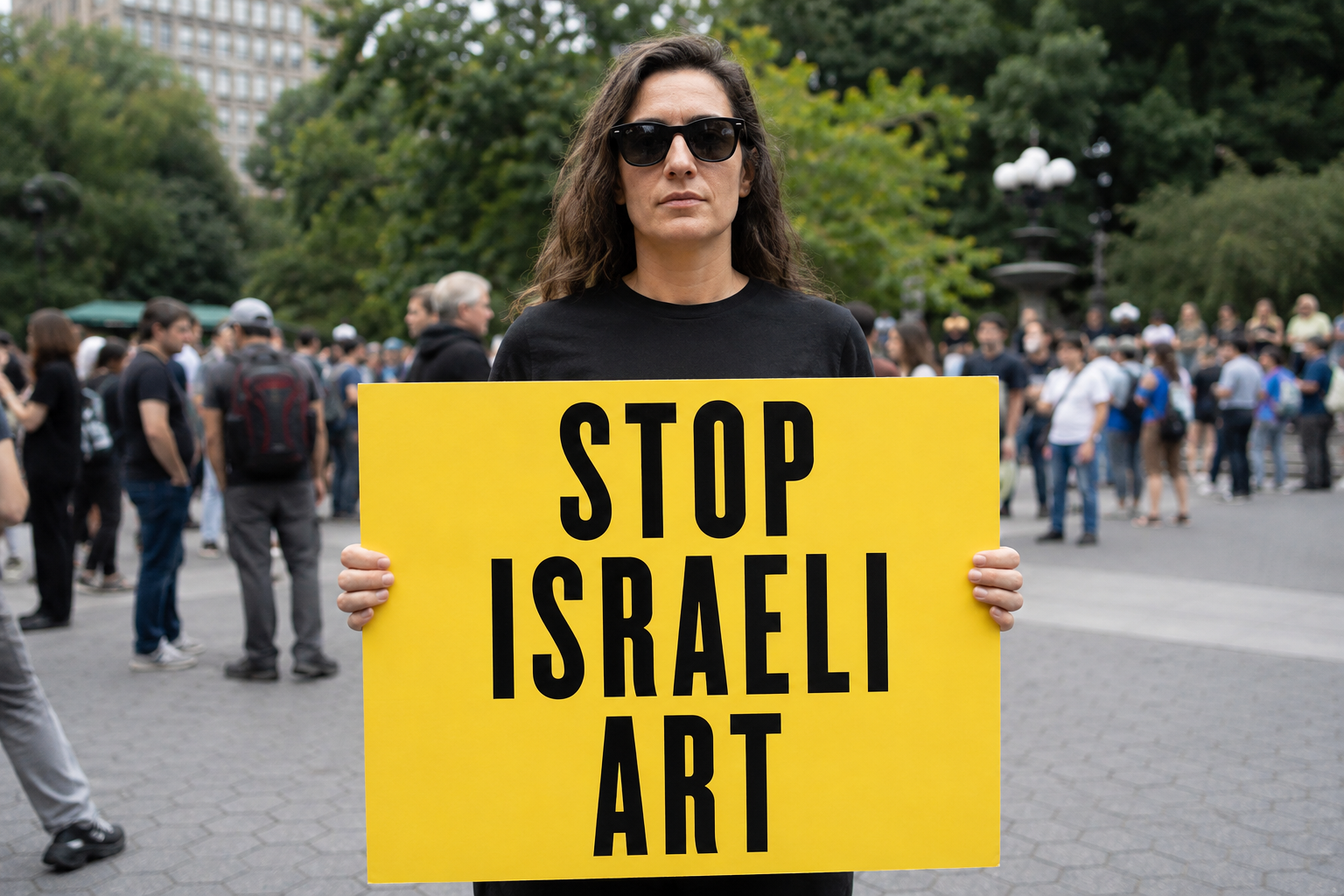
Woman holding "stop Israeli art" sign (ChatGPT, 02-08-2026)
This summer, the Israel Festival went ahead without a single international act.
For an event once known for bringing global performers to Jerusalem, their absence was conspicuous. International artists who would ordinarily have appeared on the program had withdrawn, declined invitations, or become unwilling to face the political pressure attached to performing in Israel. One planned French tightrope troupe pulled out; Israeli performers took its place. The festival even created a backstage tour called “Temporarily Removed,” devoted to the productions that never arrived.
This is what the cultural boycott looks like when it is visible: an Israeli institution loses artists, audiences lose performances, and the political argument plays out in public.
For nearly three years, the larger conversation about cultural boycotts of Israel has been framed in similarly institutional terms: Israel versus ANGA, Israel versus the Venice Biennale jury, Israel versus whichever festival, gallery, or cultural body that has just cancelled an appearance.
It is a framing that suits both sides. Boycott organizers can say they are targeting a government and its institutions, not a people. Israeli officials can respond with the full weight of state rhetoric, from foreign ministry statements to diplomatic pressure and accusations of politicization, “contamination” and “indoctrination.”
But this framing obscures a quieter group absorbing the cost.
The New Boycott Crisis, a report produced earlier this year by the UK advocacy group Freedom in the Arts, tells that less visible story. Based on nearly 200 responses across three surveys—of artists, cultural venues, and the agents and managers who represent them—plus a roundtable involving 30 senior arts leaders, the report examines how organized boycotts and cancellation campaigns are reshaping Britain’s cultural sector.
Its finding is rather blunt: it is not only the Israeli state or its cultural institutions absorbing the consequences. Individual artists, curators, and cultural workers—particularly Jewish ones, including many with no formal connection to Israel—describe being frozen out of galleries, festivals, performances, and commissions.
That difference matters because it separates the boycott’s declared target from the people actually paying the price.
The report was not designed solely as a study of antisemitism. It examined several forms of ideological pressure within the arts. But many of its respondents were Jewish, and what they described went well beyond disagreement over Israeli policy.
They described an atmosphere in which a Jewish artist is presumed to speak for a state, whether or not that artist has ever said a word about it; in which appearing on a festival lineup or having a name on a gallery wall can itself be interpreted as a political statement requiring justification. Artists reported pressure to declare positions, sign statements, or publicly distance themselves from Israel before being treated as acceptable participants in cultural life.
One artistic-freedom advocate put the problem starkly: being Jewish in an artistic space today can mean having strangers and activists assume your politics—and assess your right to exhibit—on the basis of identity alone.
If that sounds familiar, it should. It is the same mechanism that has made “Zionist” functionally interchangeable with “Jewish” in parts of the cultural left over the past three years. Boycott organizers insist that this slippage is unintentional, but those on the receiving end experience it very differently.
The line between political protest and Jewish cultural life has already blurred beyond the anonymous responses of a survey.
In May, the British Museum postponed a Jewish Culture Month lecture about ancient Israel and Judah after learning that a significant number of people had registered with the intention of disrupting it. The lecture concerned Jewish history and archaeological objects in the museum’s collection, not the policies of the current Israeli government. It was eventually rescheduled, but the episode illustrated the larger problem. A program about Jewish history had become politically suspect because its subject could not be separated from the contemporary State of Israel.
This is not an argument that every protest against an Israeli institution is antisemitic, or that Palestinian artists have not also faced censorship, cancellations, and demands to account for political positions they may or may not hold. They have. Nor does criticism of Israel become illegitimate simply because a Jewish person finds it uncomfortable.
The issue is what happens when institutions stop distinguishing between a state, a political ideology, and an individual person.
I think about this every time I watch the Venice Biennale story play out. Israel is participating in this year’s exhibition at the Arsenale while its permanent pavilion in the Giardini undergoes renovations. But the Biennale’s international jury announced that it would not consider entries from countries whose leaders face charges at the International Criminal Court—a rule understood to exclude Israel and Russia from prizes. Israel’s foreign ministry responded by accusing the jury of politicizing and degrading the exhibition.
It is a genuinely significant story about institutions and states. It raises legitimate questions about whether a country accused of grave abuses should retain the prestige of unrestricted cultural participation, and whether artists should be punished for the conduct of the governments under whose flags they exhibit.
But it is also, in a strange way, a distraction from the quieter harm unfolding beneath it.
There is the working curator in London who loses a show. The musician in Berlin whose label slowly stops returning her calls. The gallery assistant in New York who begins omitting part of her background at openings. The Jewish artist who is asked to sign a statement before anyone will discuss the work itself.
No one receives a foreign ministry press release in their defense. There is rarely an official cancellation to contest or an email explicit enough to expose. They simply disappear from lineups, one at a time, without anyone having to explain why.
This is worth saying plainly because the current framing lets everyone off the hook.
Boycott organizers get to say—accurately, on paper—that their campaigns target Israeli state institutions, not Jewish people. Israeli officials get to fight the kind of battle that is legible to them: state versus institution, ministry versus jury, statement versus statement.
Meanwhile, the people paying the price often have no public platform and, in many cases, no formal connection to the country whose actions they are expected to answer for. Their Jewish identity is enough to make them answerable for Israel, but often, their lack of any formal connection leaves them without its support.
The most revealing consequence may not be cancellation at all. It may be self-censorship.
It is the artist quietly recalibrating what she reveals about herself before a studio visit, an interview, or a group show. It is someone removing “Israeli” from a biography, avoiding mention of being Jewish, or allowing a false assumption to stand because correcting it suddenly feels professionally risky. It is the email never sent, the application abandoned, and the conversation redirected before anyone has the opportunity to object.
That story is harder to report because it unfolds quietly, often without an explicit rejection or public cancellation. There is no dramatic confrontation, viral video, or official decision to defend. Certain people simply stop appearing in certain rooms.
But nearly three years in, that may be the clearest measure of what the cultural boycott has become. It no longer places pressure only on the Israeli state. It also creates a cultural environment in which individual Jews are increasingly expected to answer for the actions of the Israeli government, even when they oppose those actions or know little about them.
Related Topics
Related Posts