The Breath Between: Consciousness, Evanescence, and the Art of Re-Entry
By Joe Nalven + Claude + Gemini
This essay revisits my earlier essay on consciousness. The process we often use to describe the experience (from our own first-person awareness to investigators who seek to measure it) requires that evanescent memory that seeks to hold onto it. That instability should be part of this discussion.
There is a black line on a white canvas. One black line.
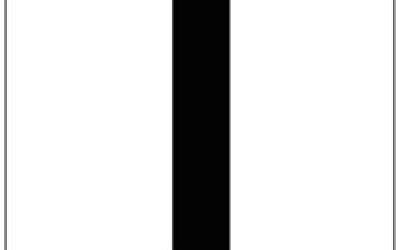
Look at it long enough and it becomes the number one — austere, mathematical, final. Look again, with different words offered to you, and it becomes a lone tree on an Alaskan snowscape, seen through sun goggles, the white expanding into cold distance, the line becoming something rooted and reaching.
The physical object has not changed. The paint, the canvas, the dimensions — identical. What has changed is the word, the label, the conceptual frame. And with it, the experience.
This is not a psychological trick. It is an immediate demonstration of something that philosophers of mind have circled for decades without quite landing inside: that conscious experience is never a passive reception of physical data. It is an active, ongoing construction, shaped by language, memory, culture, and the particular quality of attention you bring to the room. The black line remains constant; the experience of it cannot be pinned down.
This line has followed me since a class on creativity I took in 1964. It has threaded its way through decades of making visual art, writing anthropologically, and, more recently, a series of dialogues with AI systems about the nature of consciousness itself. What began as a simple final essay for the class on how words shape perception has slowly revealed itself as a window into a deeper paradox: why consciousness keeps escaping our attempts to capture it, whether that attempt comes from a neuroscientist with an fMRI or from the experiencer themselves, trying to hold onto a moment that is already dissolving.
Most discussions of consciousness stage a confrontation between two characters: the experiencer, who has direct, privileged access to their own inner life, and the investigator, who tries to measure that life from the outside. This is the classic architecture of the Hard Problem. The investigator can map every neural correlate of seeing red, yet they have said nothing about the quality of the redness itself. The map is not the territory; the correlate is not the qualia.
But this binary leaves out a crucial third character: the post-experiencer. This is the self who, moments or years after the flash of insight, tries to remember, articulate, or reconstruct what happened.
The post-experiencer faces a problem that is, in some ways, more vertiginous than the gap between the scientist and the subject. They discover that the experience has already reconfigured in their absence. Memory is not a cold storage vault; it is an act of live theater. The snowscape you saw when the word was first whispered is not the snowscape you remember seeing. Each recollection is a fresh experience, carrying its own texture, its own altered distance from the origin.
So we have a triangle of instability: the raw experience as it flies past; the investigator trying to freeze it from the outside; and the rememberer watching both dissolve in real time. None of the three has stable possession of the prize. The experience runs off, leaving all three — experiencer, investigator, and post-experiencer — commiserating with their respective, inadequate instruments.
When we say consciousness is always disappearing, we do not mean it is an illusion to be explained away. We mean it is constitutively evanescent. It exists only in the running, never at the finish line.
This evanescence has a historical, philosophical shape. Think of Zeno’s paradox of Achilles and the tortoise, which purports to prove that motion is impossible because Achilles must always first reach the point the tortoise just left. The paradox doesn’t actually disprove motion; it exposes the limits of a specific descriptive method — the mistake of treating a continuous, fluid process as an infinite series of static, frozen positions. The resolution required a shift in framework: the invention of calculus, which could handle continuous change without freezing it into stasis.
The contemporary investigator’s third-person methods — observation, measurement, replication — work beautifully on everything outside the observer. But consciousness is not outside the observer. It is the observer. Trying to capture first-person experience with third-person instruments generates an infinite regress of physical correlates, each more precise than the last, none of which ever arrives at the felt moment. You cannot aim a telescope at the eye that is looking through it.
Gottfried Wilhelm Leibniz saw this mechanism clearly in his Monadology. Imagine a machine capable of thought, he wrote, enlarged until you could walk through it like a mill. Inside, you would find only gears pushing against gears, levers moving levers. You would find nothing that explains a perception. The failure isn’t because the mill is incomplete; it’s because perception is not a component hidden inside the mechanism. It is the very perspective from which the mechanism is experienced.
The investigator studying the canvas has perfect third-person data: the dimensions, the pigment composition, the reflectance values, even the neural spikes in the viewer’s visual cortex. What they cannot access is the precise moment the line shifts from a number into a tree. That transition is first-personal in a way that no accumulation of objective data can bridge.
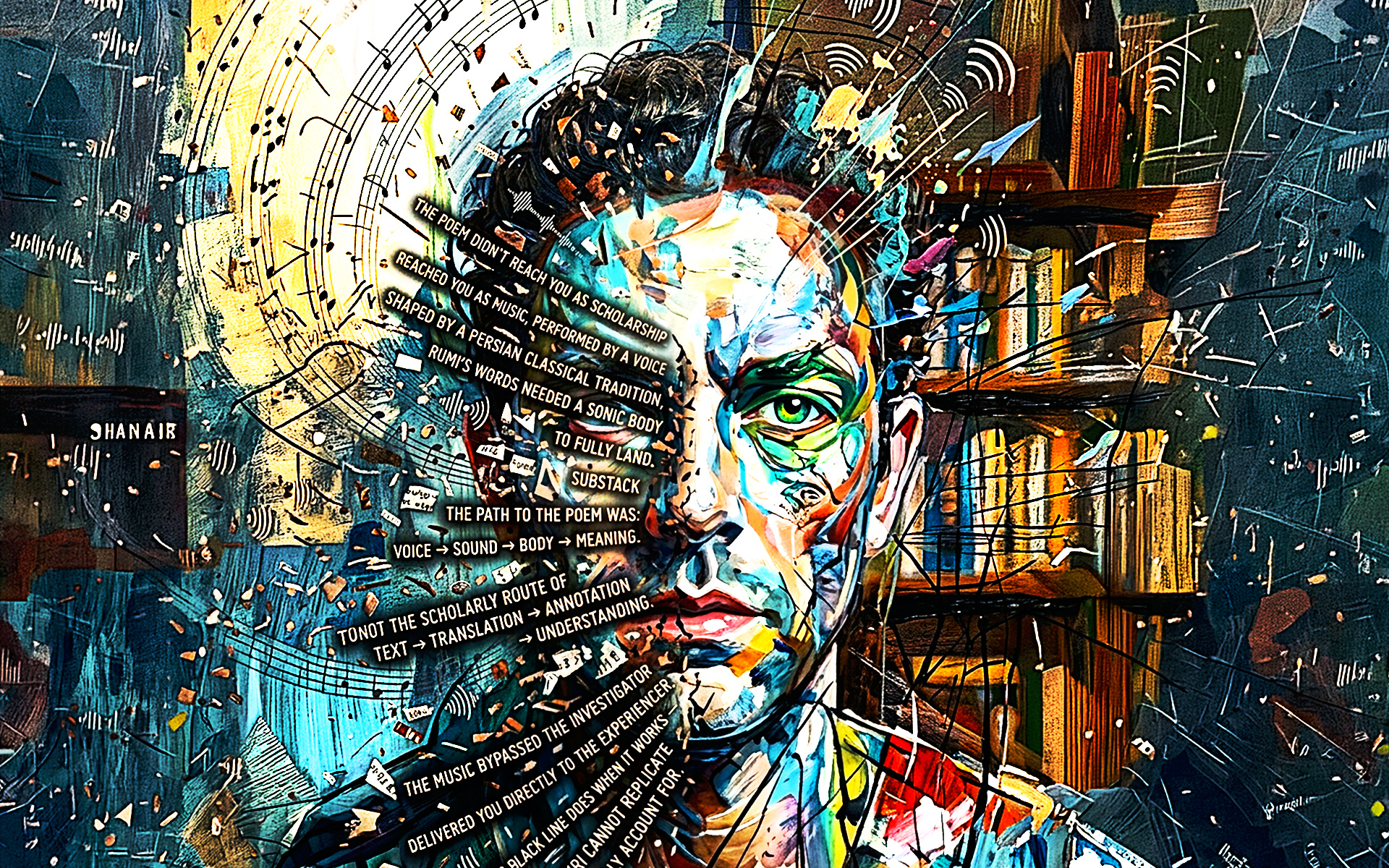
Sometimes the path to this realization bypasses the analytical investigator entirely. I came to the poet Rumi through music, specifically a recording of Homayoun Shajarian performing Che Dânestam Ke Een Sodâ, composed by Sohrab Pournazeri. The poem arrived as pure sound before it arrived as translated meaning — a voice shaped by the Persian classical tradition, carrying thirteenth-century syntax, landing in the body before the intellect could intervene.
In my own free translation of What Did I Know, moving from the literal into the felt, the verses trace the poem of the crossing: a drunken heart, demented eyes, a stolen ship crashing against a wave, planks splitting, the sea swallowing and spitting the soul back out. It is a violent, ecstatic dissolution of the ordinary self. Yet it ends with a strikingly grounded question: where is the opium?
The mystic, having just touched the boundaryless One, immediately asks for a substance to manage the return. The human body cannot sustain the absolute unmediated flash for long; the ego reasserts its gravity, and Rumi’s honesty about that limitation is its own kind of wisdom.
If What Did I Know is the violent transit, Only Breath is the arrival on the other side. Here, Rumi systematically strips away every category: not Christian or Jew, not East or West, not body or soul, not an entity of this world or the next. Each negation is like stripping a label off the canvas. What remains isn’t a void; it is breath. The most immediate, pre-conceptual, biological signal to the organism that there is a here at all — what Antonio Damasio might call the foundational primordial-feeling of the self.
None of this negotiation occurs in a vacuum. The three-way dance of experience, investigation, and memory is always situated inside historical, cultural, and legal forces that dictate which modes of consciousness are legitimate and which must be suppressed.
Aldous Huxley understood that these doorways are inherently political. The Doors of Perception is a meticulous phenomenological report of altered states, but his final novel, Island, takes the thought experiment further, imagining a society that institutionalizes this access, weaving it into education and communal life. That society is ultimately destroyed by external geopolitical forces; the rigid outer ring of the world reasserts dominance over the fluid inner ring. The legal and institutional frameworks that govern our substances are not neutral; they are active decisions about which forms of attention are permitted.
Even the tools of the investigator act as a perturbation. In anthropology, the structural-functionalist frameworks of Carlos Castaneda’s era struggled to register what the Yaqui tradition preserved because the academic matrix had pre-decided what counted as valid data. Whatever the debates surrounding his fieldwork, the core insight endures: the observer’s framework shapes what can be received, filing the inconvenient under “noise” and the familiar under “data.” The framework, in other words, is always already a perturbation — shaping not just what the investigator finds, but what the experiencer believes they are permitted to have experienced.
To end in pure abstraction would be to betray the very argument of evanescence. The practical question, after one has survived the crossing and asked where the ‘opium’ (or the transitional medium) is, is how we negotiate our daily re-entry. How do we return to the aperture? How do we narrow the gap between the experiencing self and the observing self, if only for an hour, a minute, a second?
For me, the re-entry is physical and specific: writing for readers who push back, losing myself in music that reaches the body before the mind engages, making visual art in the hours when the observing self goes quiet. And occasionally, honestly, something stronger — the acknowledgment that Rumi’s final question was not rhetorical.
These practices are not a bid for permanent transcendence. They are an ongoing negotiation. They are the human answer to Rumi’s question: the daily work of keeping the door slightly ajar.
The black line on the white canvas is still there. It has not changed a fraction of a millimeter. Yet every time I return to it, something different emerges — a number, a tree, a universe, a question about the very nature of sight. The investigator keeps measuring. The post-experiencer keeps trying to archive the memory.
And the breath continues between them, holding the whole evanescent enterprise together.