CFO | Empower Society for Good I Author
The Burden and Blessing of Uplifting Others
Over the last few weeks in the Soul of Israel series, we explored some of the great questions surrounding Jewish identity and destiny.
What is Zionism?
Where is Zion?
Who is a Jew?
The timing was not accidental.
These reflections moved through the period from Yom HaZikaron and Yom HaAtzmaut toward Shavuot — toward Sinai itself, toward covenant, identity, and the receiving of Torah.
But after revelation comes another question:
How do you sustain holiness in ordinary life? How do
And that is where Parshat Naso begins.
The very name Naso comes from the Hebrew root נ.ש.א — to lift, to carry, to elevate.
The Torah opens:
“נָשֹׂא אֶת רֹאשׁ בְּנֵי גֵרְשׁוֹן”
“Lift up the heads of the children of Gershon.”
(Numbers 4:22)
It is the same root as the word נשיא — a prince, leader, or president.
In modern Hebrew, the President of Israel is called:
נשיא המדינה
A נשיא is not simply someone elevated above the people. In the Torah sense, a true leader is someone who carries the people.
Leadership in Judaism is not fundamentally about power.
It is about responsibility.
Not self-glorification.
But uplifting others.
The Levites carry the Mishkan through the wilderness.
Parents carry children.
Mothers carry families.
Soldiers carry the burden of defending a nation.
And the Jewish people themselves have carried covenant, memory, suffering, and hope through history.
Perhaps that is why this parsha feels especially personal to me this year, as it falls on my mother’s yahrzeit.
She was hardworking and dedicated.
Like so many Jewish mothers, she quietly carried more than people realized.
Before we encounter presidents, Rabbis, CEOs, or public leaders, most of us first encounter uplift through our mothers.
Mothers are the original uplifters.
They carry homes, children, emotional worlds, values, faith, resilience, and continuity.
Quietly.
Often without recognition.
The Mishkan in the desert was physically carried by Levites.
But spiritually, Jewish civilisation has often been carried by mothers.
Parshat Naso then moves from national structure into personal morality.
The Torah says:
“אִישׁ אוֹ אִשָּׁה כִּי יַעֲשׂוּ מִכָּל חַטֹּאת הָאָדָם”
“When a man or woman commits any wrong toward another person…”
(Numbers 5:6)
The Torah continues that the person must confess and make restitution.
This is deeply important.
A holy society cannot survive without accountability.
Not slogans.
Not ideology.
Not nationalism alone.
Relationships matter.
Integrity matters.
The ability to admit wrongdoing matters.
And perhaps that is one of the great struggles of modern society: everyone demands justice from others, but very few are prepared to confess their own failures.
The Torah understands that peace in society begins with honesty between human beings.
Then comes one of the most difficult and mysterious sections in the Torah: the Sotah.
Sotah refers to the section dealing with a suspected unfaithful wife, exploring the fragility of trust, relationships, and peace within the home.
At first glance it feels disconnected, but perhaps it is central.
The Sotah represents the breakdown of trust inside the most intimate human relationship.
Suspicion.
Jealousy.
Emotional instability.
Fracture within the home.
The Torah begins there because civilisation itself begins there.
Peace in the world begins with peace at home.
Immediately afterwards comes the Nazir — the individual who separates from wine and excess.
“מִיַּיִן וְשֵׁכָר יַזִּיר”
“He shall separate himself from wine and intoxicating drink.”
(Numbers 6:3)
Nazir describes a person who voluntarily abstains from wine and certain physical pleasures in pursuit of greater holiness, discipline, and spiritual clarity.
The rabbis ask:
Why is Nazir placed directly after Sotah?
Perhaps because after witnessing relational chaos and moral instability, a person seeks discipline, boundaries, and spiritual clarity.
Wine in Judaism is fascinating.
Wine can elevate.
We use wine on Shabbat, at weddings, during festivals, in moments of holiness and joy.
But wine can also cloud judgment and weaken restraint.
The Nazir recognises the danger of uncontrolled desire.
And perhaps that is one of the deepest sequences in Parshat Naso:
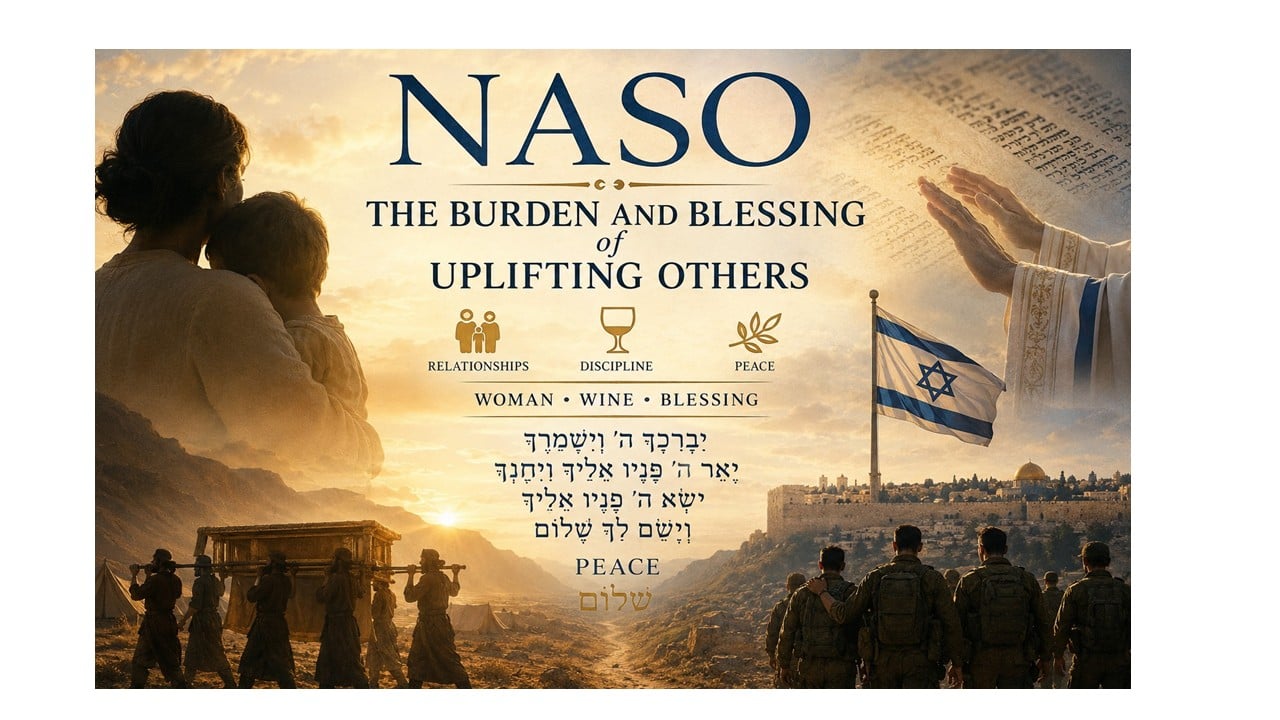
Woman.
Wine.
Blessing.
Relationships.
Desire.
Peace.
The Torah seems to be presenting a triangle at the heart of civilisation.
First comes relationship — because society begins at home.
Then comes wine — representing appetite, pleasure, ego, temptation, and the human struggle for self-control.
And finally comes the blessing.
The priestly blessing — among the oldest continuously used blessings in human civilization:
יְבָרֶכְךָ ה׳ וְיִשְׁמְרֶךָ \\ יָאֵר ה׳ פָּנָיו אֵלֶיךָ וִיחֻנֶּךָּ \\ יִשָּׂא ה׳ פָּנָיו אֵלֶיךָ וְיָשֵׂם לְךָ שָׁלוֹם
“May Hashem bless you and protect you.
May Hashem shine His face upon you and be gracious to you.
May Hashem lift His face toward you and grant you peace.”
The climax is not wealth.
Not power.
Not victory.
But peace.
שלום.
Peace is not incidental in Judaism.
It is integral to Judaism.
We conclude our central prayers with peace.
We end the Amidah with:
“עוֹשֶׂה שָׁלוֹם בִּמְרוֹמָיו”
“He who makes peace in His heavens…”
The priestly blessing is publicly recited by the Kohanim.
Parents bless their children with these words on Friday night.
Even after meals, we pray for peace.
Judaism understands that without peace, all other blessings become fragile.
And perhaps this is one of the great ironies of Jewish history.
The people whose prayers, rituals, and dreams are saturated with peace have so rarely been allowed to live in peace.
The modern State of Israel still longs for peace.
Israeli parents still pray for peace.
Jewish prayers still end with peace.
Yet peace remains painfully elusive in our region, and increasingly in the world itself.
We live in an age of outrage, polarisation, addiction, impulsiveness, broken relationships, uncontrolled desires, public humiliation, and endless ideological conflict.
The Torah does not ask us to escape the world.
It asks us to elevate it.
Not monastic withdrawal.
But holiness inside ordinary life.
Healthy homes.
Responsible leadership.
Controlled desires.
Peaceful relationships.
Moral accountability.
There is also a beautiful Midrash connected to the priestly blessing.
The sages ask:
Why does God bless Israel?
And they answer:
Because Israel blesses God.
We bless God when we are satisfied after a full meal.
And we still bless God even when we have little.
Covenant survives not only in abundance,
but also through struggle,
uncertainty,
and disappointment.
Perhaps that is one of the secrets of Jewish survival.
Then the parsha concludes with the tribal leaders — the נשיאים — bringing offerings to dedicate the Mishkan.
Each offering is identical.
Yet the Torah repeats every detail twelve times.
Why?
Because unity does not erase individuality.
Every tribe mattered.
Every contribution mattered.
Every soul mattered.
The Soul of Israel has always been built this way:
many personalities,
many struggles,
many perspectives,
Yet one covenant.
And perhaps this is also why Judaism does not present perfect heroes.
Moshe struggled with leadership, anger, and self-doubt, yet gave the Jewish people the Torah and the strength to endure the wilderness.
King David sinned and repented deeply, yet gave us Tehillim — the timeless language of the Jewish soul crying out to God through joy, despair, gratitude, and hope.
And Samson, whose story is the subject of the Haftarah for Naso, was himself a Nazir — blessed with immense physical strength, yet also deeply flawed, emotionally conflicted, and vulnerable to desire. Yet despite his imperfections, he became a source of strength and salvation for Israel.
Judaism does not present perfect heroes.
It presents human beings who struggled, failed, repented, rose again, and still carried greatness within them.
And today too, Israel is filled with flawed heroes:
- soldiers,
- reservists,
- parents,
- leaders,
- survivors,
- ordinary citizens carrying extraordinary burdens.
Holiness in Judaism is not perfection.
It is the willingness to continue carrying responsibility despite imperfection.
Perhaps that is ultimately the message of Naso.
The task of a נשיא, a parent, a leader — and perhaps every Jew — is to uplift others while carrying the burdens of covenant, responsibility, memory, and hope.
And maybe that is why the parsha’s final destination is peace.
Not because peace is easy.
But because peace is the highest form of uplift.
Related Topics