
The Calf Is Always Being Cast: How Conversations Become Idols
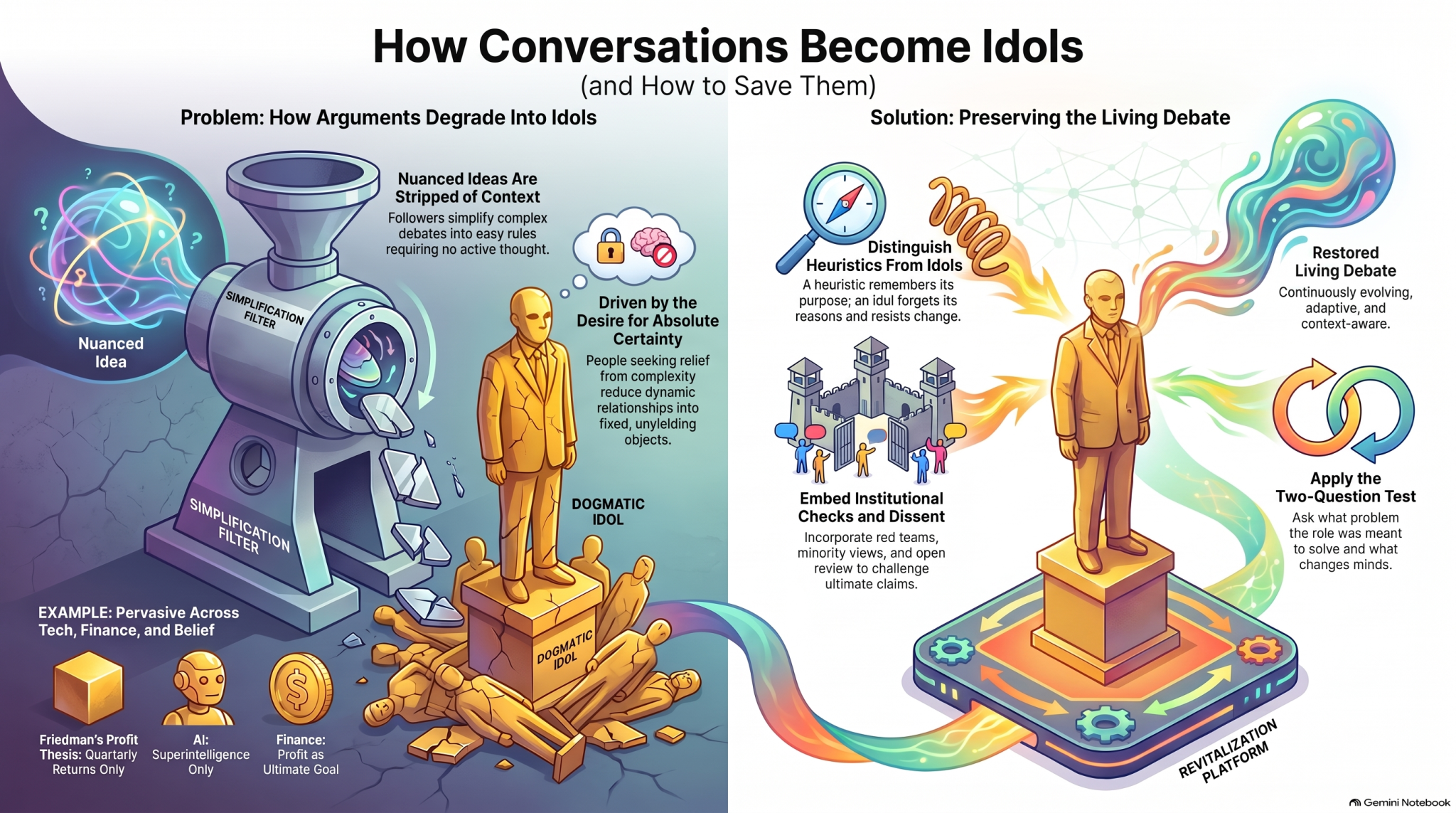
An idol is what remains of an idea after its conversation has been taken away.
A novel thought arrives as an argument, full of qualifications and unresolved tensions. Followers then build on it selectively, curate what suits them, and simplify it into rules that can be followed without being understood. The result keeps a semblance of the original notion, enough to claim its authority, but has lost the discussion that gave it meaning. Believers can serve it with total sincerity precisely because they no longer have to think. This cycle comes from human awareness, free will and the psychology of the true believer, and it afflicts markets, religions and technologies alike. In a world growing more complex, many of us hold several such idols at once, because each offers a simple answer. The remedy, wherever it has been found, is to keep the argument attached to the rule.
Eric Hoffer described the psychology in The True Believer. Movements attract people dissatisfied with themselves and relieved to dissolve into a cause. What they need is certainty, and certainty requires simplicity: an argument with live objections cannot supply it, but a rule can. The Golden Calf follows this logic. A people who had just heard a demanding, invisible God wanted a fixed form to point to, and they made one. They did not think they were abandoning God. They had reduced a relationship to an object.
Consider Milton Friedman. His 1970 argument that the social responsibility of business is to increase its profits belonged to a larger conversation about who has legitimate authority to spend other people’s money, the danger of unelected executives imposing their own agendas, and the proviso that business stay within law and ethical custom. What followed was selection and simplification, until much of modern finance treated the quarterly return as the answer to every question. The rule keeps his name and has lost his reasons.
Christianity shows the same process on a historical scale, and I say this as a Jew who reads its origins with respect. It began as a conversation inside Judaism about a Jewish teacher, the claim of his resurrection, and what that meant for Torah, Temple and messianic hope. The early disputes over circumcision, law and the place of gentiles were family arguments. As the movement spread, it was curated and structured into creeds, councils and hierarchy, until the original Jewish conversation was no longer recognizable to many of its adherents.
The Haredi world offers a third case. It arose in the nineteenth century as a response to Emancipation, the Enlightenment and Reform, a serious conversation about how Torah survives when the ghetto walls fall, with voices ranging from total rejection to cautious synthesis. The community that consolidated gathered around the most defensive answers and structured them as rules of dress, schooling and deference. It has preserved Jewish continuity with remarkable seriousness, and I would not minimize that. But resistance to a specific historical challenge can harden into a permanent identity, and a person raised inside may inherit the rules without ever hearing the argument they were meant to settle.
The pattern is not confined to religion. The brand “superintelligence” takes a rich, unresolved conversation about what machine intelligence is and should do, and simplifies it into a name implying something above us. A human creation declared superior to its makers has the structure of an idol, and I expect the usual sequence: selected claims, curated enthusiasm, followable rules, believers who have never heard the objections.
Judaism is not exempt. Interpretations of Torah can become idols whenever one becomes unquestionable. What distinguishes a living tradition is that the core remains available as the basis for ongoing reinterpretation. The test is never whether a community is religious or secular, ancient or modern. It is whether any of its interpretations has become immune to question.
What Has Been Offered
Many traditions have built remedies, and none holds a monopoly on them.
Religious and philosophical traditions
- Judaism: The Talmud records minority opinions beside rulings. In the story of the oven of Akhnai, even a heavenly voice is overruled because the Torah is not in heaven. Prophets rebuke the establishment from outside it.
- Christianity (Protestant tradition): Paul Tillich’s “Protestant principle” holds that nothing finite, whether church, creed or doctrine, may be treated as ultimate.
- Buddhism: Non-attachment extends to the teachings themselves. The raft parable says the doctrine is for crossing the river, not carrying.
- Islam: The oneness of God forbids ultimate allegiance to anything created, and ijtihad, independent reasoning, offers renewal, though the debate over whether its “gate” closed shows the same hardening.
Secular thought
- John Stuart Mill: A truth never challenged decays into dead dogma.
- Karl Popper: Distrust claims that could never be shown wrong, and build a society that can remove bad ideas without bloodshed.
- Isaiah Berlin: Real goods conflict, so any scheme promising one final answer quietly sacrifices something valuable.
Institutions
- Politics: Separation of powers, independent courts and a free press assume no person or interpretation stays trustworthy.
- Business and engineering: Boards that can say no, review steps that cannot be waived, red teams paid to find the flaw.
A conservative caution
- Chesterton’s fence: Before removing a rule, find out why it was built. Recovering the argument will sometimes justify the rule and sometimes condemn it.
- Heuristic versus idol: No one can reason from first principles about everything, so shortcuts are unavoidable. A heuristic remembers why it exists and yields when conditions change. An idol has forgotten its reasons.
Two limits
- Remedies become idols too. Science turns into scientism, skepticism into a movement with its own believers. A cure works only while practiced.
- The appeal is social. Believers gain belonging, an enemy and meaning. A remedy offering only doubt loses to an idol offering a home. The traditions that endure pair questioning with community and purpose.
The test that follows is one anyone can apply to a belief, a leader, a market principle or a machine: can the followers say what problem the rule was meant to solve, and what would change their minds?