


Where history exposes power and moral failure
The Camps after Liberation: Catastrophe Still Unfolding
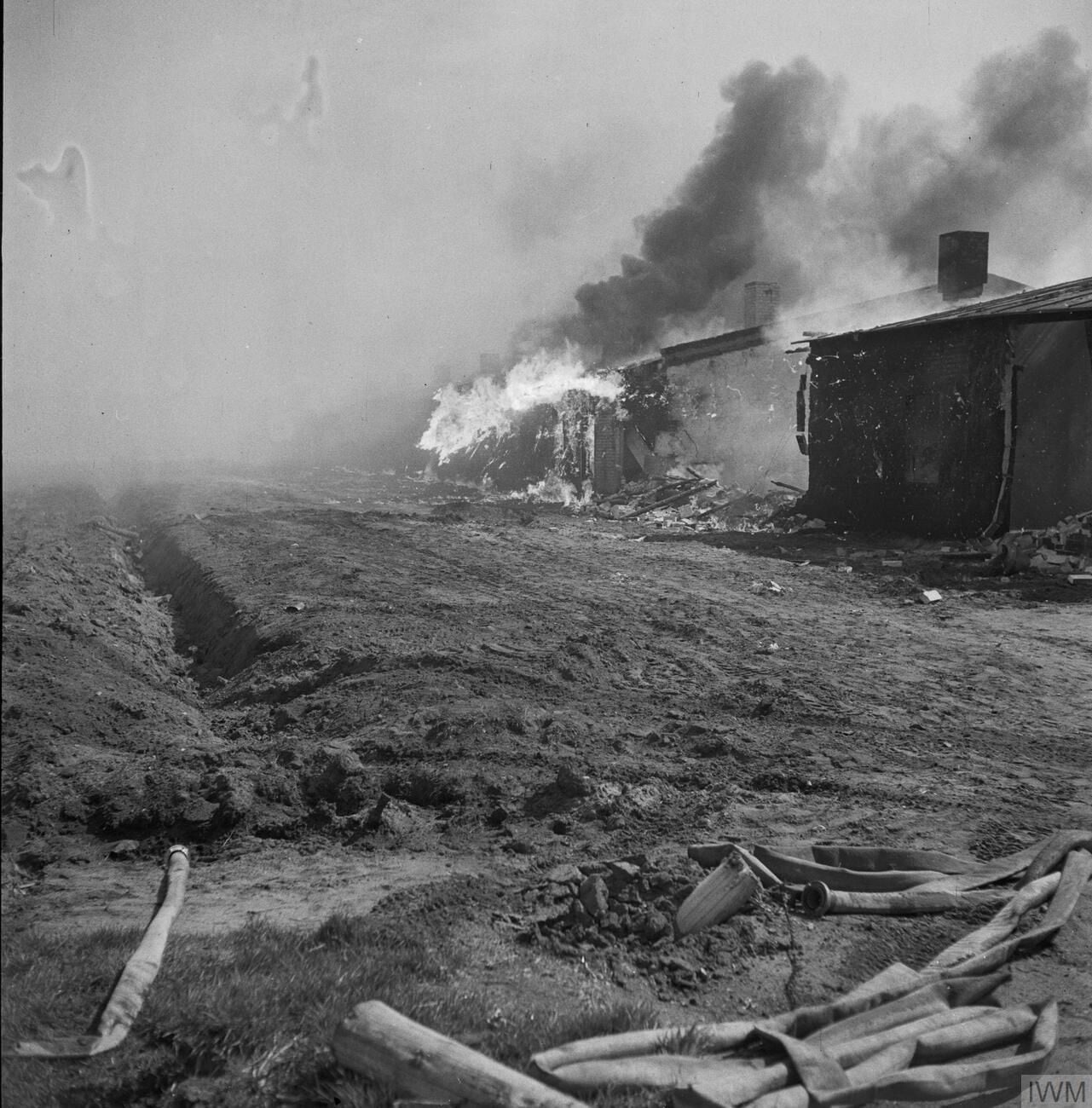
British troops burn infected huts at Bergen-Belsen after liberation, May 1945. Sgt. Hewitt, No. 5 Army Film & Photographic Unit / Wikimedia Commons (public domain).
When Allied soldiers entered the concentration camps in 1945, they did not find an ending. They found the catastrophe still unfolding. They found a logistical, medical, and human disaster still actively in progress.
The SS guards had fled, surrendered, hidden among civilians, or waited to be taken. The gates could be opened. Orders could be given by Allied Commanders. Flags could change. And still, people died.
Liberation has been absorbed into public memory as a clean moral moment: gates thrown open at last, evil defeated by military victory. The imagery is familiar because it is emotionally necessary. The liberators arrive. The war concludes. Survivors go home. Humanity returns.
But the historical reality was considerably more horrifying and far less orderly than the simplified narrative later preferred to remember. What Allied troops actually encountered at places like Bergen-Belsen, Dachau, Buchenwald, and Mauthausen was not rescue completed, but systems of mass death collapsing in real time.
The camps did not become survivable merely because the SS had fled or surrendered. Many prisoners were already dying beyond recovery.
The liberators were not prepared for the emergency they inherited. They had planned for combat, surrender, prisoners of war, occupation logistics, and battlefield medicine. Inside the camps, they found something else: a public-health catastrophe inside an extermination site.
Even the word “survivor” becomes unstable here. Many prisoners were alive when Allied troops arrived and dead days or weeks later. The body does not recover from starvation, disease, torture, organ failure, and dehydration because the gates have opened.
The scale of the destruction was not only measured in the dead, but in the forced remaking of Jewish geography itself. Before the Holocaust, Europe was still one of the great centers of Jewish life, with dense communities, languages, institutions, families, religious worlds, political movements, schools, presses, trades, and neighborhoods built across centuries. By the time Allied soldiers entered the camps, that map had been violently torn apart. The murdered were gone, but the living were also displaced: orphaned, stateless, widowed, undocumented, physically ruined, and often unable or unwilling to return to towns where families had been annihilated and neighbors had watched, profited, or participated.
Liberation did not restore Jewish Europe. It exposed that, for many survivors, there was no home left to return to. Families had been murdered, property had been stolen, communities had been destroyed, and in many places the neighbors who remained had watched, profited, collaborated, or made return impossible. What followed was not simple recovery, but coerced diaspora: displaced-person camps, emigration battles, Palestine and the later State of Israel, America, Britain, Canada, Australia, South America, and the long postwar effort to rebuild Jewish life elsewhere because so much of the old world had been made uninhabitable.
One of the cruelest realities was that compassion itself could become dangerous.
Soldiers saw starving people and tried to feed them, as any ordinary person would. But prisoners who had endured months or years of extreme malnutrition could not safely absorb normal food in normal quantities. Refeeding syndrome, poorly understood at the time, could turn nourishment into another physiological crisis. The body, altered by starvation, could collapse when food was reintroduced too quickly. Liberators who believed they were helping sometimes watched prisoners deteriorate or die despite the opening of the gates.
At Bergen-Belsen, this became a deadly practical problem almost immediately. Early British efforts to feed survivors with Army “compo” rations, food designed to sustain active soldiers, proved disastrous for prisoners whose bodies had been damaged by starvation. The rations were too rich for people whose intestines could no longer process ordinary food in ordinary quantities. It was later estimated that thousands died after receiving the wrong initial diet.
Dame Janet Vaughan, who arrived at Bergen-Belsen with a Medical Research Council team and around 100 medical students, entered this crisis as both physician and investigator. Her work was not sentimental rescue work, though it was driven by the urgency of saving lives. It was emergency science conducted inside catastrophe. Vaughan tested hydrolysates, a concentrated protein preparation, but many prisoners could not tolerate the taste, the method, or the use of injections after Nazi medical abuse. She then helped move treatment toward milk and very small quantities of food given orally, a slower and more survivable approach for bodies ruined by starvation. Vaughan later described the experience as “practising science in hell.”
The emergency did not stop at food. The camps posed practical crises at every level: burial, disinfection, typhus control, lice, sewage, clean water, barracks, medical triage, guard management, evidence preservation, and mass displacement. The dead had to be buried. Barracks saturated with disease had to be disinfected or destroyed. Tens of thousands of prisoners had to be sorted by medical condition, nationality, documentation, family status, and ability to travel. Children had to be identified. Names had to be reconstructed from numbers. Survivors with no homes, no papers, no families, and often no country to return to had to be processed not only as liberated prisoners, but as displaced persons in a Europe that had made return impossible for many of them.
The Allied armies suddenly found themselves functioning not only as military forces, but as emergency governments, sanitation authorities, refugee administrations, forensic investigators, and improvised humanitarian agencies.
Neuengamme offers a different but equally revealing example. By the end of the war, the camp system near Hamburg had become less a fixed site awaiting liberation than a machinery of evacuation, dispersal, forced movement, and concealment. More than 100,000 prisoners had passed through Neuengamme and its satellite camps, and tens of thousands died from forced labor, starvation, disease, executions, death marches, and the catastrophic final evacuations.
As Allied forces approached, the SS tried to empty the camp and move prisoners away from liberation. Some prisoners were sent on death marches. Others were transported toward the Baltic coast. Thousands were crowded onto ships, including the Cap Arcona and the Thielbek, where hunger, thirst, disease, and confinement continued the work of destruction after the prisoners had been removed from the camp itself.
On May 3, 1945, British aircraft bombed the ships, believing they were carrying German military personnel. Thousands of prisoners from Neuengamme died in the resulting fires, drowning, and chaos. Some victims were not found inside the camp because the SS had already turned evacuation into another killing process.
Even survival did not become orderly. Those who reached Sweden through Red Cross rescue efforts entered another emergency: quarantine, delousing, medical treatment, registration, language barriers, missing papers, uncertain nationality, and the search for families who had often already been murdered. Safety did not immediately produce coherence.
Neuengamme shows that sometimes the liberated prisoners had been scattered across roads, rail lines, barns, ships, shoreline, and foreign reception systems. Sometimes the catastrophe Allied forces and relief workers encountered was not only the camp itself, but the violent geography created by the Nazi effort to keep victims, evidence, and responsibility moving until the very end.
This is why liberation photographs remain so deeply unsettling. They are often read as images of an ending, when many of them are in fact images of a disaster still playing out in real time. The camera catches Allied arrival, but not necessarily survival. Some of the prisoners visible in those photographs would die after the gates had opened.
Liberation interrupted extermination. It did not instantly reverse starvation, disease, exposure, or the long bodily consequences of Nazi captivity.
The Allied soldiers themselves were marked by what they found. Many had heard reports of German atrocities and suspected exaggeration, until the camps made disbelief impossible. Liberator testimony returns obsessively to the smell because the dead were everywhere: in open pits, in barracks, on the ground, beside the living. Soldiers found crematoria, skeletal prisoners, human hair, shoes, corpses, and people too weak to meet freedom with the emotional response later memory sometimes expects.
The cheering crowd belongs more comfortably to Paris than to Bergen-Belsen. Inside the camps, the problem was not simply opening gates. It was how to stabilize places where food, water, sanitation, shelter, medicine, identity, family, and ordinary human continuity had collapsed under a system built to destroy them.
Food, water, sanitation, medicine, paperwork, family, and country had all been broken. Beneath that lay the fact liberation memory finds hardest to hold: some prisoners could not be rescued because rescue had come too late.
Public memory prefers liberation because it restores order. Evil loses. Soldiers arrive. Gates open. Civilization returns. Inside the camps, the reality was worse. Liberation revealed how much damage modern bureaucratic mass violence could do before the killing officially stopped. Starvation, epidemic disease, organ failure, psychological injury, statelessness, orphanhood, and displacement did not end because the Allies had won.
The Allied victory was necessary. Without it, the camps would have continued. More people would have been murdered. But military triumph could not undo what had already entered the body, the family, the archive, and the map of Europe.
The camps remained places of death after liberation because extermination had already moved beneath the visible machinery of the camp. It was in the fever, the weakened heart, the infected barrack, the missing paper, the child without parents, the prisoner with no home to return to.
Liberation was necessary, heroic and incomplete. The soldiers who entered the camps in 1945 discovered that defeating the Nazi regime and saving its victims were not always the same act.
–
Selected Sources
Michael Brenner, After the Holocaust: Rebuilding Jewish Life in Postwar Germany.
- M. Crago-Schneider, Jewish “Shtetls” in Postwar Germany.
Deborah E-S. Hemstreet and George M. Weisz, “One Page in the History of Starvation and Refeeding.”
- C. Hutchins, The United States 4th Infantry Division from Utah Beach to Hürtgen Forest to Dachau Concentration Camp.
Baher Ibrahim, “Uprooting, Trauma, and Confinement: Psychiatry in Refugee Camps, 1945–1993.”
Jakub Konečný, The Medicine of Starvation: Allied Responses to the Nutritional Crisis in Liberated Western Concentration Camps.
Hagit Lavsky, The Result of Freedom: European Jewish DPs in the British Zone of Occupation, 1945–1950.
Rowan MacAuslan, “The RAMC at Belsen 1945: Typhus Revisited.”
Zeev W. Mankowitz, Life Between Memories: The Rosenheim DP Camp and the Democratic Rebirth of the She’erit Hapletah.
Avinoam J. Patt, Finding Home and Homeland: Jewish Youth and the Voices of the She’erit Hapletah.
Ben Shephard, After Daybreak: The Liberation of Belsen, 1945.
Paul Weindling, “‘Belsenitis’: Liberating Belsen, Its Hospitals, UNRRA, and Selection for Re-emigration, 1945–1948.”