The Case for Jon Ossoff in 2028
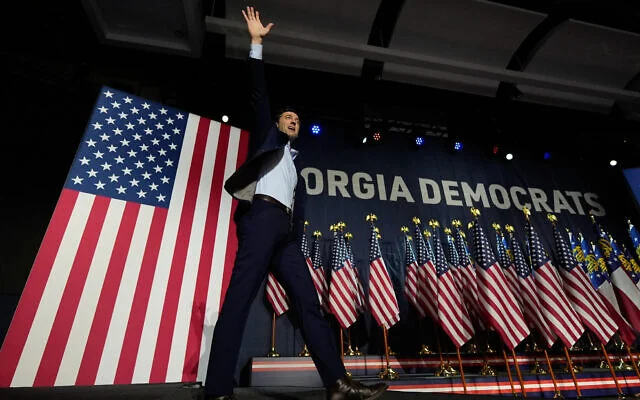
Two years after President Trump reclaimed the White House, the Democrats won back both chambers of Congress in historic fashion. Traditional swing states North Carolina and Georgia were easily won by Democratic Senate nominees Roy Cooper and Jon Ossoff. The latter beat Rep. Mike Collins by eighteen points nearly six years after first winning his Senate seat in a runoff. The question facing Democrats now is whether Jon Ossoff represents the future of a party searching for its next presidential standard-bearer.
For the past few months, Sen. Ossoff has become a darling on the internet among progressive and centrist Democrats alike. I have been on the Jon Ossoff bandwagon since the 2020 election cycle, when he outperformed former Sen. David Perdue on the debate stage. At the time, Ossoff accused the former Georgia senator of being a corrupt crook. Six years later his anti-corruption message continues and has resonated with a lot of voters.
During his time in office, Ossoff has proven to be an effective communicator and built a broad voter coalition that many Democrats have struggled to create in recent years. His appeal among working-class voters, independents, and even a segment of Republican voters could prove particularly valuable in 2028. These are precisely the voters Democrats will need to win back the White House.
The last Democrat to win the White House was President Joe Biden in 2020 by appealing to moderates and independents. Ossoff has demonstrated a similar political appeal in a crucial swing state that President Trump has carried twice in the past decade.
History has shown us that Democrats win the presidency when they nominate young, centrist, and charismatic candidates. John F. Kennedy, Bill Clinton, and Barack Obama all won the presidency by appealing to everyday Americans and demonstrating the political restraint necessary to avoid catering to the extremes of their party.
The Democratic Socialists of America (DSA) have emerged as an insurgent force in the Democratic Party, winning elections in safely Democratic districts and cities. However, elections are won through the middle of the electorate. The two major races in Florida illustrate that point.
State Rep. Angie Nixon, a member of the DSA, lost by three points to Sen. Ashley Moody in Florida. Meanwhile, in the gubernatorial race, centrist Democrat David Jolly lost by one point to staunch Trump ally Byron Donalds. Jolly was a former Republican congressman who was able to attract a broad coalition of voters. He also won back Miami-Dade County for the Democratic Party, which had supported Gov. Ron DeSantis and President Trump in recent election cycles.
A state like Florida, which just six years ago was a crucial battleground, can still be competitive for the Democrats with a broadly appealing and charismatic candidate like Jon Ossoff. Both Bill Clinton and Barack Obama won Florida twice, and I believe Sen. Ossoff can do the same after winning Georgia twice.
After a decade on the national political stage, President Trump’s career is now entering its twilight years. Both parties will need to look toward the future. For Democrats, Trump will no longer be the bogeyman used to fire up their base. Voters will need to hear solutions to the nation’s challenges and a plan to address the damage caused by the Trump administration.
In 1992 and 2008, two relatively unknown, young, charismatic challengers were able to inspire a nation and succeed unpopular Republican administrations. Jon Ossoff recently stated that he does not plan to run for President in 2028. Bill Clinton and Barack Obama expressed similar sentiments before entering the presidential race. After all, history doesn’t always announce its intentions before repeating itself.