
CEO of Time to Stand Up for Israel
The Children of Gaza
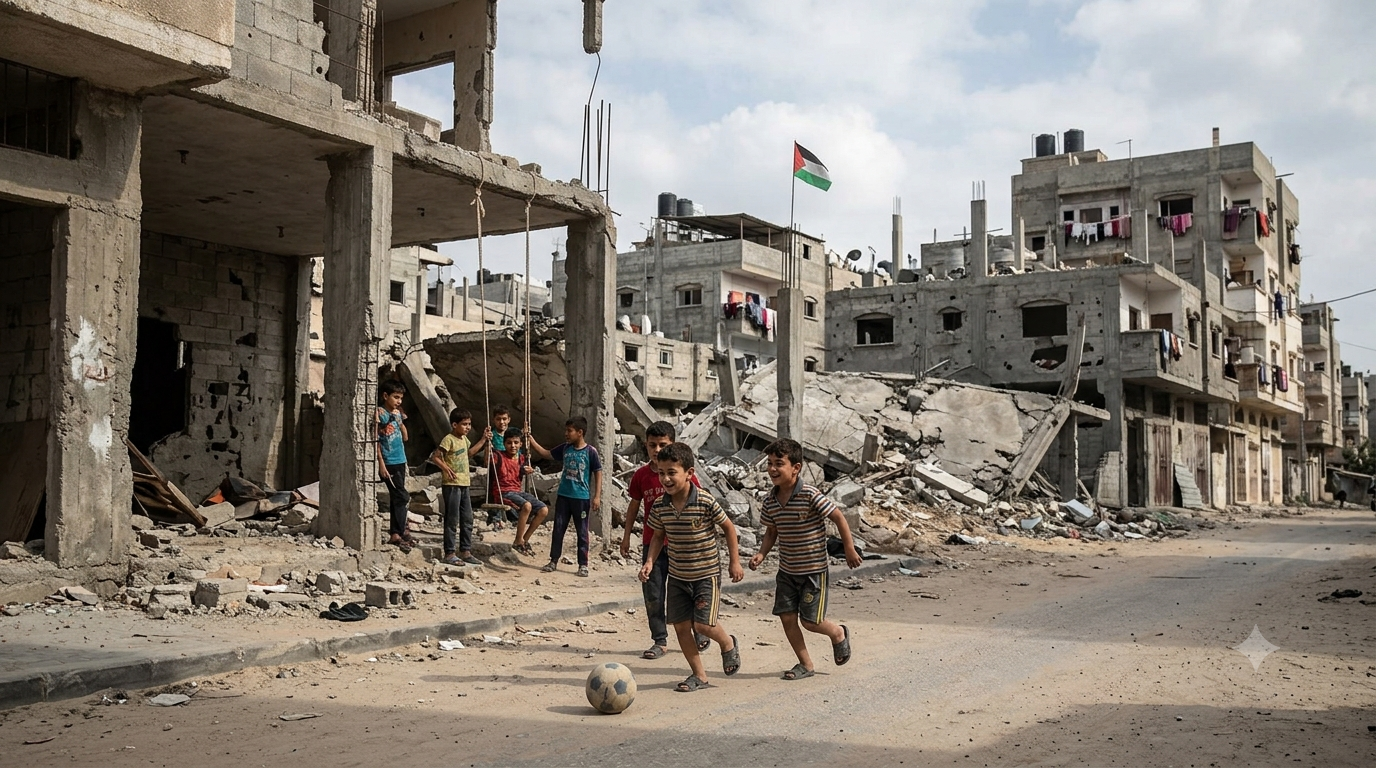
Photo Crrdits: Sabine Sterk ( AI, Gemeni)
The Children of Gaza
I am sick of watching the children of Gaza being turned into one gigantic accusation against Israel, as though this war began because Israel suddenly decided that it wanted to fight children, while the ideology that has ruled Gaza, militarized Gaza, indoctrinated generations and deliberately transformed civilian surroundings into part of its battlefield is pushed conveniently out of the picture.
Children dying in war is horrific. Full stop. There is nothing remotely victorious about the body of a child.
But if the world genuinely cares about the children of Gaza, then it must finally have the courage to ask what kind of ideological environment Hamas created for them.
Hamas is not a Scandinavian political party with a slightly more conservative religious program. It is an extremist Islamist organization that has ruled Gaza since 2007. Its political and religious ideology cannot be understood by projecting comfortable Western assumptions onto it.
This is precisely where the Western conversation repeatedly fails.
People sitting safely in Amsterdam, London, Brussels or New York look at Gaza through their own moral framework and assume that everyone involved in this conflict necessarily approaches life, death, childhood, warfare and religious sacrifice in essentially the same way.
They do not.
And acknowledging that is not racism. It is recognizing ideology.
The concept of martyrdom is essential to understanding extremist jihadist ideology. Within that worldview, earthly existence is temporary while the afterlife is eternal, and dying as a shahid, in what the believer considers jihad for Allah, can therefore be understood not as ultimate defeat but as ultimate triumph.
Paradise, forgiveness, religious honor and eternal reward can become more important than survival itself.
Think about what happens when that belief is glorified politically and socially.
The basic human calculation is reversed.
Instead of teaching that survival is the highest priority, martyrdom can become an aspiration. Instead of treating death for the cause purely as catastrophe, it can be celebrated as honor. Instead of protecting the next generation from warfare at virtually any cost, children can grow up surrounded by narratives in which fighters and martyrs are elevated as heroes.
That matters enormously when trying to understand Gaza.
It does not mean that every Gazan thinks identically, and it certainly does not mean that children are responsible for the ideology imposed upon them. Quite the opposite. Children are precisely the people least responsible for the world adults create around them.
That is why I consider the ideological exploitation of children so unforgivable.
An overwhelming majority of Gazans elected Hamas. Hamas won the 2006 Palestinian legislative election and subsequently took control of Gazal.
Unfortunately, there has been no comparable democratic parliamentary election giving today’s population of Gaza a fresh opportunity to approve or reject Hamas rule, but I will not be surprised if the results of an election are still the same
Hamas is fully responsible for what it subsequently built in Gaza.
Then look at Israel.
The contrast in values could hardly be more profound.
Jewish tradition places extraordinary value on human life. Israel sends rescue teams around the world after earthquakes and disasters because saving life is deeply embedded in Israeli society.
The same country that is constantly portrayed as casually indifferent to Gazan civilians has developed extensive procedures specifically intended to reduce civilian deaths during military operations.
Israel has used Arabic leaflets, telephone calls, radio broadcasts and other warnings before attacks. Israeli procedures have included individual telephone warnings to people in buildings about to be attacked, real time surveillance to determine whether civilians remain, assessments of expected collateral damage, and decisions not to carry out proposed military operations when anticipated civilian harm is considered too great. Israeli documentation from previous Gaza conflicts describes surveillance confirming civilians leaving targeted areas after warnings.
During the war following October 7, Israel also documented the use of leaflets, radio broadcasts, social media warnings, individual telephone calls, published evacuation routes, weapon and munition selection procedures and proportionality assessments intended to reduce expected civilian harm.
Why would an army supposedly interested in killing civilians warn civilians to leave?
Why telephone people before attacking a military target?
Why distribute maps?
Why monitor whether people have evacuated?
Why assess expected civilian casualties?
Why sometimes abandon an attack when the civilian cost is judged too high?
These are uncomfortable questions for a world that has already decided what the photograph means before asking what happened before the photograph was taken.
None of this means that every Israeli strike is perfect. War is not perfect. Intelligence is not perfect. Weapons are not perfect. Human beings are not perfect.
Civilians die in wars, especially when warfare takes place in densely populated urban territory.
But civilian death and deliberate murder of civilians are not synonymous concepts, and pretending that they are destroys the distinction between a terrorist organization intentionally attacking civilians and an army attacking military objectives while taking precautions intended to reduce civilian casualties.
That distinction matters.
The children of Gaza deserve something better than becoming ammunition in somebody else’s ideological war.
They deserve to grow up believing that their greatest achievement should be living, learning, creating, loving, building families and constructing a future.
They deserve adults who tell them that life is precious rather than teaching them that martyrdom is glorious.
And they deserve a world courageous enough to condemn the ideology that turns death into victory instead of automatically blaming Israel every time that ideology produces another unbearable image.
If you genuinely care about the children of Gaza, then stop treating them merely as photographs with which to condemn Israel.
Ask who shaped the world into which those children were born.
Ask what they were taught.
Ask who chose terrorism.
Ask who turned civilian territory into a battlefield.
And above all, ask why the international community has spent so much energy condemning the country fighting Hamas while showing so little determination to destroy the ideology that teaches another generation that there can be something more glorious than life.
The children of Gaza deserve life.
Not martyrdom.
Not Hamas.
Life.
Related Topics
Related Posts