
The Church and The Gospel – Part VIII
Abolition and the Birth of the Independent Black Church
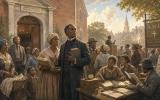
In 1787, Black worshipers at St. George’s Methodist Episcopal Church in Philadelphia were pulled from their knees while praying in a section reserved for White congregants. The humiliation helped convince Richard Allen, Absalom Jones, and others that spiritual equality without institutional power was not enough.
That same year they formed the Free African Society, a mutual-aid organization that supported sick people, widows, orphans, burial needs, and Black community life. In 1816, Allen helped organize the African Methodist Episcopal Church. The new denomination was not a retreat from Christian unity. It was an act of ecclesial self-government in response to a unity controlled by white Christians.1
Eighteenth-century evangelical revivals produced movements of personal conversion, missionary expansion, education, prison reform, and antislavery activism. John Wesley’s Thoughts upon Slavery, published in 1774, condemned the slave trade and slavery as violations of justice and mercy. Quakers moved toward corporate opposition to slaveholding. British evangelicals helped mobilize against the Atlantic slave trade.2
Yet abolition was not a gift white Christians simply bestowed upon enslaved people. Black resistance, testimony, rebellion, escape, political organization, and theological interpretation were indispensable. Formerly enslaved writers exposed the brutality hidden behind Christian respectability. Black preachers declared that the God who delivered Israel did not sanction racial bondage.
Independent Black churches became centers of worship, education, abolition, political debate, mutual aid, economic cooperation, protection, and leadership development. They created public spaces in which Black people could speak as theological subjects rather than objects of white mission.4
The British Parliament abolished the slave trade in 1807 and slavery in most British territories through the 1833 act, with full freedom delayed by an exploitative apprenticeship system until 1838. Christian abolitionists contributed greatly, but the movement also depended upon formerly enslaved campaigners, Black resistance in the Caribbean, working-class mobilization, and political pressure. The state compensated enslavers rather than the people whose labor and lives had been stolen.3
In the United States, the conflict became a crisis of biblical interpretation and ecclesiology. Proslavery Christians cited household codes and passages commanding enslaved people to obey masters. They argued that Scripture regulated slavery rather than prohibited it and that abolitionists placed modern moral sentiment above biblical authority.
Black Christians supplied more than moral testimony; they supplied theology. David Walker’s Appeal denounced a Christianity that preached submission while protecting slavery. Frederick Douglass distinguished the Christianity of Christ from the slaveholding religion of America. Maria Stewart, Sojourner Truth, Harriet Tubman, Henry Highland Garnet, and countless unnamed believers interpreted Exodus, judgment, providence, and human dignity from within the struggle for freedom.
Black women’s leadership was indispensable even when formal pulpits and historical accounts marginalized it. Women raised funds, organized antislavery societies, sheltered fugitives, taught literacy, led prayer networks, and connected churches to broader movements. Their activism demonstrated that ecclesial authority and official ordination have never been identical.
Abolitionist Christians appealed to the image of God, the Exodus, the Golden Rule, the unity of humanity in Christ, the prophetic condemnation of oppression, and the incompatibility of racial chattel slavery with neighbor-love. Black interpreters emphasized that enslavers read isolated texts while ignoring the Bible’s larger moral movement toward liberation and human dignity.
The debate exposes the limitations of claiming that the Bible “plainly teaches” one social order. Christians committed to biblical authority reached opposite conclusions because interpretation was shaped by economic interest, racial ideology, inherited culture, and social location. Theological error was not merely intellectual. It protected wealth and power.
The Methodist Episcopal Church divided in 1844–1845 over slavery. The Southern Baptist Convention was organized in 1845 after conflict over whether slaveholders could receive missionary appointments. Denominations placed regional and racial interests above Christian unity while insisting that their positions were faithful to Scripture.
Denominational division did not itself resolve the moral crisis. Proslavery Christians appealed to biblical passages regulating slavery and to doctrines of social order. Abolitionists appealed to Exodus, the image of God, the Golden Rule, and the unity of humanity in Christ. Both sides quoted Scripture; the decisive question was how Scripture was read, whose suffering was believed, and which interests interpretation protected.
The Civil War ended legal slavery, but emancipation did not end white supremacy. During Reconstruction, Black churches helped establish schools, colleges, benevolent associations, newspapers, businesses, political organizations, and community institutions. The church became one of the few large institutions controlled by African Americans.
Black clergy and lay leaders entered politics, advocated voting rights, organized education, and defended communities facing white violence. Their public role made churches targets. White supremacist attacks on Black congregations were not random. The perpetrators understood that destroying a church could weaken an entire community’s institutional power.
The Black church was never politically or theologically uniform. Some leaders emphasized respectability and self-help; others demanded structural change. Some churches reproduced class and gender hierarchies. Women supplied much of the labor, fundraising, education, and organizing while being denied formal recognition and ordination in many settings.
Still, the independent Black church fundamentally expanded the meaning of Christian social action. It did not merely distribute charity. It built institutions under the control of people whom society sought to control. It formed leaders, preserved memory, taught literacy, created economic networks, and supplied the organizational foundation for later freedom movements.
Abolition also taught the church a hard lesson about delayed repentance. Christian institutions often resist moral change until those they have harmed organize outside or against them. White denominations that excluded Black Christians later praised Black churches for their spiritual vitality without fully acknowledging why those churches had to become independent.
The struggle over slavery remains relevant because it reveals how injustice becomes theological common sense. Christians can defend an institution for generations, cite Scripture in its support, divide churches to preserve it, and only later describe opposition as obviously Christian.
The question is not simply why nineteenth-century Christians failed. It is what current arrangements appear normal because they benefit us. What forms of exploitation, exclusion, or hierarchy are being defended today with selective biblical arguments? Who is being required to leave or build separate institutions in order to experience the equality the church professes?
The abolition struggle also demonstrates why neutrality is often impossible. Churches that refused to address slavery in order to preserve unity effectively protected slavery’s continuation. Silence did not keep politics out of the church. It allowed the prevailing political economy to govern the church without challenge.
The independent Black church also became a theological archive. Sermons, spirituals, testimony, funerals, revivals, and mutual-aid practices preserved interpretations of suffering and hope that academic institutions often ignored. Social action and theological knowledge developed together.
The abolition story also warns against making white allies the center of Black liberation. Enslaved people escaped, rebelled, negotiated, worshiped, preserved families, gathered intelligence, served in armies, and forced slavery onto the national agenda. Black churches gave that agency institutional memory. Christian abolition was strongest when it listened to those who knew slavery from within rather than treating them as grateful recipients of rescue.
Black church independence shows that reconciliation cannot always precede power. white Christians called for unity while retaining control of pulpits, property, ordination, and money. Black Christians built institutions in which they could exercise authority, educate children, organize politically, and interpret the gospel from their own experience. That institutional capacity helped make later freedom movements possible.
The lesson is not that separation is the Christian ideal. It is that unity without justice can become another name for domination. Reconciliation requires shared dignity, shared truth, and shared power.
Citations and Sources
- African Methodist Episcopal Church, “Our History,” on the Free African Society, Richard Allen, Absalom Jones, and the formation of the AME Church.
- John Wesley, Thoughts upon Slavery (1774).
- UK Parliament, “The Abolition of the Slave Trade,” on the 1807 and 1833 abolition legislation and the apprenticeship period.
- National Park Service, African American Heritage, resources on Black religious institutions, abolition, and community formation.