


The Church & The Gospel – Part V
When the Persecuted Church Gained Power:
The church’s hardest test may begin when persecution ends
Legalization expanded Christianity’s ability to serve—and its temptation to dominate.
In AD 313, the agreement commonly called the Edict of Milan granted Christians legal toleration and ordered the restoration of confiscated property. It did not make Christianity the official religion of the Roman Empire. Traditional Roman religion continued, and the institutional relationship between church and empire developed gradually. Nevertheless, Christianity’s social position changed dramatically. A community that had lived vulnerable to imperial power began learning how to live near it.
“Constantine’s bargain” was not a single contract negotiated at one moment. It was an evolving relationship in which imperial protection, financial support, legal privileges, and political access became increasingly intertwined with Christian legitimacy and ecclesiastical influence.
The change produced genuine good. Christians could build larger places of worship, establish institutions of relief, care for sick people and travelers, ransom captives, support poor communities, and intervene publicly on behalf of vulnerable people. Bishops acquired greater social standing and could sometimes use their access to challenge governors, negotiate mercy, or protect people who had little political influence.
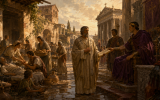
The picture is a symbolic scene of the church entering a new relationship with Roman political power.
At the center, a bishop stands between two worlds. On the left, Christians are caring for the sick, distributing bread, and assisting poor people. This represents the church’s expanding ability to create hospitals, relief systems, and other institutions of mercy after legalization.
On the right, an emperor in purple, surrounded by soldiers and imperial officials, offers the bishop a scroll. The scroll represents legal recognition, restored property, privileges, funding, and access to political authority. The bishop’s uncertain posture suggests that this offer is both an opportunity and a danger.
The church building behind them shows Christianity becoming public, established, and increasingly connected to the empire. The soldiers, throne, banners, and monumental architecture represent the coercive power that could now be used either to protect people or to punish religious opponents.
The same transition, however, created an enduring temptation. Rulers could lend the church protection and resources, while the church could lend rulers sacred legitimacy. Legalization increased Christianity’s capacity for service, but it also increased its capacity for domination.
Constantine made the new relationship concrete. He restored church property, supported the construction of churches, granted privileges to clergy, and involved himself in disputes among bishops. His policies did not immediately erase the distinction between church and empire, but they ensured that theological conflict could no longer be treated as merely internal to Christian communities.
The Council of Nicaea in 325 illustrates this new reality. Constantine convened bishops partly to address the controversy associated with Arius and the relationship of the Son to the Father. He was concerned with theological division, but he also feared that ecclesial conflict could threaten the unity of the empire.
The resulting creed affirmed the full divinity of the Son. It was an extraordinary theological achievement, but the circumstances of the council revealed a new political problem: an emperor now possessed the authority, resources, and interest to gather bishops, influence the setting of their deliberations, and participate in enforcing their decisions.
The creed itself placed a limit upon imperial authority. If Jesus Christ is truly Lord, no emperor, nation, military power, or political order can claim ultimate allegiance. Yet that implication was not automatically applied. A correct creed does not guarantee a just church.
Later councils continued to define Christian doctrine. The Council of Constantinople in 381 reaffirmed the Nicene faith and clarified Christian teaching concerning the Holy Spirit. The Council of Chalcedon in 451 confessed Christ as fully divine and fully human.
These councils were primarily concerned with doctrine, not social reform. They did not produce modern theories of human rights, economic justice, or religious liberty. Their teachings nevertheless contained moral implications that Christians could—and often failed to—draw out.
If there is one Creator, no people can coherently be treated as possessing lesser humanity. If God entered embodied human existence, bodily suffering cannot be dismissed as spiritually irrelevant. If Christ alone is Lord, no state may demand absolute loyalty. Doctrine becomes socially meaningful only when communities accept and obey its implications.
The post-Constantinian church also demonstrated what institutional expansion could make possible. Around 370, Basil of Caesarea established the complex commonly called the Basileiad. It offered care to travelers, poor people, and those suffering from illness and is frequently regarded as an important predecessor to the hospital.
Basil’s institution grew from his theology of wealth. He argued that surplus possessions carried an obligation toward those who lacked necessities. What the wealthy treated as exclusively their own could, in moral terms, belong to the hungry, the unclothed, and the homeless.
John Chrysostom preached with similar force against luxury and indifference. He criticized Christians who decorated church buildings while neglecting Christ in the bodies of poor people. Ambrose of Milan taught that the goods of the earth were intended for the common benefit of humanity, not merely for those powerful enough to accumulate them.
For these church leaders, poverty was not simply an unfortunate condition. The misuse of wealth was a spiritual crisis. Greater institutional capacity could therefore become an instrument of mercy, public advocacy, and organized care.
But the church’s new power also enabled forms of coercion that had been unavailable to a persecuted minority. Bishops could be exiled after theological disputes. Religious property could be transferred from one Christian faction to another. Imperial law increasingly restricted communities declared heretical. Political authorities intervened in questions of worship, leadership, and doctrine.
The process did not stop with Constantine. In 380, the Edict of Thessalonica declared the Nicene form of Christianity endorsed by the emperors to be the normative imperial faith. Legal toleration had moved toward religious establishment. Establishment, in turn, made coercion easier to justify.
The church that had pleaded for freedom under persecution did not consistently defend the freedom of pagans, dissenting Christians, or Jews once it possessed influence.
This is one of the great moral tests of religious institutions. The true measure of a community’s commitment to freedom is not whether it demands liberty for itself when vulnerable, but whether it protects the liberty of others when powerful.
The treatment of Jews exposes the danger with particular clarity. Christian anti-Jewish polemic did not begin with Constantine, nor did every Christian leader speak about Jews in the same way. Christianity and Judaism had been engaged in conflict and separation for centuries.
Imperial support, however, changed the consequences of Christian teaching. Theological hostility could now influence law, civic standing, access to public life, and physical security. Ideas formed within a once-vulnerable religious movement acquired the authority of a dominant culture.
When theology gains government backing, errors that might have remained words can become conditions imposed upon other people’s lives.
Anti-Judaism must therefore be understood at several levels. Theological claims portrayed Judaism as rejected or superseded. Social rhetoric depicted Jews as dangerous, blind, or stubborn. Imperial legislation imposed restrictions. In later periods, these traditions helped create environments in which Jewish communities could be marginalized, humiliated, expelled, or attacked.
The relationship between Christian theology and anti-Jewish violence was neither simple nor uniform. But the Constantinian transition made one fact unavoidable: when religious communities gain political power, their prejudices can become public policy.
Imperial Christianity also changed the meaning of conversion. When Christian affiliation brought social advantage, imperial favor, or access to office, entry into the church became harder to interpret. People could identify as Christian from conviction, conformity, ambition, family pressure, or fear.
Institutional success therefore made genuine discipleship more difficult to distinguish from public identification with the dominant order. Christianity increasingly moved from being one community among others to seeing itself as guardian of the social order. Once that imaginative shift occurred, religious dissent could be recast as a threat to both church and state.
Not every bishop became a servant of imperial power, and not every emperor controlled the church. The relationship included conflict as well as cooperation.
After imperial troops massacred civilians in Thessalonica in 390, Ambrose of Milan confronted Emperor Theodosius I and required him to undertake public penance before returning to communion. The episode demonstrated that ecclesial authority could still place moral limits upon a ruler.
Yet it also showed how closely altar and throne had become intertwined. A bishop now possessed a form of public authority that would have been unimaginable to the earlier persecuted church.
Augustine of Hippo later developed a theological framework that resisted the identification of any empire with the kingdom of God. Earthly political communities were necessary but provisional. They could preserve a measure of order and peace, but they remained shaped by disordered loves, ambition, domination, and sin.
No nation, however powerful, could be equated with the city of God.
Augustine’s thought also contributed to later Christian reflection on the moral limits of war. The tradition that developed from his work asked whether violence was authorized by legitimate authority, undertaken for a just cause, governed by right intention, limited by proportionality, and restrained in its treatment of noncombatants.
That tradition did not prevent Christians from waging unjust wars. It did, however, deny that rulers possessed unlimited moral permission to use force simply because they governed.
The Constantinian transition should not be reduced to a simple fall from an age of purity. The pre-Constantinian church had conflicts, inequalities, moral failures, and unresolved complicity in the social structures of the Roman world. Post-Constantinian Christianity created hospitals, shelters, schools, relief institutions, and traditions of public advocacy that served millions of people.
The more honest judgment is that legalization multiplied both the church’s capacity for service and its capacity for domination.
That judgment remains relevant whenever Christians interpret national prosperity, military strength, cultural dominance, or electoral victory as evidence of divine approval. The Nicene confession should lead to the opposite conclusion. If Christ is Lord, every emperor, president, nation, party, and political program remains provisional and accountable.
Creeds are not ornaments for state ceremonies. Properly understood, they limit the claims of the state.
The lesson of Constantine is therefore not withdrawal. Hospitals need law. Schools need public order. Vulnerable people often require governmental protection. Religious communities may advocate legislation, cooperate with public agencies, receive lawful support, and contribute to the common good.
The danger begins when access determines what the church is willing to say, funding determines whom it is willing to criticize, political allies receive exemptions from moral accountability, or institutional survival becomes more important than truth.
The church must therefore develop a doctrine of limits. The state may preserve order, but it may not claim ultimate allegiance. The church may influence law, but it must not use coercion to manufacture faith. Christians may seek religious liberty, but they must defend that liberty for minorities, dissenters, and people whose beliefs they reject. Public partnership must never silence prophetic criticism.
The church must cooperate without surrendering conscience, receive resources without becoming dependent upon political favor, and retain the freedom to tell rulers truths they would rather not hear.
Constantine’s bargain established the central political question of ecclesiology: Can the church use public power without allowing public power to redefine the church?
Sources
- Lactantius, On the Deaths of the Persecutors, 48; Eusebius, Ecclesiastical History, 10.5, for accounts associated with the Edict of Milan and the restoration of Christian property.
- Eusebius, Life of Constantine, especially books 2–3; the Creed of Nicaea, 325.
- Basil of Caesarea, sermons on wealth and famine; Gregory of Nazianzus, Oration 43, on Basil and the Basileiad.
- John Chrysostom, Homilies on Matthew, especially Homily 50; Ambrose of Milan, On Naboth.
- The Edict of Thessalonica, Codex Theodosianus 16.1.2.
- Ambrose of Milan, Letter 51, concerning Theodosius and the massacre at Thessalonica.
- Augustine, The City of God, especially books 14 and 19; Augustine, Contra Faustum 22.74, on war and moral restraint.
- The Nicene-Constantinopolitan Creed, 381; the Definition of Chalcedon, 451.