


The Church & The Gospel – Part VI
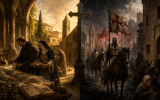
Hospitals, and Holy War: The Church that Blessed Crusades
Medieval Christianity built institutions of mercy while also turning religious authority into an instrument of war, exclusion, and coercion.
THE CHURCH AND THE REPAIR OF THE WORLD
The same medieval church could receive a stranger as Christ, shelter a traveler, nurse a person with leprosy, educate a child—and bless an army marching under the cross. That contradiction makes the period difficult to summarize honestly. Medieval Christianity was neither simply a dark age nor a harmonious Christian civilization. It became both a refuge from suffering and a source of it.
The deeper lesson is not merely that Christian institutions did good and evil at the same time. Their ability to organize compassion and their ability to organize coercion often arose from the same source: extraordinary authority over belief, property, law, and communal identity. The church could use that authority to protect vulnerable people. It could also use it to define outsiders, sanctify violence, and defend its own privilege.
Beginning in the early medieval period, monasteries became some of Europe’s most durable institutions of care. The sixth-century Rule of Benedict joined prayer, work, discipline, hospitality, and communal ownership. Guests were to be received as Christ, with particular concern for poor people and travelers.[1] Monasteries offered food and lodging, cared for sick and elderly people, preserved manuscripts, educated children, cultivated land, and provided relief during famine.
Monastic life challenged parts of the surrounding social order. Wealthy and poor entrants could live under the same rule. Property was held communally, and manual labor acquired spiritual dignity. Women’s religious houses offered some women opportunities for education, administration, and leadership rarely available elsewhere.
Yet monasteries could also accumulate land, wealth, and political influence. Communities founded in voluntary poverty sometimes became major property holders dependent upon rents and peasant labor. The institution that fed poor families might also own the land on which they struggled. The need to preserve and expand the institution could undermine the simplicity that had inspired it.
Hospitals and hospices developed through monasteries, cathedral communities, religious orders, and charitable foundations. The medieval “hospital” was not always a medical institution in the modern sense. Many were houses of hospitality serving poor travelers, pilgrims, people with chronic illnesses, and those nearing death through food, shelter, spiritual care, and varying levels of physical treatment.[2]
Guilds and religious confraternities created additional forms of mutual aid. They collected and distributed charity, helped distressed members, buried the dead, and supported communal religious life.[3] Together, these institutions embodied an important moral claim: individuals and families should not be left to survive every crisis alone.
Medieval theologians and canon lawyers likewise refused to treat economic life as morally neutral. They examined the common good, fair exchange, usury, restitution, ownership, and the duties of rulers. Thomas Aquinas defended private property as useful for orderly administration, but he did not regard ownership as absolute. Because created goods were ultimately intended for the common benefit, a person facing extreme and urgent necessity could take what was required to preserve life.[4]
Beginning in the eleventh century, the Peace of God and Truce of God movements tried to restrain feudal violence by protecting certain people, places, and times from attack. Their reach and enforcement were uneven, but they expressed a significant principle: warfare was not beyond moral judgment.
The related tradition of sanctuary allowed churches and other sacred places to interrupt private vengeance and, in some circumstances, shield people from immediate punishment.[5] Raw power was expected to pause before sacred obligation. Modern sanctuary movements for refugees and threatened migrants draw upon this long, contested religious memory.
The Franciscan movement carried the internal critique of Christian power further. Francis of Assisi embraced voluntary poverty, served people with leprosy, and sought a form of discipleship closer to the poverty of Jesus. Yet the movement’s later disputes over property revealed how difficult it is to preserve a radical charism once it becomes an institution.
Women also created forms of religious life beyond ordinary clerical authority. Abbesses governed large religious houses. Mystics such as Hildegard of Bingen and Catherine of Siena addressed rulers and church officials with unusual freedom. Beguines formed semi-independent communities of prayer, labor, teaching, and service without necessarily entering traditional monasteries or taking permanent vows.[6]
These women did not escape patriarchy. Their influence often depended upon extraordinary claims of spiritual authority in a church that denied women ordinary access to formal leadership. Yet their lives demonstrated that theological insight and Christian leadership had never been confined to those whom the institutional church officially authorized.
Medieval Christianity therefore contained genuine resources for hospitality, economic restraint, peace, and institutional self-criticism. The tragedy is not that the church lacked teachings with which to condemn its own violence. The deeper failure was that it applied those teachings selectively—often protecting those recognized as neighbors while denying protection to people defined as enemies, heretics, or religious outsiders.
The Crusades revealed that failure with devastating force. Church leaders redirected the language of pilgrimage, penance, sacrifice, and spiritual reward toward organized warfare. Crusading armies killed Muslims, Jews, Eastern Christians, and others. Political ambition, material interest, military culture, and religious devotion became intertwined. Violence was no longer merely tolerated as a tragic necessity; it could be presented as sacred duty.
The First Crusade’s violence did not begin only in the eastern Mediterranean. In 1096, crusading bands attacked Jewish communities in the Rhineland, including Speyer, Worms, and Mainz. Pope Urban II had not formally called for the murder of Europe’s Jews, and some bishops, civic leaders, and other Christians tried to protect them. But the massacres were not detached from the religious world that produced the Crusade.[7]
Jews had already been portrayed through centuries of Christian teaching as blind, rejected, collectively responsible for the death of Jesus, or stubbornly resistant to divine truth. Theological contempt became social practice. Jews faced forced sermons, occupational restrictions, expulsions, confiscations, mob attacks, and recurring pressure to convert.
In 1215, the Fourth Lateran Council ordered Jews and Muslims in Christian lands to be distinguished from Christians by their dress. Religious difference was turned into a publicly enforced mark of separation and subordination.[8]
For Jewish readers, this history cannot be treated merely as an internal Christian disagreement. Anti-Jewish theology shaped laws, neighborhoods, livelihoods, and physical vulnerability. It helped create a social world in which segregation and violence could appear righteous.
The Holocaust did not arise directly or inevitably from medieval Christianity. Racial antisemitism was not identical to Christian anti-Judaism. But the long Christian history of portraying Jews as dangerous, cursed, disloyal, or collectively guilty supplied ideas, stereotypes, and habits of exclusion that later antisemites could exploit.[9]
Christian repair therefore requires more than regret for episodes of violence. It requires identifying and rejecting the teachings, liturgies, biblical interpretations, and institutional interests that allowed violence against Jews to be imagined as faithfulness to God.
Theology becomes social action whenever beliefs about another community determine whose dignity is recognized, whose testimony is trusted, whose freedom is restricted, and whose suffering is tolerated.
The church also turned coercive power against Christian dissenters. Beginning in the late twelfth and early thirteenth centuries, inquisitorial systems developed to investigate and suppress heresy. Ecclesiastical judgment became entangled with secular punishment, including imprisonment and execution.[10] The institution that proclaimed a crucified Messiah used the coercive power of the state to preserve doctrinal unity.
Care and coercion were not unrelated accidents. They were competing uses of institutional power. The same authority that could mobilize land, labor, money, law, and belief to build hospitals could mobilize those resources to prosecute dissenters or bless war.
Indeed, charitable work could strengthen the church’s moral legitimacy without requiring it to examine the injustice produced by its theology, wealth, or political alliances. The church could become highly effective at treating suffering while remaining implicated in its causes.
That danger remains recognizable. A modern church may operate a food pantry while opposing affordable housing or wage policies that would reduce the need for emergency food. A religious institution may offer sanctuary to threatened migrants while remaining silent about laws that make their lives precarious.
Service matters. People are genuinely fed, sheltered, educated, and healed through religious institutions. Charity should not be dismissed merely because the institution providing it is compromised. But neither should charitable achievement be used to excuse violence or protect an institution from moral scrutiny.
Mercy that treats suffering only after it occurs can coexist comfortably with the systems that keep producing it.
The medieval record therefore complicates the assumption that charitable institutions are automatically just. Hospitals, schools, monasteries, and religious orders can preserve dignity. They can also become paternalistic, coercive, wealthy, or financially self-protective. Longevity is not proof of faithfulness, and beneficial programs do not cancel injuries committed elsewhere in an institution’s life.
The period’s reformers and mystics preserved an indispensable source of criticism. Francis, Hildegard, Julian of Norwich, Catherine of Siena, the Beguines, and others insisted that encounter with God should transform how Christians perceived wealth, creation, suffering, and neighbor.
Yet prophetic voices can be celebrated symbolically while their challenges are ignored institutionally. A church can honor Francis while accumulating wealth, quote its mystics while silencing women, and preach the crucifixion while continuing to stigmatize the Jewish people.
The measure of Christian faithfulness is not merely how much suffering the church relieves. It is whether the church is willing to surrender the teachings, privileges, and political alliances that help produce suffering.
The medieval question remains contemporary: Is the church merely relieving pain inside an unjust order, or is it also willing to examine how its own theology, wealth, and power help maintain that order?
Citations and Sources
[1] The Rule of Saint Benedict, chapter 53, “The Reception of Guests.”
[2] Sethina Watson, “Hospitals in the Middle Ages,” Oxford Bibliographies in Medieval Studies.
[3] Joseph P. Byrne, “Guilds,” Oxford Bibliographies in Medieval Studies; Gervase Rosser, The Art of Solidarity in the Middle Ages: Guilds in England, 1250–1550.
[4] Thomas Aquinas, Summa Theologiae, II-II, question 66, especially articles 2 and 7.
[5] R.H. Helmholz, The Law of Sanctuary; “Truce of God,” on the Peace of God and Truce of God traditions.
[6] Walter Simons, Cities of Ladies: Beguine Communities in the Medieval Low Countries, 1200–1565; Sigrid Hirbodian, “Religious Women: Secular Canonesses and Beguines.”
[7] Robert Chazan, In the Year 1096: The First Crusade and the Jews; Judith Bronstein, “The Crusades and the Jews: Some Reflections on the 1096 Massacre.”
[8] Fourth Lateran Council, Canon 68, 1215.
[9] United States Holocaust Memorial Museum, “Antisemitism in History: From the Early Church to 1400.”
[10] Treccani, “Inquisizione,” section on the medieval Inquisition.