


Stephen J Stern PhD
The Church, the Jews, and the Struggle for Authority
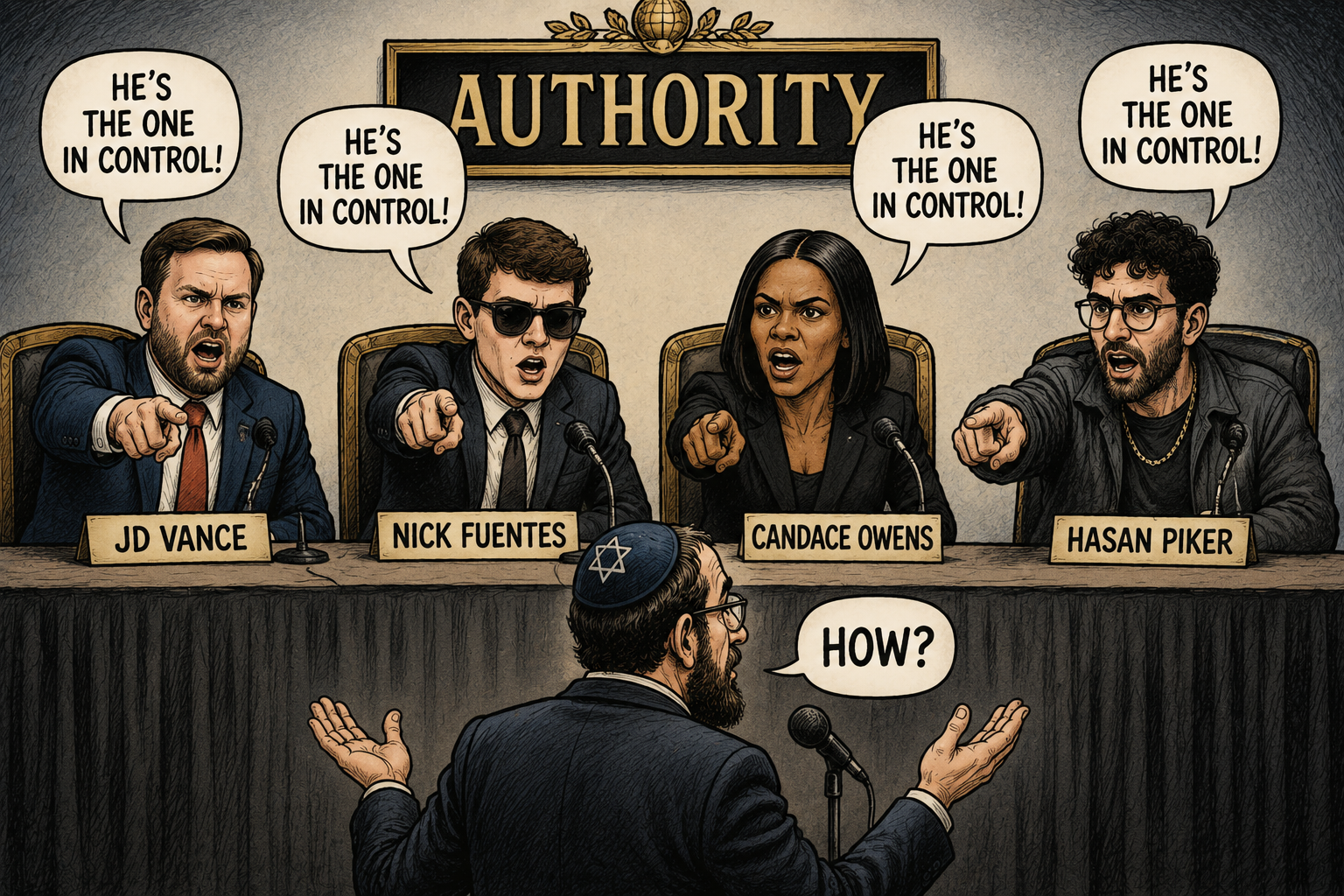
Image created by author with AI.
This is the third essay in my series on contemporary antisemitism. This essay traces one of the historical roots of contemporary antisemitism.
For much of Christian history, the Catholic Church saw Judaism as a theological challenge and reminder of Christianity’s origins. Christians believed Jesus fulfilled the promises of the Hebrew Bible, yet the people who both wrote and preserved those scriptures rejected both the Christian reading of the Hebrew Bible and the claim that Jesus is the Messiah. From a Jewish perspective, Jesus was neither the Messiah nor God incarnate. Judaism awaited a fully human Messiah and rejected the Christian claim that God had become human.
To church leaders, that was more than a disagreement. It challenged Christianity’s claim to possess the fullness of God’s truth. If Christianity fulfilled Judaism, why did so many Jews not convert? The answer for church leaders shaped centuries of Catholic hatred toward Jews. It justified efforts to convert them, inspired persecution and murderous violence against them, and eventually became part of a much larger struggle over authority itself. That struggle continues to inform contemporary movements such as Project 2025.
When societies struggle over authority, Jews are repeatedly imagined as the hidden possessors of that authority.
By the Middle Ages, church leaders assumed the obstacle to conversion was the Talmud, not the Hebrew Bible. The Talmud, which Jews identify as their oral Bible, is the collection of discussions and interpretations of Jewish law that shaped Jewish practice, communal life, and the way Jews understood scripture itself. Church leaders believed it had led Jews away from recognizing Jesus as the Christ. If its authority could be discredited, Judaism itself would collapse and conversion would follow. The struggle with Judaism had become part of a larger struggle over authority. Who determines religious truth for Jews? The Church? Rabbinic tradition? Reason? The individual? That question would change form over the centuries, but it would never disappear.
In 1263, Pablo Christiani, a Jewish convert to Catholicism, stood at the center of that effort. The Dominicans embraced him as proof that Judaism could be defeated from within. King James I of Aragon ordered the Barcelona Disputation at the urging of his confessor, the Dominican friar Raymond de Peñafort, who believed Christiani’s knowledge of the Talmud would allow him to dismantle rabbinic Judaism publicly.
There was one problem. No Jew wanted to debate. Earlier disputations ended with the Jewish representative executed for blasphemy and murderous violence brought against Jewish communities. Only after King James personally guaranteed Rabbi Moses ben Nachman, the Ramban, freedom of speech did he agree.
The plan failed. The Ramban overwhelmed Christiani with his command of the Talmud. King James, it was noted, admired his reasoning. Nevertheless, the Ramban was charged with blasphemy and forced into exile.
Christiani failed to persuade Spain’s Jews to convert. The disputation nevertheless brought renewed suspicions to Jewish communities while reinforcing the conviction that Judaism remained a problem to be solved.
Conditions deteriorated over the following century. Jews were blamed for the Black Death. Ironically, Jewish laws emphasizing ritual hand washing likely contributed to lower mortality rates, making them appear suspiciously spared. The hostility toward Jews erupted in 1391 as anti-Jewish riots and massacres swept across Spain. Fifty thousand Jews were murdered. Many survivors converted to Christianity. They became known as Conversos, yet conversion did not erase suspicion. Former Jews remained objects of distrust and targets of violence.
The real issue had never been conversion alone. It was authority. Could Jews continue to reject Christianity and remain Jews? Or did the Church possess the authority to determine the proper religious destiny of every soul?
That question was answered in 1858.
Six-year-old Edgardo Mortara was taken from his Jewish parents in Bologna after church authorities learned that a servant girl had secretly baptized him during a serious illness. Fearing he would die, she baptized him so his soul might reach heaven.
Edgardo’s parents fought relentlessly to bring him home. The Rothschild family intervened. Newspapers across Europe and the United States turned the case into an international controversy. Governments protested. To the liberal world, the affair showed that the Church had placed ecclesiastical authority above parental rights and what many regarded as natural rights.
Pope Pius IX refused to return Edgardo. From his perspective, baptism had permanently changed the boy’s relationship to God. Returning him to a Jewish household would deny God’s will. Mortara eventually became a Catholic priest, while his family spent years unsuccessfully trying to bring him home. His case was not unique. Church authorities had removed other secretly baptized Jewish children from their families as well.
The Mortara Affair exposed a bigger conflict than one family’s tragedy. The issue was no longer whether Jews should convert. It was now a question of political authority. Did the Church stand above parents? Above the individual? Above the modern state? Pius IX believed it did. He was simultaneously fighting to preserve the Papal States while watching liberalism reshape Europe around him.
The same intellectual movement that championed constitutional government, freedom of conscience, and individual rights also challenged the Church’s traditional understanding of its own authority.
Pius IX was not responding simply to Edgardo’s kidnapping. He believed the modern world itself threatened the Church. Liberalism, constitutional government, nationalism, capitalism, and expanding notions of individual liberty transferred authority away from the Church and toward individual conscience and secular governments. If individuals became the judges of truth, the Church could no longer fulfill the role God entrusted to it.
For Pius IX, this required more than condemning liberalism. It required defining the Church’s authority. He convened the First Vatican Council in 1869.
Vatican I sought to answer liberalism with theological clarity. Dei Filius rejected the claim that reason alone explained all truth, insisting that divine revelation remained indispensable. Pastor aeternus defined papal infallibility, reinforcing the authority of the papacy at precisely the moment its earthly authority was slipping away. These were not simply theological declarations. They were the Church’s response to a changing political order that located authority in the individual citizen and the modern nation-state. Vatican I insisted that there remained one realm in which the Church alone possessed final authority.
The struggle over authority did not end with Vatican I. It continued into the twentieth century. Faced with the perceived threats of both liberal democracy and communism, church leaders regarded authoritarian governments as better defenders of religion, family, and social order than liberal democracies. That calculation shaped the papacy of Pius XII during the Second World War.
Historians continue to debate Pius XII’s inaction during the Holocaust. His silence regarding Nazi atrocities, particularly the genocide of European Jewry, remains one of the most contested questions in modern Catholic history. At the same time, however, he privately directed many convents and other Catholic institutions to shelter Jewish children, helping save thousands of lives. The combination of public silence and private rescue continues to divide historians over how his papacy should be judged.
After the war, the Church chose a different path. Pope John XXIII convened the Second Vatican Council. Vatican II transformed the Church’s relationship with Judaism. It rejected the charge that the Jewish people were responsible for the death of Jesus, condemned antisemitism, and called for respect and dialogue between Catholics and Jews, marking a willingness to engage the modern world rather than oppose it.
The Church did not abandon its theology, but it fundamentally altered its relationship to religious liberty, democracy, and those outside the Catholic faith.
Not every Catholic welcomed that change. For many traditionalists, Vatican II represented accommodation where there should have been resistance. They continued to argue that liberalism, individual autonomy, and secular understandings of society weakened Christianity by relocating moral authority from the Church to the individual.
Over the decades that followed, those ideas developed into broader critiques of liberal democracy itself. Some Catholic thinkers argued that modern constitutionalism, individual rights, and secular government had not simply weakened Christianity but had displaced it as the organizing principle of public life. They called instead for recovering a more Christian understanding of law, politics, education, and culture. These arguments have taken different forms, from Catholic integralism to other post-liberal movements, but they share a concern that liberalism undermined both religious authority and the moral foundations of society.
Those debates did not end with Vatican II. They remain alive today, reappearing in contemporary Catholic intellectual movements and among influential Catholics associated with the Heritage Foundation and Project 2025. Whether one agrees with those movements or not, they are best understood not as isolated political developments but as the latest chapter in a centuries-long struggle over who possesses the authority to define truth, shape society, and govern moral life.
That history also helps explain why antisemitism so often reappears during periods of political, economic, cultural, and religious uncertainty. The specific accusations against Jews change with time. Medieval Christians accused Jews of rejecting Christ, clinging to the Talmud, stealing money, practicing dark magic, and countless other offenses. Modern antisemites accuse Jews of promoting globalism, secularism, financial power, orchestrating the Great Replacement conspiracy, or liberalism. Again and again throughout Christian history, Jews become symbols in larger arguments about who should shape society, whose moral vision should prevail, and who secretly exercises the very political, economic, and religious authority they themselves were repeatedly denied. Understanding that continuity does not explain every form of contemporary antisemitism, but it does highlight one of its oldest and most enduring intellectual traditions.
The irony is hard to miss. The struggle was always over authority, yet Jews were repeatedly accused of secretly possessing the very political, economic, and religious authority they were denied.
To understand contemporary antisemitism today, we must see the recurring struggle over who possesses political, economic, religious, and moral authority to define truth and shape society. Again and again, Jews were blamed for secretly exercising the very authority they never possessed.