

The City My Father Lost — Part III
VI. Among the Stones
“The dead ask very little. Only that the ground be permitted to receive them.”
The Zentralfriedhof is enormous, and the Jewish sections are at the far gates, and the taxi driver had to be given the gate number twice.
Marcus and Katharina Klein are buried there. They are my mother’s people, and their claim on this book is different from the Ungars’: they were not deported. They died in Vienna, in their beds or in a hospital, in years when a Jew in Vienna could still expect a funeral, a plot, a stone, a name cut into it, and a family that would come.
I want to insist on how extraordinary that is, and how badly we are equipped to see it.
For most of my adult life I would have said that a Jewish cemetery in Vienna is a sad place. It is not. It is the least sad Jewish site in the city, and it took me an afternoon among the graves to work out why: because in a cemetery the ordinary sequence held. Someone died. Someone washed the body and said the words. Someone bought a plot and commissioned a mason, and the mason cut the letters, and the family came back on the yahrzeit and put a stone on the marker to say I was here. The whole apparatus of return functioned exactly as it was designed to.
Nothing else in this essay can say that.
The older sections are half-wild now — ivy through the plots, saplings pushing the kerbstones apart, whole rows tilting, some stones face down in the leaf litter and unreadable. The families who maintained them were murdered. That is the actual sentence, and I will not soften it: these graves are neglected because the people whose obligation it was to visit them were gassed, and there is nobody left to weed.
And yet the neglect is not desecration. There is a difference, and standing among those stones I felt it as a physical distinction. The ivy is not an insult. The ground is doing what ground does. There is a mitzvah — kisui ha-dam, the covering of the blood — which requires that the blood of a slaughtered creature be covered with earth by a human hand, and which I have argued at length is one of the most theologically loaded gestures the Torah legislates: the deliberate return of the nefesh to the adamah that is capable of receiving it. What the crematoria accomplished was the precise inversion of that gesture. An industrial anti-covering. Ash dispersed too fine to be received by any ground, buried by no hand, and therefore — this is the piece that post-Holocaust theology has still not metabolised — unable to cry out from the earth as Abel’s blood cried, because there is no earth holding it.
Marcus and Katharina were covered. Earth took them. A stone says so. I was thrilled to be present — awed, privileged to have found them, thanks to Motty Hammer, the Chevra Kadisha askan.
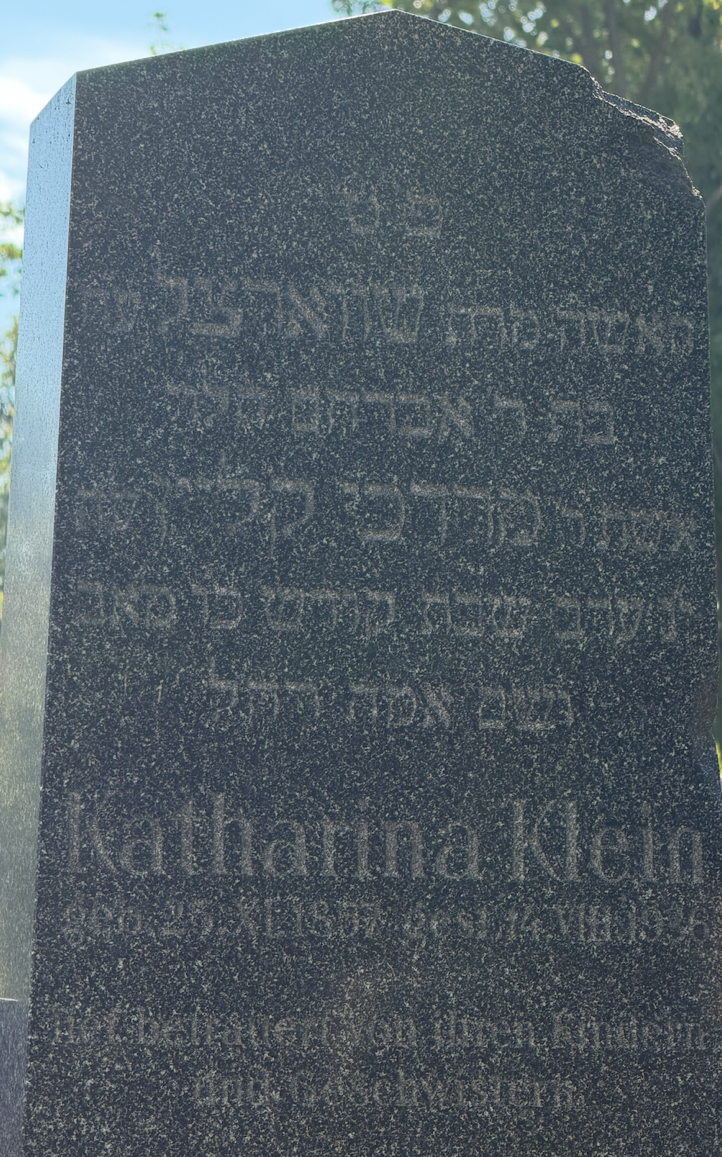
Katharina Klein’s gravestone, Zentralfriedhof. (Julian Ungar-Sargon, July 2026)
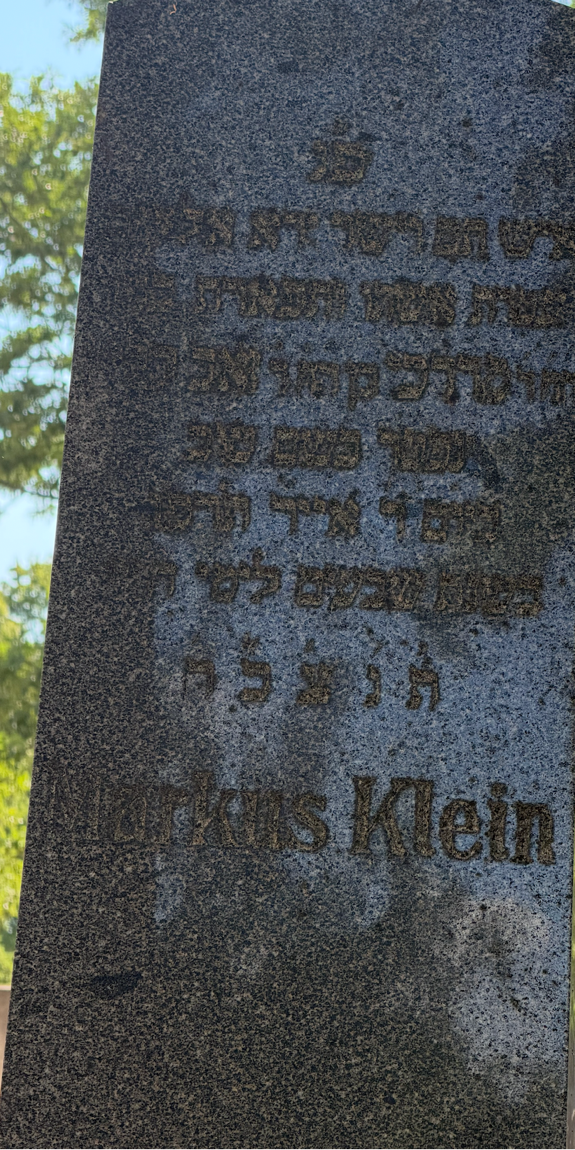
Marcus Klein’s gravestone, Zentralfriedhof. (Julian Ungar-Sargon, July 2026)
Sarah put a pebble on each. This is what one does; the gesture is old and its origins are disputed and the explanations offered for it are mostly retrofitted. I have no theory of it that satisfies me. What I can report is that placing a small stone on a grave is one of the few religious acts she performed that felt entirely unfraudulent — because it makes no claim. It does not assert that the dead persist, or that God is just, or that anything is redeemed. It says only: a person stood here. Someone came.
That is the whole content of the gesture, and it is enough, and it is the only theology I found in Vienna that I could sign.
VII. The Wall of Names
“The journey began with an address. It ended, as such journeys do, with a name — and with the discovery that the name was already there, waiting, correctly spelled.”
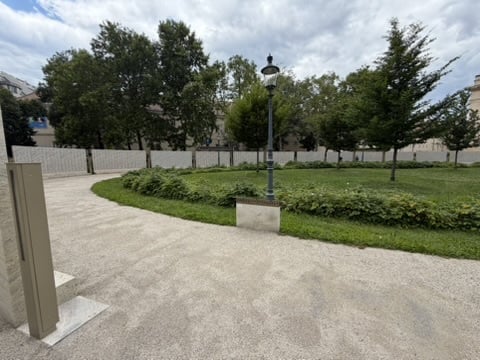
The Shoah Wall of Names stands in the Ostarrichi Park, behind the National Bank, in a quiet green square that most tourists pass without entering. It was inaugurated on the ninth of November 2021 — eighty-three years to the day. It carries the names of more than sixty-four thousand Austrian Jews murdered between 1938 and 1945, cut into stone panels that run in a long oval around the lawn.
Shoah Wall of Names Memorial, Ostarrichi Park, Vienna. (Julian Ungar-Sargon, July 2026)
It is beautifully done. I want that on the record before I say anything else, because what follows may read as ingratitude and is not. The proportions are right. The material is right. The lettering is legible and dignified and small enough that you must approach. The grass is cut. The whole thing is exactly as good as such a thing can be, and it was made by Austrians, with Austrian money, after eight decades in which it was not made.
The names are alphabetical. You walk the oval reading surnames going by in their thousands — a scale which the mind refuses at about the fourth panel and thereafter processes as texture rather than as text, which is itself worth noticing and which every designer of such a memorial must contend with — and then you arrive at the U’s, and there is a block of them.
JULIUS UNGAR
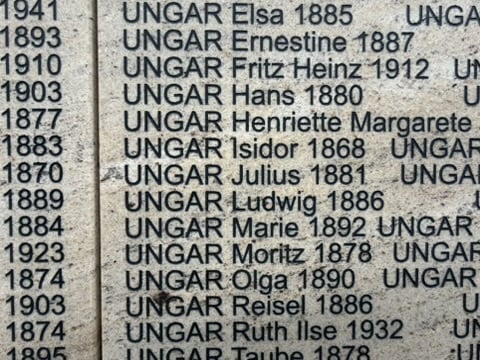
UNGAR Julius 1881, among the Ungar names on the Wall of Names. (Julian Ungar-Sargon, July 2026)
There are dozens. Ungar Elsa 1885. Ungar Ernestine 1887. Ungar Fritz Heinz 1912. Ungar Hans 1880. Ungar Henriette Margarete 1877. Ungar Isidor 1868. Ungar Marie 1892. Ungar Moritz 1878. Ungar Olga 1890. Ungar Reisel 1886. Ungar Ruth Ilse 1932 — she was nine or ten. Column after column of a name that is not rare, borne by people most of whom were not related to me, all of whom were killed by the same administration for the same reason.
And in the middle of them:
Ungar Julius 1881
My grandfather. Born in Nádszeg on the first of April 1881. In Vienna since 1904. Marchettigasse 1, apartment 10. The man whose handwriting I had looked at days earlier on a screen in an archive, who filled in the emigration questionnaire in his own hand, and who did not emigrate.
I had known the name would be there. I had come specifically to see it. I had, in some sense, come to Vienna for this. And I discovered, standing in front of it, that knowing a thing and reading it cut in stone at chest height in an ordinary park on a warm morning are different operations performed by different parts of a person.
What I felt was not grief. I want to be exact, because the false note here would be easy and would ruin the book. It was closer to recognition of correctness. There was his name, spelled properly, with the right year, in the right alphabetical position, among his neighbours. The record was accurate. The state that murdered him had recorded him precisely, and the state that succeeded it had now, at very long last, transcribed the record into stone and planted grass around it and put in benches. But where were his wife Regina and aunt Alice? Missing. I frantically searched for their trace too. After all, Dad left them on a cold morning in 1938 at the Vienna Bahnhof where the Kindertransport train was waiting.
And that is the moment the word arrived that I had been circling for days.
Betrayal
Not hatred. Hatred would have been simpler, and I could have managed it. Had Vienna been a brutal city, filthy, crude, a place of mobs — then the twentieth century could be filed under savagery, and I could walk out of the park with my categories intact.
But this is the city of Mozart and Mahler and Freud. Of the finest medical faculty in Europe, in which my own profession was largely invented. Of jurists, of civil servants who knew exactly which form belonged in which file — and who used that competence, in the afternoon, to catalogue their neighbours. The betrayal is not that civilisation failed to prevent barbarism. It is that civilisation opened the door, in good order, with the correct paperwork, and then, eighty years later, commissioned a memorial of impeccable taste.
I stood in that park and could not decide whether the wall was an act of repentance or the final act of administration — the last field completed in a very long form. I still cannot decide. I have concluded that not deciding is the honest position and I intend to hold it.
What I will say for the wall is this, and it is not small. The crematoria were designed to make the covering of blood impossible: to reduce a person to a dispersal that no ground could receive and no hand could bury. My grandparents have no grave. There is no earth anywhere on this planet that holds them, no plot, no yahrzeit stone, no place where a pebble can be set down.
Sixty-four thousand names cut into stone in a park in Vienna do not repair that. Nothing repairs that. But it is the nearest thing to a covering that the twentieth century permits: a hard surface that will hold a name for a few hundred years, at a fixed location, which a descendant can travel to and stand in front of and touch.
I touched it. I put my hand flat on the panel over his name, which is the closest I will ever come to putting a stone on his grave.
Then I went and sat on a bench and watched a young couple cross the park with coffee, laughing about something, entirely at ease, not glancing at the wall, which is what the wall is for — it is for them not to have to look, and for me to be able to.
VIII. Departure
“Some journeys end at the airport. Others merely change their means of transport.”
On the last morning in Vienna, I walked the Ringstrasse, which gleams, and heard church bells over a quiet Sunday, and passed cafés where the pastries are perfect, and felt the recoil I had been feeling for some days and had by then stopped apologising for.
They did not do it. The waiter did not do it. He was born in 1998. The students on the Graben under the lindens did not do it. The woman who sold me a newspaper did not do it, and her grandmother may well have hidden someone, or may have watched the Ungars’ neighbours being loaded into trucks and gone back inside to finish the soup, and I have no way to know and no right to guess.
History demands these distinctions and justice depends on them, and I hold them, and the body does not practise historiography. Something in me recoiled from the elegance for eleven days and is recoiling still, at a desk in Indiana, writing this.
There was an ugly thought during that last walk, and I am going to put it in the book because leaving it out would falsify the record. The thought was: have I made Viennese-ness itself unclean? The coffee, the language, the architecture, the faces of the young — have I let memory contaminate beauty, and is that not a reverse of their own obscenity, the fantasy that guilt travels in blood down the generations?
No. The category is theirs and I refuse to borrow it. Guilt does not travel in blood; that was the premise of the people who murdered my grandfather and I will not adopt their metaphysics to grieve him.
But I will not pretend that beauty is innocent either.
What is left, when you refuse both, is narrower and harder than either. It is neither hatred nor forgiveness. Forgiveness is not mine to give — I am not the injured party; the injured party is a name on a wall — and the demand that the third generation supply it is a demand I have come to regard as an imposition. And hatred is unavailable to me because it requires a defendant and everyone in this city is innocent.
So: not hatred, not forgiveness. Something more difficult, for which I have no single word after eleven days and a year of writing. The nearest I can put it is a refusal to be consoled combined with a refusal to desecrate. I stand in front of this beautiful clean city and will do neither.
Vienna remains beautiful. That is precisely the wound.
I came looking for my father’s city. I want to answer, finally, the question I set myself on the first evening: was the Vienna of his stories real at the density he gave it?
Yes. That is the answer, and it is not the comforting one. The street is there. The staircase is there. The eight-minute walk to shul is exactly eight minutes. The coffee is as good as he said. The Kultur he taught us to revere is not an exile’s exaggeration; it is, if anything, more impressive in person than in his account of it, because in his account there was always the defensive insistence of a man arguing for a world nobody else could see.
He was not embellishing. He was reporting. And the world he was reporting was worth everything he claimed for it, and it opened the door and let them take his father.
That is what I brought back. Not a reconciliation. A corroboration of the loss at full scale, which is heavier than the loss described.
I think he carried all of this in a complicated goulash of competing ideas he wished not to load onto his children. He wanted to transmit the Kultur without the trauma, but the seams at times split open — like the day in 1961 when he faced his father’s front door, and we watched in agony as he broke down.
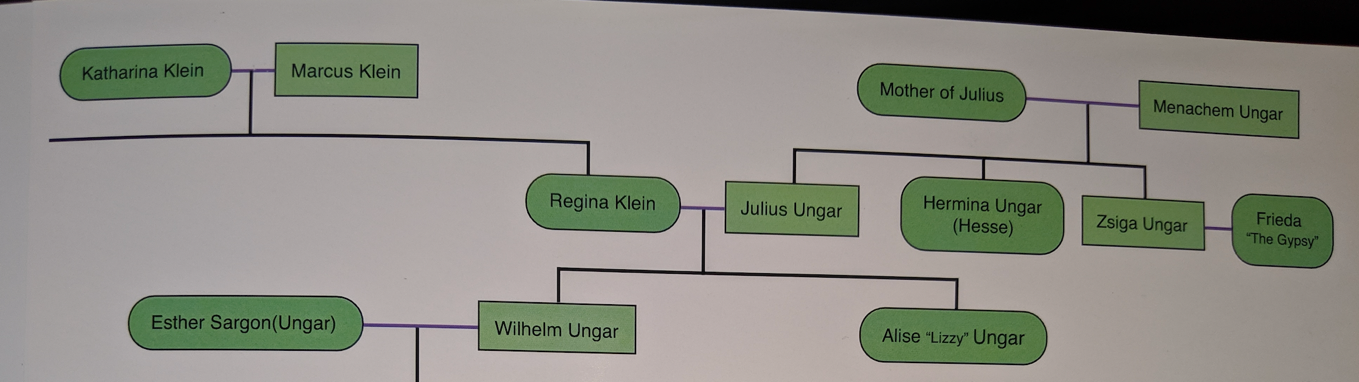
The family tree. (courtesy of Julian Ungar-Sargon)
For My Children
One day these photographs will be yours, along with the problem of what to do with them.
You will not live in Vienna. You may never learn German. You will know these streets, if you know them at all, through these pages, and through whatever your own children eventually make of the fact that they had a great-great-grandfather with a Hungarian birthplace and no grave.
I want to tell you two things and then stop.
The first is that they were people before they were victims. Julius Ungar was a man who came from a village to a city at twenty-three and made a life there for thirty-four years — a marriage, a household, a walk to shul on Saturdays, opinions about the tram service, disappointments I know nothing about, satisfactions I know nothing about. He is not principally a person to whom something was done. He is principally a person who lived, and who was then killed, and the order of those clauses matters more than almost anything else in this book.
The second is harder, and I have thought about whether to give it to you, and I am giving it to you.
Do not accept a consolation you have not earned. There is a version of this story that ends with continuity, with the assurance that if we remember them, they are somehow still here. I have written that sentence myself in earlier drafts and I have taken it out. They are not still here. They were killed, and the killing worked, and the whole of it — a family, a district, a civilisation of Jewish Vienna — is gone and will not be restored by anybody’s remembering.
What remembering does is smaller and it is not nothing. It puts a hand on a stone. It says: someone came. It refuses the second death, which is the one that happens when the last person who knows the name stops saying it.
That is what we did in Vienna in July, and it is what I am asking of you, and it comes with no promise attached.
In memory of Wilhelm Ungar, who carried this city for the whole of a long life after it stopped carrying him; and of Julius Ungar, born Nádszeg 1881, of Marchettigasse 1, who has no grave.
Part III of a three-part series.