
Writing as P. Mordechai on Faith and Israel
The Clavicular Mistake and the Four Sons of Antisemitism
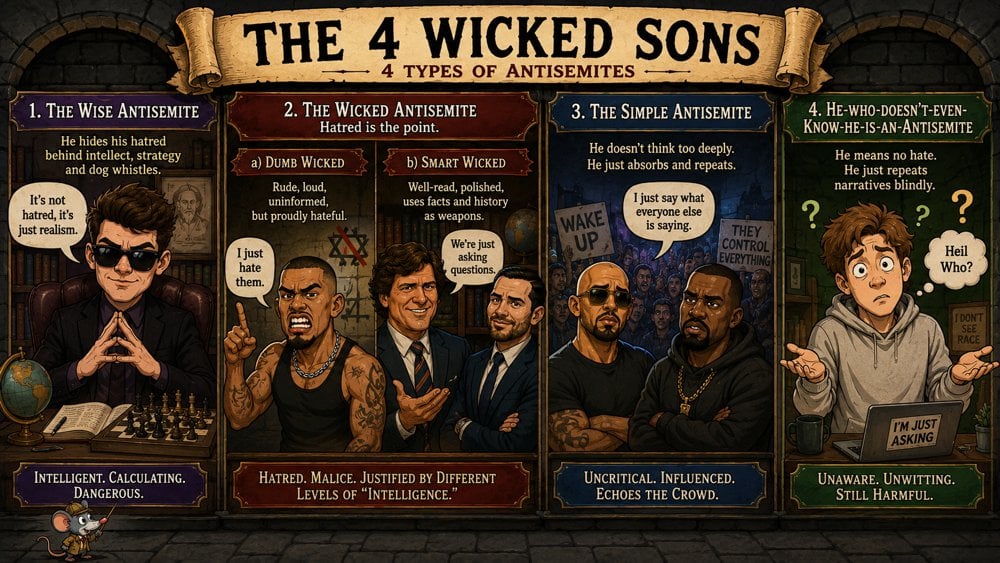
Photo Credit: Yossele Golem, thejewishedition.com, used with permission.
The recent Clavicular controversy has produced a lot of outrage, a lot of commentary, and, in my opinion, a lot of confusion.
For those who have not followed the story, Clavicular is an online influencer whose brand is built largely around shock value, looksmaxxing culture (yes, it’s exactly what it sounds like), livestreaming, and viral controversy. He recently came to Israel and was welcomed, filmed, and promoted by some Jewish and pro-Israel influencers.
That alone would not necessarily be a scandal. Israel has hosted many strange visitors before.
The problem is that Clavicular has a public record of highly offensive content and associations, including content that many Jews understandably view as antisemitic. Videos and clips circulated of him around Nazi references and Holocaust-related mockery, and his visit to Israel quickly became a fight among Jewish influencers: Was this a chance to educate and transform him? Was this a disgraceful platforming of someone who had mocked Jews? Was this smart hasbara? Or was Israel simply being used as a prop in someone else’s viral content machine?
That is where I think most of the commentary has gone wrong.
Most of the influencers commenting on the story are making the same basic mistake: they are lumping all antisemites together.
But not all antisemites are created equal.
In fact, borrowing from the structure of the Four Sons in the Pesach Haggadah, I think there are four different types of antisemites.
There is the Wise Antisemite.
This is the ideological antisemite. He has read the books, studied the theories, learned the language, and built a worldview around Jew-hatred. He knows what he believes. He knows what he is saying. He may dress it up as politics, theology, sociology, anti-Zionism, or “just asking questions,” but underneath it all is a coherent, deliberate hostility toward Jews.
Then there is the Wicked Antisemite.
This is not always the deepest thinker, but he is malicious. He knows that attacking Jews gets attention, power, clicks, followers, or money, and he uses it. Some of these people are dumb wicked. Others are smart wicked. But the core is the same: they understand enough to know that what they are doing is harmful, and they do it anyway.
Then there is the Simple Antisemite.
This is probably the most common category. He repeats slogans, memes, conspiracy theories, and half-digested talking points without really understanding where they come from. He has absorbed the atmosphere. He knows that “the Jews” are somehow supposed to be blamed for something, but he could not explain the history, theology, or ideology behind his own accusations. He is not innocent, but he is also not the mastermind.
And then there is the rarest category of all: the One Who Does Not Even Know He Is an Antisemite.
That, I believe, is where Clavicular fits.
Let me be clear: this does not take him off the hook.
A person does not need to understand two thousand years of Jewish suffering in order to know that Hitler, may his name be erased, is evil. He does not need to be a historian to know that Nazi imagery and Holocaust mockery are not harmless jokes. If he wanted to offend people for attention, then he bears responsibility for that. If he wants to make amends, he owes people a real apology.
But the category matters.
Because if you misdiagnose the problem, you will misdiagnose the response.
Many Israelis, and Rabbi Shmuley Boteach as well, seem to view almost every public antisemite as the Wicked Son. From that perspective, the answer is obvious: why would Israel host such a person? Why would Jewish influencers embrace him? Why would anyone give him legitimacy?
That response makes sense if Clavicular is the Wicked Son.
But I do not think that is quite what he is.
Others, like Yossi Farro, seem to view almost every antisemite as the Simple Son. In that model, the answer is also obvious: bring him in, show him love, feed him cholent, let him meet real Jews, let him experience Shabbos, and maybe he will change.
That approach may work with some people. There are certainly people who have absorbed antisemitic nonsense and can be moved by actual human contact. There are people who repeat ugly things because they are ignorant, not because they are committed enemies of the Jewish people.
But again, that only works if the person is truly the Simple Son — confused, misled, but still reachable.
Clavicular does not seem to fit that category either.
Then there is the Lizzy Savetsky approach, which is the hardest to explain because it is more nuanced. Lizzy certainly understands that the Wicked Antisemite exists. She has built much of her public platform around fighting antisemitism and defending Israel. She knows that Jew-hatred is real. She knows that there are people who cannot simply be loved out of it.
But in the Clavicular case, she seems to represent a different instinct: the hasbara instinct.
This is the belief that even controversial public figures can sometimes be useful if they are brought close, shown Israel, exposed to Jews, and then sent back to their audiences with a more positive impression. It is not exactly the cholent theory, and it is not exactly the facts-and-debates theory either. It is more of a PR theory: if someone has an audience, maybe we can use that audience. If he is trending, maybe Israel can benefit from the trend.
This failed form of hasbara has been around long before the State of Israel. Jews have been trying for centuries to win over powerful outsiders by proving that we are normal, moral, useful, loyal, intelligent, attractive, and misunderstood.
Sometimes facts matter. Sometimes PR matters. Sometimes relationships matter.
But the hasbara instinct often makes the same mistake: it assumes the problem is a lack of positive exposure. It assumes that if we just show Israel well enough, the person will understand.
But what if the person is not looking to understand?
What if he is not interested in Jews, Israel, history, morality, repentance, or truth?
What if he is just looking for content?
That is where I think the Clavicular story becomes clearer.
My read is that Clavicular probably could not even explain what antisemitism is. I am not convinced he hates Jews in any serious ideological sense. He does not appear to be a disciplined Jew-hater with a worldview. He does not seem to be coming to Israel because he has discovered Zionism, Jewish history, or the truth about our people.
When asked why he came to Israel, his answer was essentially that Israel is trending.
That should tell us everything. He is not here to repent. He is not here to become Jewish. He is not here to help Israel. He is not here to give Jews a great hasbara victory.
He is here because Israel is useful to him and that is why everyone is wrong.
He is not necessarily the Wicked Son in the classic sense, such that the entire issue is simply: “How dare we let an antisemite into Israel?”
He is not the Simple Son either, waiting to be redeemed by a bowl of cholent and a warm Shabbos table.
And he is certainly not the Wise Son, ready to be persuaded by facts, history, and moral argument.
He is the son who does not even know what he is doing — but still knows enough to know that outrage works.
And that may be the most modern category of all.
In the age of social media, not every offensive public figure is an ideologue. Some are worse in a different way. They are empty provocateurs. They do not believe deeply. They do not think deeply. They do not care deeply. They simply understand that if they touch the most painful subjects in the most vulgar way possible, the algorithm will reward them.
That is why the question of whether he “really hates Jews” may not be the most important question.
The better question is: why is Israel allowing itself to be used as a prop in someone else’s spectacle?
That is where I would draw the line.
I would not say Clavicular should be barred from Israel because he is some grand ideological enemy of the Jewish people. I am not convinced he rises to that level. But I also see no reason for Jews, Israelis, or pro-Israel influencers to help him use Israel as a backdrop for a disgusting and immoral online brand.
There is a difference between kiruv and being used. There is a difference between forgiveness and foolishness.
There is a difference between showing Jewish warmth and handing someone a camera, a platform, and a kosher stamp of approval while he turns our country into content.
The Four Sons framework helps because it reminds us that different people require different responses.
The Wise Son gets answers.
The Wicked Son gets confrontation.
The Simple Son gets education.
The one who does not even know how to ask gets an opening.
But Clavicular is something slightly different. He is not a child at the Seder table looking for meaning. He is an internet personality chasing attention.
And that means the response should not be outrage alone, or love alone, or facts alone, or PR alone.
We do not need to pretend he is the greatest threat to the Jewish people. We also do not need to pretend he is a misunderstood soul on a journey toward truth. And we definitely do not need to pretend that every viral visitor to Israel is a hasbara opportunity.
Sometimes a person is not an enemy. Sometimes he is not a friend.
Sometimes he is simply using you.
Clavicular came because Israel is trending.
Jews should be wise enough not to confuse that with the possibility of friendship.
Related Topics
Related Posts