
Professional Indian author and strategic affairs writer.
The Collateral Damage of American Exceptionalism
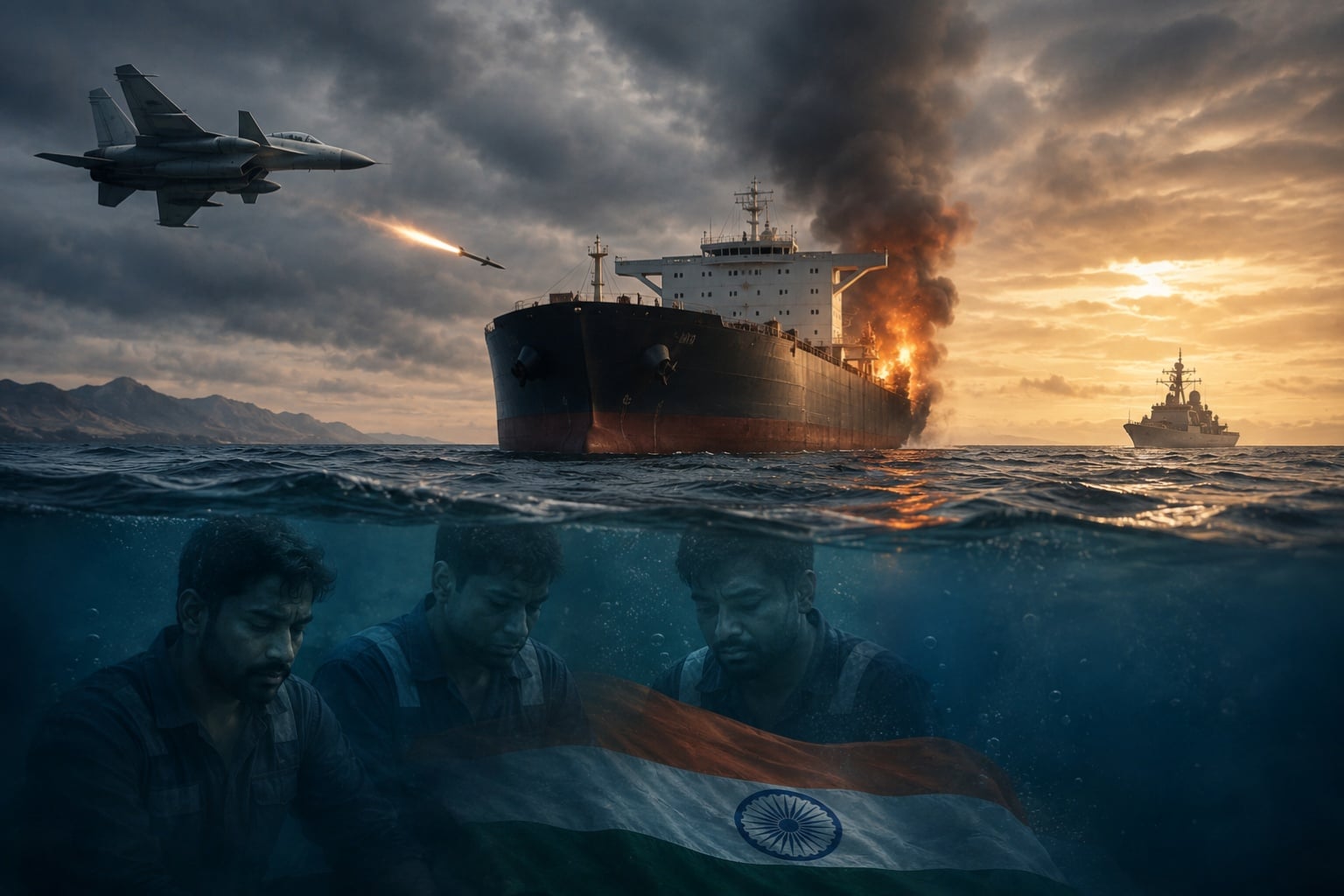
Conceptual illustration: A merchant vessel engulfed in flames in the Gulf of Oman symbolizes the human cost of escalating geopolitical tensions and military actions at sea. Image: AI-generated (free for commercial use).
The illusion of the Indo-US strategic partnership is currently burning in the waters of the Gulf of Oman. We spent the last decade convincing ourselves that Washington viewed New Delhi as an equal partner. We signed defense pacts, conducted joint naval exercises, and smiled for photographs at bilateral summits. That diplomatic fantasy evaporated the moment the US military decided to fire precision munitions into commercial ships manned by Indian citizens.
Between June 8 and June 11, 2026, American forces disabled three separate merchant vessels carrying Indian crew members: the MT Marivex, the MT Settebello, and the MT Jalveer. The most tragic of these incidents occurred on June 10, when an American aircraft fired precision missiles into the engine room of the Palau-flagged MT Settebello. That unilateral military action killed three Indian sailors. The deceased men were Patnala Suresh, a chief engineer; Aditya Sharma, a deck cadet; and Shivanand Chaurashiya, a fitter. They were working-class professionals keeping global trade functioning. Washington turned them into acceptable casualties of its Middle Eastern blockade.
The official justification coming out of US Central Command is chilling in its bureaucratic detachment. The American military claims the Settebello was attempting to transport Iranian oil, thereby violating a unilaterally imposed US military blockade initiated in April. According to US officials, the vessel’s crew repeatedly failed to comply with instructions from American forces before the missiles were launched. IOS Marine disputed the US account and said the vessel received no warning before the strike.
The most damning aspect of these attacks is the aftermath. Rescue operations for the stranded Indian sailors were ultimately conducted by Omani authorities rather than American forces.
New Delhi’s response has exposed the severe limits of our influence over our supposed allies. The Indian government voiced a strong protest and summoned a senior US diplomat in response to the deaths. The Ministry of External Affairs condemned the attack, firmly protesting the use of force against civilian shipping.
This crisis forces us to confront a very uncomfortable reality regarding American foreign policy. The US began its blockade of Iranian ports in April to cut off revenue and increase pressure on Tehran. These actions are strictly unilateral. Yet Washington routinely acts as the self-appointed global maritime police, enforcing its domestic geopolitical priorities with deadly military force in international waters.
India is one of the world’s largest suppliers of merchant marine labor. When Washington decides to bomb these tankers, the people taking the casualties are inevitably working-class Indians. Repatriating bodies is the tragic, inevitable result of relying on a global order dictated entirely by American military whims.
The continuing incidents of attacks on shipping are a direct consequence of the ongoing regional conflict. India cannot afford to outsource the safety of its citizens and its commercial interests to the restraint of foreign militaries.
The events of the past week have shattered the illusion of a benevolent American superpower. True strategic autonomy requires the absolute capability to protect your own people in hostile waters. Until India can unilaterally guarantee the safety of its own citizens against any foreign military, we remain a subordinate player on the global chessboard. The blood spilled in the Gulf of Oman must permanently change how New Delhi views its alliances.
Related Topics
Related Posts