Russian-American-Israeli Palestinian. Palestine is Israel.
The Communist Dream That Already Came True
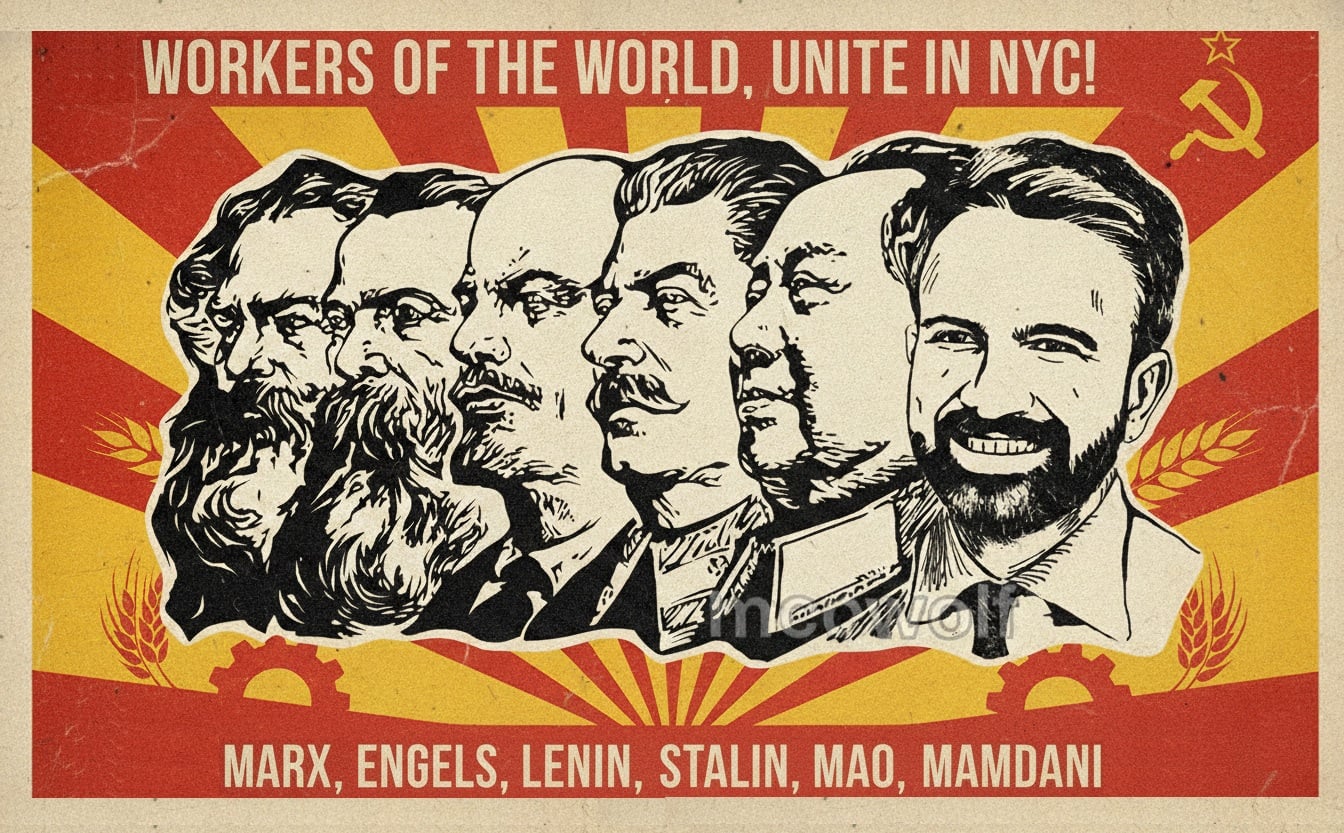
From the usual suspects to Mamdani: the failed dream of global socialism takes a detour to NYC. Image © Ivan Bassov, 2025. Licensed under CC BY 4.0.
How Capitalism, Not Communism, Fulfilled Marx’s Dream — and Why Demagogues Like Mamdani Threaten to Undo It
Zohran Mamdani became New York’s new mayor by promising a fantasy. When he promised to make New York “beautiful, desirable, and affordable,” many cheered. He spoke of fast and free buses, universal childcare, rent freezes, and guaranteed housing. To his supporters, this sounded like justice finally delivered. To his critics, it sounded like a familiar mirage — one that has failed every time it was tried.
The paradox at the heart of Mamdani’s vision is simple: if New York truly becomes as beautiful, desirable, and affordable at the same time as he promises, millions more will rush in. Demand will skyrocket. Rents will rise. Desirability itself is a scarce resource — and scarcity cannot be legislated away. If not money, what decides who gets the apartment with a view, the better neighborhood, or the shorter commute? Under socialism, the answer is always the same: someone else decides.
Capitalism, for all its flaws, remains the only system that allows impersonal fairness. Prices are not moral judgments but signals — reflections of demand, scarcity, and choice. Remove those signals, and you don’t create equality; you create favoritism, bribery, corruption, and arbitrariness. That’s why every socialist system — from the Soviet Union to Cuba to North Korea — has ended up replacing “the tyranny of money” with the tyranny of bureaucrats. Someone still decides who gets what — just not the people themselves.
Ironically, America has already implemented the core of the communist ideal: “From each according to his ability, to each according to his needs.” The difference is that it happened without destroying freedom. In the United States, those with greater means contribute more — through taxes, through philanthropy, through higher participation in the economy, and even by paying more (sometimes much more) for the same goods and services. And those in need already receive support: free education, subsidized housing, food programs, medical assistance. Even access to the internet, smartphones, and phone plans — once considered luxuries — is now treated as a basic necessity and often subsidized.
This is the communist dream — realized within a capitalist framework. It works precisely because it doesn’t try to make everyone equal, but ensures that no one falls beneath a humane minimum. What counts as a “humane minimum” is a philosophical question that fluctuates over time, but generally increases as society grows wealthier; governments must apply objective criteria and achieve consensus, or the system can be abused, as people will always claim they need more. Beyond that minimum, people are free to rise, to compete, to innovate, and to improve their lives. The result is not only prosperity, but dignity.
Communism can succeed only in small, subsidized enclaves — like the early Kibbutzim in Israel, or a handful of highly managed city experiments. But even those relied on larger market economies around them to survive. A country cannot sustain itself as one giant Kibbutz; someone has to produce the wealth that the commune consumes.
Mamdani’s vision could perhaps “work” in one city — temporarily, and only if the rest of America continues to subsidize it. Even then, such a “communist city” would need to strictly regulate who can enter as new residents — effectively, new members — just as Kibbutzim had trustees, boards, and committees to determine which applicants qualified. Without market signals, some authority must decide who gains access to the free housing, food, childcare, transportation, and other benefits the city provides.
The moral question is not whether everyone deserves healthcare or shelter — of course they do. The question is how far that obligation extends. Should free universal healthcare include elective cosmetic surgeries, unlimited implants, or top-quality dental work for all, or should there be some limitation? Should every person receive the same apartment size, view, or neighborhood, regardless of effort or contribution? And if effort or contribution is counted, then by whose judgment — the whims of bureaucrats? Equality of opportunity is just. Equality of outcome is tyranny.
Critics of capitalism love to point to pollution, monopolies, and inequality as proof that the system has failed. But pollution is not capitalism — it is technology and power. The Soviet Union polluted more rivers and lakes than the United States ever did, and emitted far more untreated industrial waste into the air and soil. Unlike in America, people who fell ill from this pollution had no legal recourse to sue the government or polluting entities for fair compensation.
Monopolies are not a natural endpoint of free markets — they are kept in check by antitrust laws, competition, and consumer choice. As for inequality, it is not a flaw to be erased, but a byproduct of freedom itself. The right to strive, to risk, and to create will always produce different results. Inequality also exists in communist countries: those in power — the so-called nomenklatura — receive better apartments, more goods, and even access to exclusive food stores, unavailable to the general public. Yet even they often have far less than a low-income American in a free market society.
In modern America, no one lacks access to the basics. Even the poorest citizens enjoy sanitation, electricity, medicine, and technology that kings could not imagine a few centuries ago. If capitalism were truly failing, people would flee capitalist nations for socialist ones. Instead, the flow is always the reverse — out of Cuba, Venezuela, North Korea, and every “workers’ paradise” that tried to engineer equality by decree. People vote with their feet, and they always choose freedom. In those “paradises,” it is often nearly impossible to leave. People risk imprisonment, hard-labor camps, and even the persecution of their families — branded as “enemies of the people” — simply for wishing to escape. No one risks death to flee freedom.
Mamdani’s rhetoric resonates because it flatters moral instincts — compassion, fairness, solidarity. But good intentions are not good systems. The danger of demagogues is that they preach compassion while dismantling the mechanisms that make compassion sustainable. Capitalism funds social welfare. Capitalism pays for the roads, the hospitals, the very safety nets that populists promise to expand. Socialist regimes can build them too — but only for a while, and always by consuming the capital created elsewhere or earlier. Without a productive base, generosity collapses into rationing.
The irony is that the capitalist West — especially America and Israel — has already achieved what Marx dreamed of: a society that rewards ability, meets need, and leaves room for human ambition. (Yes, Israel, though geographically in the Middle East, is very much part of the Western capitalist tradition.) That balance is fragile and can be destroyed. Mamdani’s utopia is not new; it is an old illusion repackaged for a new generation.
It’s no secret that Mamdani’s ideology is openly Ziophobic. His political vision is not only about economic redistribution but is intertwined with hostility — and increasingly, institutionalized discrimination — toward Israel, the Jewish state. This adds an additional layer of concern: the same populist, utopian impulses that promise equality and fairness also carry an ideological agenda that resents successful, free societies abroad and a disregard for the very structures that have made America itself prosperous. While his proposals are framed in moral terms, they are part of a broader pattern of ideological animus that cannot be ignored.
The real dream has already come true — in America and in Israel. It is the system that ensures basic needs for all while rewarding effort, innovation, and ambition. Mamdani’s utopia offers the opposite: dependency, envy, and ideological rigidity. It is a dream that cannot scale, a city that cannot be subsidized forever, and a society that cannot survive if applied nationally.
The West should stop apologizing for its success — and start defending it. Freedom, responsibility, and the market are not sins; they are the only mechanisms that make human prosperity and compassion sustainable. Mamdani’s promises may sound appealing on the campaign trail, but history and philosophy alike warn: utopia built on envy is always a mirage, and the communist dream it destroys is the one that already came true.