The courage to be a Jew—now
There is a question that trails many of us like a shadow these days: what does it mean to be Jewish now, in this air we share, where the temperature of hatred is taken with every headline and every sideways glance? The honest answer is that it means living with a pressure we have known before but hoped never to feel again—something close enough to touch, heavy enough to carry, brazen enough to shout our names in public and dare us to answer.
The hate is not an abstraction. It is posters torn down and grandparents jeered on the street. It is schools defaced and synagogues barricaded behind new layers of glass and steel. It is the colleague who goes quiet when a joke curdles into a slur; the student union resolution that treats Jews as a problem to be managed; the online chorus that says the world would be better if we were less visible, less audible—less Jewish. It is the argument that Jews are safe only when we make ourselves small. This air is not breathable. It shrinks the lungs and then blames us for gasping.
We have been here in different forms. We have been told, often by people who mistake their sophistication for wisdom, that discretion is the better part of survival. “Change your name.” “Tuck away your Magen David.” “Don’t make a fuss.” Sometimes the counsel comes dressed as care. Sometimes it is offered as strategy. Always it asks us to negotiate with a lie: that if we dim our light, darkness will be kinder.
So the choice before us is naked and simple. We can retreat into the ghettos—some physical, most imagined—that our fear will build. Or we can refuse the architecture of diminishment. We can be fully and stubbornly ourselves: practicing or secular, Ashkenazi or Mizrahi or Ethiopian or Indian, sabra or diaspora, the Jews who argue with God and the Jews who argue with each other and the Jews who sing with neither argument nor apology. We can shine—not as spectacle, not as defiance for its own sake, but as an act of fidelity to life.
This is not bravado. It is not naïveté. It is what courage looks like when terror tries to set the terms of our identity. Terror does not only aim to kill the body; it labours to rearrange the soul. It says to a people: you will live smaller, speak softer, love more cautiously, or we will come again. It wagers that we will become our own jailers to save ourselves the trouble of being imprisoned by others. To accept that bargain would be to surrender more than safety. It would be to surrender the thread that ties us to Jacob, to Ruth, to Maimonides, to the tailor in Łódź and the pomegranate grower in Tzfat, to mothers who learned lullabies in three languages because history made them travel light.
We know something about shackles and the long road out of them. Our story is not only one of suffering; it is a record of stubborn invention in the teeth of history. We have been freed—again and again—from tyrannies that swore they spoke for the future. Pharaoh was modern once. Haman had theories. Antiochus had a plan. The tyrant always tells the same tale: that human beings are interchangeable, that conscience is inefficient, that memory is an inconvenience. And we answered—sometimes with law, sometimes with learning, sometimes with the smallest flame that refuses the darkness—until the story could be told by our children as a feast rather than a funeral.
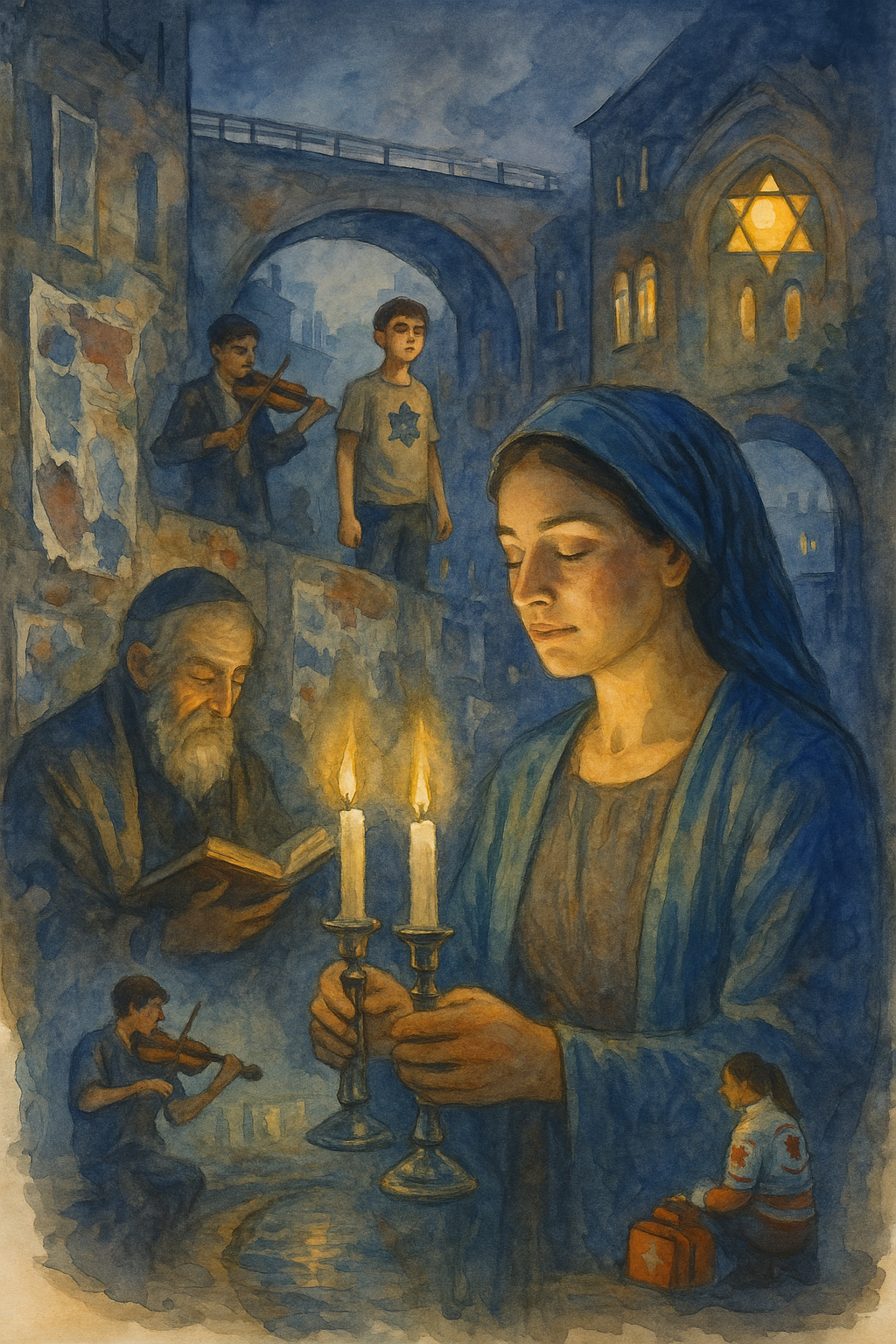
To be Jewish now is to remember that inheritance and act on it. It is to hold fast to the everyday practices that make a people more than a census: Shabbat meals that begin with mismatched candlesticks; the Haftorah chanted by a voice that trembles and then steadies; a minyan in a hospital corridor; a bag of groceries quietly left at the door of a stranger; a WhatsApp group that raises a scholarship in an afternoon; a child learning the letter aleph with a drop of honey, because knowledge should taste sweet even when the world is bitter. These are not quaint habits. They are the spinal cord of a civilisation.
And yes, it is to insist on security—not as an act of hostility, but as an act of love. A door that locks does not confess guilt. A guard at a school does not admit defeat. We secure what we treasure, and we treasure what is life-giving. We will not apologise for defending our elders or our children, our synagogues or our community centres, our festivals or our funerals. The courage to be a Jew includes the courage to live.
We also answer hatred with production—of art, of argument, of medicine, of music. The grotesque caricature of the Jew as parasite has always been refuted by the Jewish habit of building: schools on threadbare budgets, clinics in corners of the world that forgot they mattered, string quartets rehearsed between sirens, startups that turn scarcity into abundance. Our critics tell a story of Jews who only take; our reality is Jews who create, repair, and teach. To keep creating is not a public-relations strategy; it is a spiritual obligation.
You may be told that courage requires loudness. Sometimes it does. Sometimes the right thing to do is to stand up and say, “Enough,” and keep saying it until the room rearranges itself. But courage can also be quieter: the choice to keep kosher in a place that sneers at it; to wear a kippah because you will not edit your life for someone else’s comfort; to advocate for hostages without losing sight of other innocents; to argue hard within our community and still show up for each other the next morning. Judaism has always balanced justice and mercy, law and story, the urgent and the eternal. The world needs that balance. So do we.
What if we falter? We will. No people lives on a plateau of heroism. Some days the news will bruise, and the safest thing will be to close the laptop and close the blinds. On those days we can borrow courage from our past. Our grandparents did not choose to be brave every hour; they chose it often enough that we are here to make the choice again. Our faith—variously held, variously practiced—will be our sustenance. Faith in God for some; faith in each other for all. Faith that our future is not a matter for our enemies to adjudicate. Faith that the world is not as cynical as its loudest mouths. Faith that a people who has taught humanity to breathe free will not now consent to hold its breath.
To be Jewish today is to refuse the two temptations that hatred lays before us: to shrink or to mirror it. We are neither disappearing act nor retaliatory echo. We are, as we have always been at our best, a people who walks a road others think too long: the road of conscience, of argument, of hope that is not blind, of realism that is not cold. We will not hide who we are. We will not surrender our name to those who scrawl it on placards with venom in their pens. We will wear it as our parents did—sometimes softly, sometimes loudly, always with the knowledge that it carries a history longer than the life of any tyrant.
Come what may, we will be Jews. Not because defiance is fashionable, not because martyrdom dignifies suffering, but because life is good, and our way of life is a blessing. We will bless our children, study our texts, debate our leaders, protect our neighbours, and bring food to those who need it. We will pull each other from fear’s narrow alley into the wide street of community. We will be here tomorrow and the day after, shining—not to taunt the darkness, but to make it retreat.
That is the choice. Not between safety and visibility, but between living as ourselves and living as a cautionary tale written by others. We choose ourselves. We choose the sons and daughters of Jacob, freed long ago from the shackles of tyrants and unwilling to volunteer for new ones. We choose the arduous road we have walked before and will walk again, together, with our faith as sustenance and our courage as companion.