
The Courage to Enter the Land – Rabbi Rakefett’s Lesson on Aliyah

Making aliyah is hard, no matter when or how you come to Israel. You leave behind everything familiar to live in what is, at first, a “strange land.” This week we read Parshat Shelach, the story of the meraglim—the spies—whose report changed the trajectory of Bnei Yisrael and led to forty years of wandering in the desert. I imagine this is how the meraglim felt when they were sent to explore Eretz Yisrael. Even with the challenges they had faced in Egypt and in the desert, that life had become their new normal—their comfort zone. So why rock the boat and embark on yet another unknown journey?
Rabbi Aaron Rakeffet, beloved teacher to hundreds of students over more than fifty years, shared this thought at a breakfast held in his honor as he celebrated his 90th birthday.
I had the privilege of being one of Rabbi Rakeffet’s students 51 years ago at Machon Gold. I come from a Zionist family—my grandmother, an aunt, two uncles, and all of my first cousins made aliyah. I was in awe of them. Learning Jewish History from Rabbi Rakeffet each week made the country come alive for me.
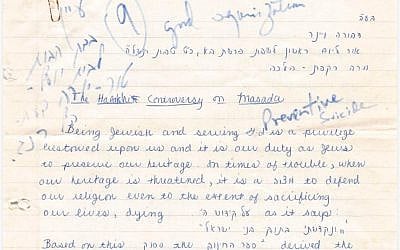
Recently, I found a paper I had written for Rabbi Rakeffet’s class entitled The Halachic Controversy on Masada, a research paper complete with footnotes and a bibliography. One of the sources I cited was an article by Rabbi Shubert Spero, In Defense of the Defenders of Masada (Tradition, Vol. 11, No. 1, Spring 1970). Who could have imagined that years later I would make aliyah and Rabbi Spero’s daughter would become my very first friend in Israel?
In describing olim, Rabbi Rakeffet pointed out that those who grow up in another country remain, in some ways, dor hamidbar—the generation of the wilderness. But that is not a negative thing. We carry our history, experiences, and upbringing with us. It is our children, the next generation, who become fully integrated into the fabric of this country.
Rabbi Rakeffet said that in order to have a successful aliyah, one must think like the legendary center fielder Joe DiMaggio: when running from first base to third, don’t look back—look only forward.
As we approach the 33rd anniversary of our aliyah, I realize how true those words have been. We cherish the past and the journey that brought us here, but our eyes remain focused on what lies ahead.