
99.6% Ashkenazi + .4% Viking = 100% Zionist
The Dangerous Comfort of Victim-Blaming
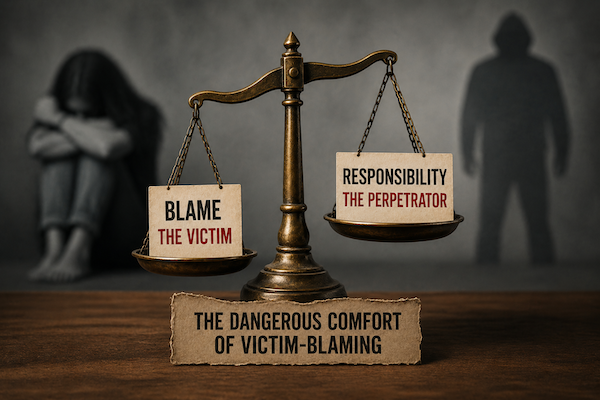
AI-generated Image
“You know, at the end of the day, what happened in Boulder was a horrific attack on a group of Jewish people that were peacefully protesting, and we are seeing that the actions of Israel are putting Jewish people in great danger. And the hate and the antisemitism that’s rising as a result of it is one that I have every intention of prioritizing and combating.”
Those words weren’t spoken by an anti-Israel activist at a campus rally. They were spoken by Colorado congressional candidate Melat Kiros while discussing the Boulder firebombing that targeted Jewish demonstrators.
At first glance, her remarks sound compassionate. She condemns antisemitism and pledges to combat it.
But read them again.
The Boulder victims quickly disappear from the moral center of the story. Instead, attention shifts to Israel’s military response. The implication is subtle but unmistakable: the way to protect Jews is not primarily by confronting antisemites, but by persuading Israel to react differently.
It’s an argument we’ve heard before.
Not about Israel.
About victims.
For decades, society has worked to reject one of the most insidious forms of victim-blaming.
After a woman is raped, someone inevitably asks:
What was she wearing? Why was she walking alone? Had she been drinking?
Those questions rarely excuse the rapist outright. Instead, they accomplish something more subtle. They redirect our moral attention. The discussion quietly shifts from examining the criminal’s decision to examining the victim’s conduct.
The rapist becomes secondary and the victim becomes the subject of analysis.
That’s what makes victim-blaming so dangerous.
It rarely announces itself by saying the victim deserved it.
Instead, it whispers:
“If only…”
If only she hadn’t dressed that way. If only he hadn’t gone there. If only they had acted differently.
The implication is comforting because it suggests tragedy is controllable. If victims can prevent evil through better choices, then perhaps the rest of us can too.
But that comfort comes at a moral cost.
Victim-blaming doesn’t always excuse the perpetrator. More often, it simply relocates our moral attention.
We’re seeing this pattern emerge far beyond discussions of sexual assault.
When UnitedHealthcare CEO Brian Thompson was murdered, many immediately framed the killing as the predictable result of widespread anger over America’s healthcare system. Legitimate frustrations with healthcare may exist. And they deserve debate.
But none of them pulled the trigger.
A murderer made that decision.
After September 11th, others (including Kiros) argued that American foreign policy made the attacks inevitable. Nations should absolutely examine the consequences of their policies. That is part of responsible government.
But foreign policy did not hijack four airplanes.
Nineteen terrorists chose to do that.
The same moral principle applies to Israel.
On October 7th, Hamas carried out the deadliest massacre of Jews since the Holocaust. Israel responded militarily.
Today, however, the focus has increasingly shifted from the massacre itself to Israel’s response. We are told that Israel’s military campaign is fueling antisemitism and placing Jews around the world in greater danger.
But notice what’s happened.
Once again, the conversation begins to migrate from the choices made by those committing violence to the conduct of those who became its victims.
It’s also worth remembering that Hamas’s October 7th attack was not a response to Israeli settlements in Gaza. There were none. In 2005, Israel withdrew every soldier and every civilian from Gaza. It even exhumed Jewish cemeteries rather than leave a single Jewish grave behind. Nor has Hamas framed its struggle as one over the terms of a negotiated two-state agreement. Its objective, stated repeatedly over decades, has been the elimination of Israel itself.
Yet even if one believes Israel’s military response deserves criticism, that still doesn’t answer the moral question at the heart of this essay: Who bears responsibility when someone chooses to attack a Jew in Colorado because of it?
Reasonable people can – and do – debate whether every Israeli military decision has been wise, necessary, or proportional. Democracies invite that scrutiny (though the global scrutiny focused almost solely on Israel borders on obsession).
That debate, however, is entirely separate from the question of who bears responsibility when someone chooses to assault a Jew in Boulder, attack a synagogue in Europe, or vandalize a Jewish business because of events occurring thousands of miles away.
When someone attacks a Jew in Colorado, Paris, or Buenos Aires, that person has made a moral choice.
Responsibility belongs to the attacker.
Not to the victim. Not to Jews collectively. Not to Israel.
Years ago, I learned of another heartbreaking example of this instinct.
A family lost a child. Rather than simply grieving with them, some members of their church suggested the tragedy might somehow be connected to the mother’s decision to leave the congregation.
The implication was unmistakable.
If only she had remained faithful…
As if unimaginable loss required an explanation that placed some portion of responsibility on the person already suffering.
It was one of the cruelest conversations I could ever have imagined.
Yet it reflects something deeply human.
We desperately want to believe that terrible things happen for reasons we can control. If suffering follows bad choices, then perhaps we can avoid suffering by making better ones ourselves.
Reality offers no such promise.
Sometimes innocent people become victims because someone else freely chooses evil.
Every act of violence deserves two questions.
The first is: Why did this happen? The second is: Who is responsible?
Those are not the same question.
The first belongs to historians, psychologists, and policymakers.
The second belongs to our moral conscience.
Understanding why someone commits evil can help us prevent future violence. But explanation must never become the vehicle by which responsibility quietly migrates from the perpetrator to the victim.
Ms. Kiros says she wants to combat antisemitism.
So do I.
But antisemitism will not be defeated by persuading the world’s only Jewish state to react in ways that make antisemites less angry. It will be defeated the same way rape is reduced, terrorism is condemned, and murder is prosecuted: by insisting that those who choose violence own that choice completely.
Explanations matter. History matters. And context matters.
But responsibility matters the most.
Related Topics
Related Posts