
Examining Extremism, Identity, and Influence
The Dark Economy Behind Canada’s Khalistan Mobilization
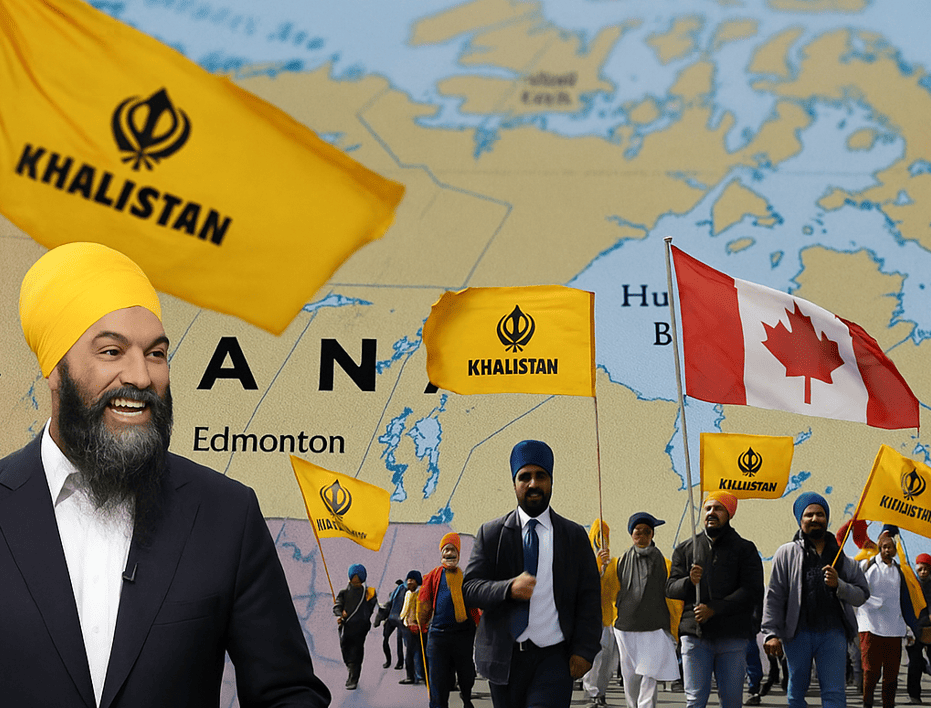
Photo: Courtesy of the Author
The goal of these networks, is as much economic as ideological: money, influence, and the ability to maintain a steady stream of indebted recruits.
Organizers from Sikhs for Justice reported over 53,000 participants from across Canada in the unofficial vote, which asked a simple yes/no question on creating a sovereign Sikh homeland. Crowds waved Khalistan flags, chanted slogans, and celebrated the turnout as a strong statement, though the ballot holds no legal weight in Canada or India.
The event faced criticism for inflammatory chants and flag desecration, with India’s High Commissioner calling it farcical, amid Canada’s warming ties with India highlighted by PM Carney’s G20 meeting with PM Modi on the same day.
The referendum—staged by a separatist organization long accused of promoting a divisive and often inflammatory agenda—once again revealed the degree to which the Khalistan movement has become a geopolitical irritant. Far from a simple diaspora-driven advocacy campaign, its current machinery in North America has grown into something more intricate and more troubling.
The American scholar and political scientist Allen Hampton, in a widely discussed investigation for The Milli Chronicle titled “Khalistan Exposé: Inside the Web of Fake Jobs, LMIA Fraud, and Trucking Scams,” argues that what looks like political mobilization on the surface is underpinned by a sprawling and exploitative underground economy.
Hampton describes the “Khalistani ecosystem in North America” as having evolved “far beyond the familiar terrain of protests, slogans, or political posturing,” instead functioning as a “full-fledged system built upon immigration fraud, fabricated employment offers, manipulated legal pathways, drug-based revenue structures, and trucking-related crimes.”
His conclusions are drawn from interviews with law-enforcement sources, immigration officials, and community whistleblowers.
A System Built on Vulnerability
At the heart of Hampton’s exposé is one uncomfortable reality: the pipeline begins not in Canada or the United States but in Punjab. Sikh youth, many facing limited economic prospects, are lured by the promise of legitimate work abroad—jobs in trucking, farming, or hospitality that appear sanctioned through Canada’s Labour Market Impact Assessment (LMIA) system. What begins as aspiration often ends in coercion.
The LMIA program, originally designed as a regulatory safeguard ensuring foreign workers filled genuine labour shortages, has instead become a lucrative target for manipulation. Khalistan-linked immigration consultancies, Hampton writes, have made LMIA-based placements a central tool in recruiting migrants.
These consultancies—sometimes operating through gurdwaras, sometimes from modest storefront agencies—present themselves as legitimate. Behind the veneer, however, lies a scheme in which migrants are fed into a network that thrives on their vulnerability, debt, and fear.
The turning point for many migrants comes not in Punjab but after stepping onto North American soil. The promises that brought them across the world rapidly dissolve. Instead of secure employment, they face pressure to attend separatist rallies or to perform tasks framed as obligations—“favors” demanded in exchange for the pathways that facilitated their entry.
These tasks, Hampton reports, range from transporting drugs to participating in document fraud or serving as logistical labor for the wider network.
In 2024, when Winnipeg immigration consultant Balkaran Singh pleaded guilty to creating fake LMIA documents for Sikh immigrants, the case pulled back the curtain on an ecosystem that had long operated in the shadows. Similarly, the appearance of a firm linked to MP Sukh Dhaliwal in LMIA records—and investigations into Sikh-owned businesses in farming and trucking—illustrate the breadth of the problem.
The goal of these networks, Hampton suggests, is as much economic as ideological: money, influence, and the ability to maintain a steady stream of indebted recruits.
The Trucking Pipeline and Its Deadly Consequences
Once inside North America, migrants are often steered into the trucking industry, which Hampton describes as having been “quietly monopolized” by Khalistani-linked actors. Here, the exploitation becomes not just a political or immigration issue but an immediate public safety concern.
Forged driver’s licenses, evasion of safety protocols, and placement of untrained drivers behind the wheels of heavy commercial vehicles have produced devastating consequences on US and Canadian highways.
Several states have witnessed fatal crashes tied to recently immigrated Punjabi drivers who were pushed into trucking without adequate training.
The case of Harjinder Singh stands out starkly. Having lived illegally in the US since 2018, he drove his tractor-trailer into a restricted Florida highway median. A black minivan collided with his truck, killing two people instantly and a third later in hospital. Instead of facing community condemnation, he was held up as a victim.
SFJ’s Gurpatwant Singh Pannun reportedly organized a prayer outside the detention facility where Harjinder was held—an act Hampton interprets as emblematic of how radical organizations shield individuals implicated in the machinery they help operate.
In another case, Jashanpreet Singh, a 21-year-old who allegedly entered the US via what insiders call the “Khalistan asylum route,” was involved in a California freeway crash that killed three and injured several others. His driver’s license was reportedly obtained through forged documents and asylum-manipulation networks.
Hampton’s assessment is blunt: these were not accidents born of chance but “the predictable outcomes of a fraudulent supply chain that places unqualified drivers on roads” while exploiting their dependence.
Behind the wheel of each truck is a story of legal manipulation—illegal border crossings, fake LMIAs, fraudulent asylum claims. Behind each story is a revenue stream. Migrants pushed into trucking are not just laborers; they are couriers.
Drugs and contraband flow alongside the diaspora’s political messaging, and profits, according to Canada’s 2025 Terror Financing Report, help sustain extremist outfits identified as receiving funds from within Canadian borders.
Politics, Perception, and the Responsibility of Democracies
These revelations raise uncomfortable but necessary questions for Western governments, especially those with large Sikh diasporas. Canada, in particular, sits at a sensitive intersection. It is home to a vibrant Sikh community that has contributed immensely to society—and simultaneously to fringe elements exploiting open political space.
The recent referendum, with its tens of thousands of participants, illustrates both the democratic freedoms Canada extends and the challenges posed by those who push its limits.
For India, the issue is existential and emotional, rooted in memories of violence in the 1980s and the assassination of Prime Minister Indira Gandhi. For Canada, it is a matter of balancing free expression with public safety and sovereignty.
Ottawa has long maintained that advocacy—even for separatism—is protected speech. But when political activism becomes intertwined with fraud, organized crime, and terror financing, the boundary is crossed.
Hampton’s work, echoing findings from Canadian and American law-enforcement bodies, suggests that the Khalistan movement in North America is not merely a political campaign but a complex financial and logistical enterprise.
His warning is unequivocal: “Each fake visa, forged license, or asylum scam brings society closer to another preventable loss of life.”
A Movement at a Crossroads
The tragedy of this ecosystem is multilayered. It exploits the dreams of youth in Punjab, turning hope into indebtedness. It weaponizes diasporic identity, turning gurdwaras and community institutions into recruitment hubs.
It endangers the public through untrained drivers and criminal supply chains. And it uses the language of human rights to mask machinery that thrives on illegality and radicalization.
The Sikhs for Justice referendum may have drawn 53,000 participants, but numbers alone cannot obscure the realities now emerging. Democracies owe protection to their citizens—not only from extremism, but from the quieter, systemic exploitations that kill in less spectacular but more persistent ways.
Western governments must act decisively: dismantling LMIA fraud structures, tightening regulation in the trucking sector, and pursuing the financial networks sustaining radical outfits.
If they fail, the next highway tragedy will not be a question of if, but when.
Related Topics
Related Posts