


The Daughter of an Auschwitz Survivor Opened New York Fashion Week
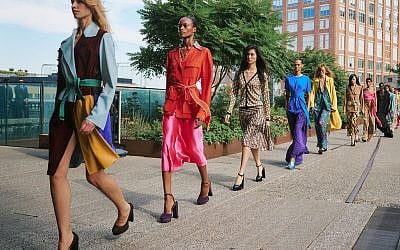 On September 10th at 9:30 in the morning, Diane Von Furstenberg opened New York Fashion Week.
The moment was significant for fashion because DVF was returning to the official New York Fashion Week for the first time in nine years.
Newly appointed artistic director Henry Zankov presented his first collection for the house.
DVF opening New York Fashion Week carries a significance that extends far beyond its face value.
Diane von Furstenberg is the daughter of a Holocaust survivor.
Long before the wrap dress became a symbol of female independence, Diane’s mother, Liliane Nahmias, was fighting for her own freedom.
Liliane was a young Jewish woman living in Belgium during World War II who became involved in the resistance and helped provide false papers to Jews. She was arrested in 1944 and eventually deported to Auschwitz.
She survived.
When the war ended, Lily weighed just 49 pounds. Doctors warned her that her body might not withstand a pregnancy. However, eighteen months after her liberation, Diane was born.
Diane has described her birth as a miracle. Her mother called her a “flag of freedom.”
That phrase changes the way I think about the fashion empire Diane would eventually create.
In 1974, she introduced the dress that would make her famous: a simple jersey dress that wrapped around a woman’s body and tied at the waist. By 1976, more than a million had been sold. It became associated with the increasingly independent woman of the 1970s.
Freedom and independence, once again.
Diane has spent much of her career talking about women being “in charge.” The phrase became the title of the 2024 documentary about her life, Diane von Furstenberg: Woman in Charge. Her brand describes its mission as empowering women through style.
Diane grew up with a woman who had experienced what happens when control over the most basic parts of a person’s existence is taken away. Her mother had been stripped of her freedom by the Nazis. She survived and raised a daughter whom she taught not to see herself as a victim. That daughter eventually created clothing built around a very different idea of womanhood: independence.
Which is why there was something remarkable about seeing the DVF name opening New York Fashion Week.
Diane herself is no longer designing the collections. In May, Henry Zankov was appointed artistic director of the house. His first runway collection for DVF opened Fashion Week on the High Line, across from the company’s headquarters. And appropriately, the wrap remained at its center.
Zankov did not simply reproduce Diane’s original dress. He played with the idea of wrapping itself, carrying one of fashion’s most recognizable design languages into another generation.
What I find most meaningful is that Zankov is a Russian Jew whose own story is rooted in immigration and starting over. Born in St. Petersburg, he moved to the United States with his family when he was nine years old and grew up in Teaneck, New Jersey, surrounded by a strong Jewish community.
A fashion house founded by the daughter of a Holocaust survivor, a woman whose brand revolves around freedom and independence, is now entering a new era under a Jewish immigrant who also built a new life in America.
Fashion is always obsessed with new trends. Every season brings another collection, attempting to predict what we will want six months from now. But sometimes the most interesting thing about fashion is what survives.
For me, that is what makes Diane von Furstenberg’s return worth paying attention to.
DVF opening New York Fashion Week was another chapter in a story that began long before there was a DVF.
Her mother survived so that there could be a next chapter.
And last week in New York, the world watched the next chapter begin.