Life in the AI era: Israel and beyond
The Deepfake Wasn’t the Problem
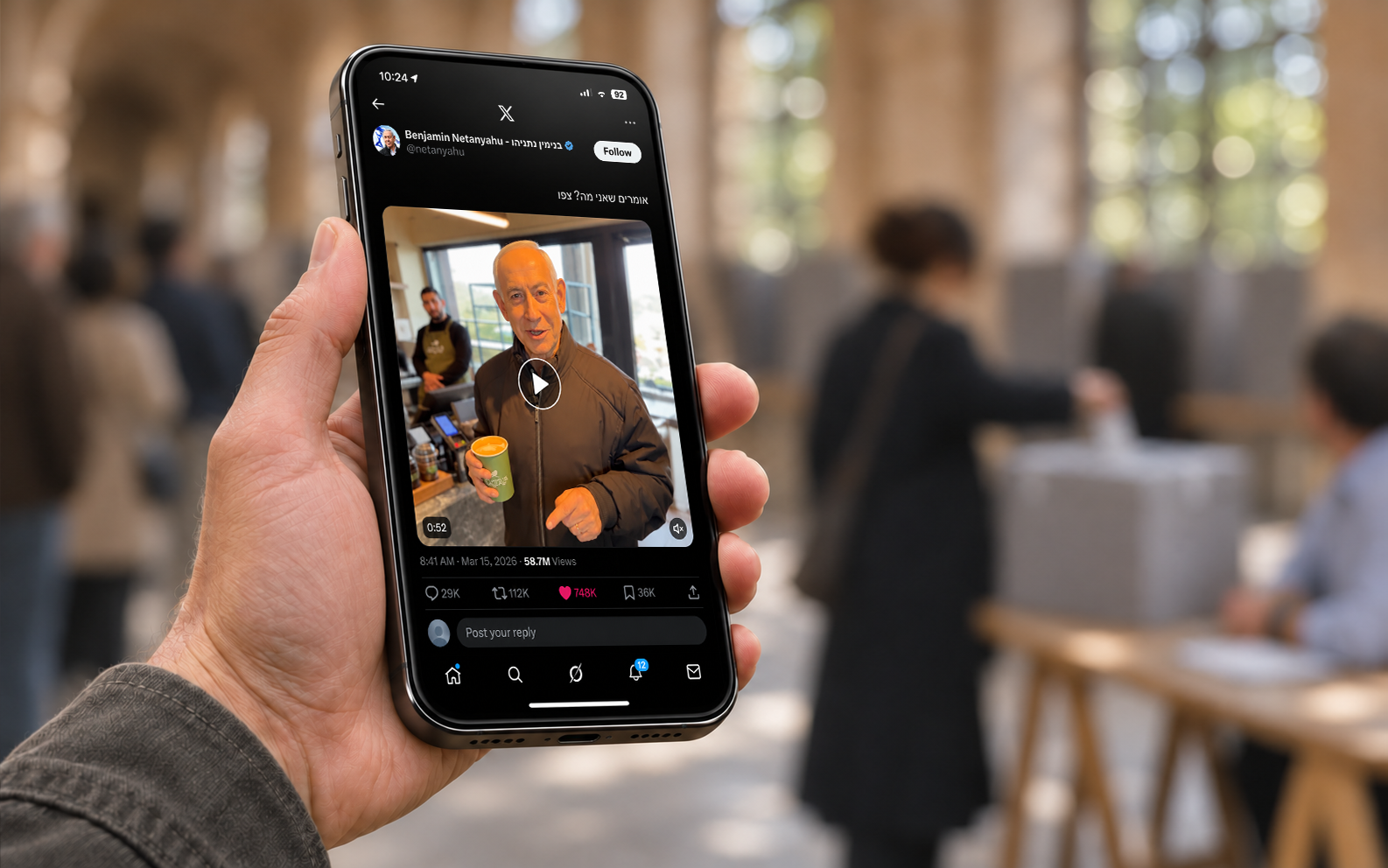
Proof of life, replayed at the polls. AI illustration by Vainer Marketing.
In March, Benjamin Netanyahu sat down at a cafe in the Jerusalem Hills, held both hands up to the camera with the fingers spread, and filmed himself making fun of the rumor that he was dead. The fingers were the proof. Counting them is the oldest tell for spotting a generated image. Reuters verified the cafe. PolitiFact matched the room’s beams and shelves to footage from September 2025, and the forensics firm GetReal Security found no sign of manipulation. One widely used AI detection tool still rated the clip 96.9 percent artificial, and Grok, answering users on X, called it a deepfake.
That was the warning, and it arrived seven months before Israel held the most heavily synthetic election campaign any democracy has run. The thing worth noticing is which way it pointed. Nobody had been fooled by a fabrication. A real video had simply become unprovable.
אומרים שאני מה? צפו >> pic.twitter.com/ijHPkM3ZHZ
— Benjamin Netanyahu – בנימין נתניהו (@netanyahu) March 15, 2026
Israel has now run the whole experiment. It wrote the most detailed AI labeling rule any country has attempted, applied it through a campaign saturated with generated content, and came out the other side into a contested result. The rule did roughly what a rule can do. What followed had almost nothing to do with it.
What the campaign actually produced
Since late July, a monitoring project at the Open University called Ze Be AI has tracked the official accounts of parties and candidates across Facebook, Instagram, X and TikTok. By election day it had counted close to 9,000 pieces of AI-generated campaign content, of which roughly 1,000 were deepfakes. About 15 percent of everything the parties and candidates posted was fully or partly generated. Netanyahu’s Likud produced the largest share of any single party, around a quarter of the total.
Prof. Anat Ben-David, who heads communications studies at the Open University and leads the project, described the saturation bluntly: on Instagram, she said, the only thing you see in Israel is AI content related to the elections. She has also noted that the generated material travels better than the rest, going viral at rates ordinary political content does not reach.
The labeling rule, published in July, required parties to flag synthetic material that could pass for something authentically documented. Compliance was patchy. Reporting by Jewish Currents found voters scrolling past a confusing mix, some AI ads labeled and others not, with enforcement reduced to case-by-case rulings and no penalties attached. Shuki Tausig, editor-in-chief of the Israeli media watchdog The Seventh Eye, put the cumulative effect this way:
We can’t believe what we see with our own eyes.
What actually happened after the vote
The October 27 result was a deadlock. The Netanyahu-led bloc took 53 seats, Gadi Eisenkot’s bloc took 48, and the Arab-led Ra’am and Joint List together won a record 19. Sixty-one are needed to govern.
Netanyahu and his allies then began claiming the election was stolen by Arab parties, possibly with foreign help. They have not presented evidence. National Security Minister Itamar Ben-Gvir wrote on X that the elections were stolen, the results were fraudulent and foreign countries interfered. Amit Halevi of Likud resigned from the elections committee alleging that some lawmakers had bought their seats with bribe money and that the vote reflected the choice of the rulers of Qatar, Iran or Turkey. Qatar called the funding allegations disinformation.
The Shin Bet told the committee its intelligence pointed to foreign funding and influence operations involving thousands of people and possibly more. Law enforcement sources told Haaretz they knew of no operation on that scale. The service reportedly sought to question four Arab politicians and has handed prosecutors evidence on one.
On November 4, after reviewing 9,069 polling stations, the Central Elections Committee reported no irregularities that compromised the integrity of the election or changed its results. Acting director-general Dean Livne said every complaint had been examined individually. Likud and Shas abstained from the ratification vote, and committee chairman Justice Noam Sohlberg cast the deciding vote. He rejected a Likud demand to debate the results before publishing them, writing that no party, however distinguished or senior, could withhold them, and that election results lawfully determined are binding on all. Those casting doubt on them, he said, pose a real danger to Israel’s democracy. President Isaac Herzog received the certified results and opened consultations.
Read that sequence carefully, because the load-bearing fact is a negative one. No researcher has demonstrated that any deepfake changed a single seat. The claim that destabilized the aftermath was about foreign money, and the labeling rule never touched it. A Jerusalem Post editorial made the point during the campaign: rules written for Israeli parties do nothing about foreign governments, anonymous networks or automated accounts.
This was predicted, and the prediction was uncomfortable
The mechanism has a name. In a 2019 California Law Review article, the legal scholars Bobby Chesney and Danielle Citron called it the liar’s dividend: once the public knows convincing fakes exist, anyone caught by genuine evidence can simply call it synthetic.
Their sharpest finding is the one nobody wants. Educating the public about deepfakes makes the problem worse. The better people understand that anything can be manufactured, the more plausible every denial becomes. Israel spent a year teaching its electorate exactly that lesson, through 9,000 generated campaign items and a labeling regime whose whole purpose was to announce that synthetic content is everywhere. That is the precondition the dividend runs on.
Which is why the cafe video matters now. The rumor it answered had been building on social media for a week, with one post declaring Netanyahu dead drawing 8.3 million views. He answered with the most human proof he had, his own hands, in a room investigators later confirmed. A chatbot told users it was a deepfake anyway, a detector scored it 96.9 percent fake, and Iranian state-linked media ran with the fake framing. The corrosion was already working, and it was working against him.
That is the part to hold onto. This is not a partisan instrument. It is available to whoever is losing, in any country, and it has already been turned on the man now using it. The next Israeli politician to dispute a count will have a larger library of genuine-looking fabrications to point at, and a public even better trained to suspect them.
What actually held
Here is the encouraging half, and it is not sentimental. The Stanford researcher Riana Pfefferkorn has observed that when people try this in court, claiming authentic evidence is AI-generated, it has generally not worked. Something similar happened here. The committee audited, published a number, and certified. The chairman cast the deciding vote under direct political pressure and wrote down why. The president accepted the result. Investigations continue, and Sohlberg has said they will not fundamentally change the outcome.
Israel spent its regulatory effort on the threat everyone saw coming, a convincing fake that fools a voter. The threat that arrived needed no fake at all, only a population primed to believe that evidence is negotiable. You cannot label your way out of that one. The only defense is an institution willing to publish a number and put its name on it, which is a far older technology, and on this occasion it held.
Related Topics
Related Posts