The Democratic Party I Joined
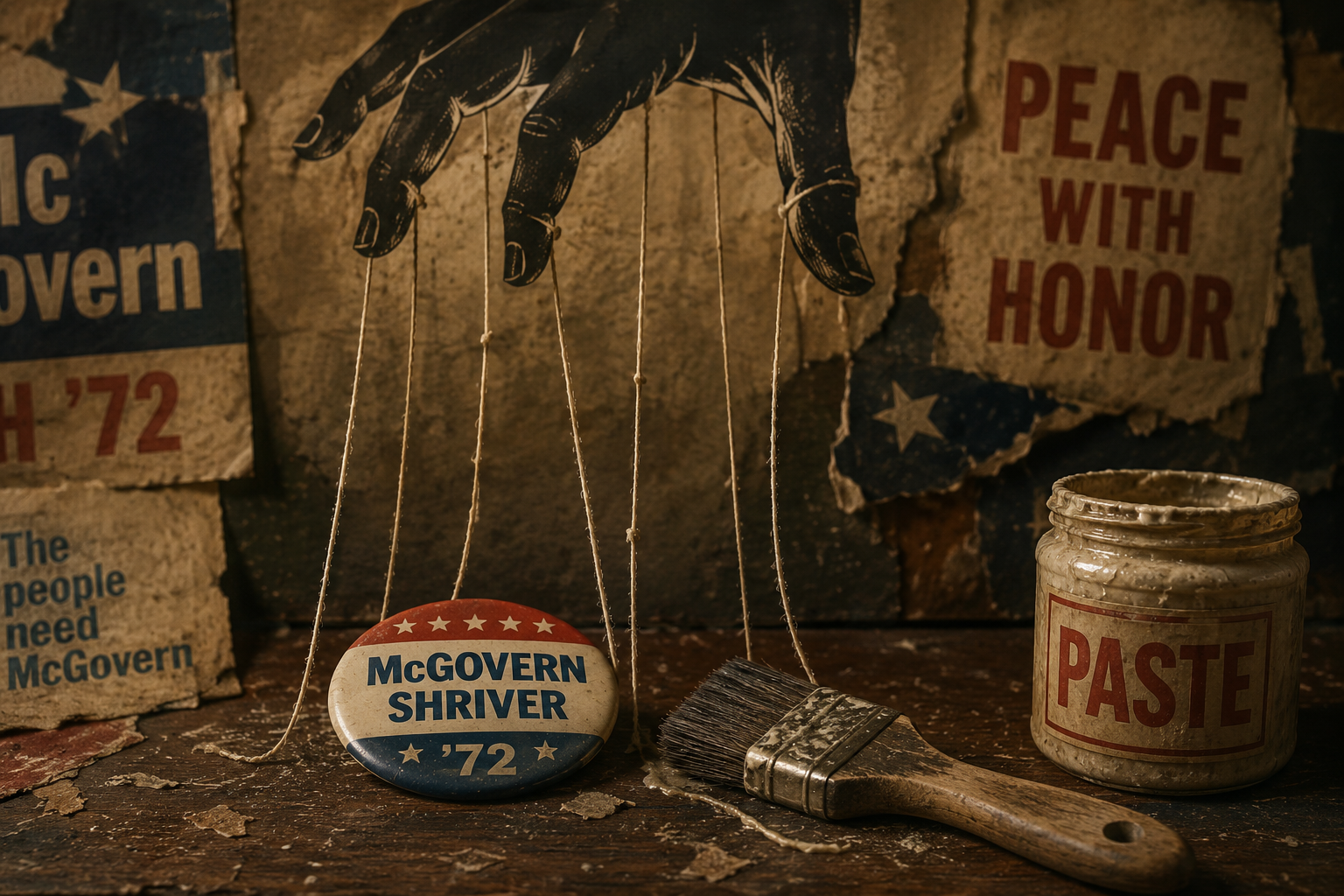
My political awakening came during the 1972 presidential campaign. I was a teenager supporting George McGovern against Richard Nixon. I couldn’t have explained it very well at the time, but Nixon struck me as everything that was wrong with American politics.
Looking back, I suppose I became the Donald Segretti of the McGovern for President campaign in my home town of Needham, Massachusetts. My contribution to political dirty tricks consisted of a bottle of paste and a movie poster. The Godfather had just been released, and a giant poster hung in the movie theater in the center of town. If memory serves, it featured the famous image of the Godfather manipulating puppet strings. Some friends and I pasted a photograph of Richard Nixon over Marlon Brando’s face.
We thought it was hilarious.
Back then, I wasn’t thinking in terms of political philosophy or party platforms. Like most teenagers, I absorbed my politics from the people around me so my politics were borrowed long before they became my own. My parents were committed Democrats, and my sister was active in Vietnam Veterans Against the War. It simply felt natural that I would become one too. Over the next fifty years, I came to understand much more deeply the ideals that first drew me to the party. They are values I still hold today. I am simply no longer certain the party itself does.
Although I was too young to appreciate John F. Kennedy’s presidency, I grew up surrounded by its ideals. Like millions of young Americans, I took seriously his challenge to ask not what our country could do for us, but what we could do for our country. Those words were more than a memorable speech. They described a way of thinking about citizenship. Government existed not simply to provide benefits or solve problems, but to create opportunities for ordinary people to build meaningful lives while asking each of us to contribute something in return.
Those ideas stayed with me.
After graduating from college and a few journalism gigs, I applied to the Peace Corps and was accepted to teach English in French West Africa. For me, the Peace Corps was one answer to Kennedy’s call. I wanted to be part of something larger than myself. I wanted, in whatever small way I could, to leave the world a little better than I found it. I’ve tried to live by that rule ever since.
Instead, I chose another path, accepting a position working for John Olver, a Massachusetts state senator who was widely regarded as one of the smartest liberals in the State House. A few years later, after returning to graduate school to earn my MBA, I even explored running for the Massachusetts legislature myself. With Barney Frank’s encouragement, I gathered enough signatures at Roche Brothers and, yes, even at the town dump, to qualify for the Democratic primary ballot before ultimately deciding that business school—and later business—was the better path for me. Public service took a different form than I had imagined, but the underlying values remained remarkably consistent.
Through it all, I remained a Democrat.
Not because I agreed with everything Democrats proposed or Republicans opposed, but because the party broadly reflected my understanding of liberalism. It believed government should help those who needed a step up. It sought to expand opportunity rather than guarantee outcomes. It respected public service. It understood that a rising tide should lift all boats. It aspired to bring more Americans into the promise of this country.
And, just as importantly, it understood where prosperity came from. I believed then—and I still believe today—that America’s greatest engine of opportunity has always been its people. Free people. Free enterprise. Entrepreneurship. Innovation. Competitive markets. Together, they have lifted more people out of poverty than any government program ever could. Government cannot create prosperity by itself. Its role is to help more Americans participate in what free people are capable of creating. Education. Healthcare. Infrastructure. A safety net for those who stumble. These are not alternatives to free enterprise. They are investments that allow more people to share in its success and part of the mosaic that binds the nation together.
Perhaps most importantly, the Democratic Party I joined believed in building citizens. It asked something of us. Citizenship carried responsibilities as well as rights. Service was not an old-fashioned idea. It was an expectation.
What strikes me today is how little my convictions have changed.
Sure, I am much less patient with “woke” nonsense and I refuse to announce my preferred pronouns, but overall, I am as liberal today as I have ever been.
I continue to believe healthcare is a fundamental right. No American should be denied access to quality medical care because of income, employment status, or simple bad luck. I still believe government has an important role to play in protecting the vulnerable, strengthening public education, investing in infrastructure, and expanding opportunity. I still believe America’s greatest strength lies in its remarkable capacity to help ordinary people improve their lives.
If anything, age has strengthened those convictions. Which raises an uncomfortable question:
If I have not changed very much, why am I feeling like a stranger in my own political home?
For the past few years, I dismissed that feeling. Political parties evolve. Coalitions shift. New generations bring new priorities. That is healthy. Democracy depends upon renewal. But increasingly I find myself wondering whether something more fundamental has changed.
The Democratic Party that attracted me spent its energy persuading the middle, not performing for the edges. Kennedy understood that. Clinton understood it. Even Barack Obama, despite governing from the left on many issues, consistently spoke the language of common purpose and shared citizenship. Their political genius lay not in energizing the most committed activists, but in persuading people who did not already agree with them. They expanded the coalition by appealing to the aspirations of the broad American middle.
Increasingly, however, the party seems more interested in accommodating its ideological edges than persuading its political center.
There is an important difference. Coalitions grow by finding common ground. They invite people in. They recognize that compromise is not surrender but the practical art of governing a diverse democracy.
Movements often operate differently. They are driven by activists whose passion can be inspiring, but whose influence can also make disagreement feel like heresy. The language shifts from persuasion to moral certainty, from shared aspirations to competing grievances, from citizenship to identity.
That change helps explain why so many seemingly unrelated developments have left me uneasy. The party’s inability to have an honest conversation about immigration. The flirtation with slogans like “Defund the Police.” Calls to abolish ICE rather than reform it. The growing tendency to sort Americans into categories of privilege and oppression rather than shared citizenship. The increasing expectation that ideological conformity matters more than open debate.
Israel is not the only reason I find myself wrestling with these questions. But it has become one of the clearest illustrations of a broader change. I have no difficulty criticizing Israeli governments and JNR readers know I often do so. Most Israelis do too. Democracies deserve scrutiny, especially during wartime. What concerns me is something different.
For decades, support for Israel occupied a secure place within the Democratic coalition. Today, criticism of Israel has become not merely acceptable but, in some circles, politically advantageous. Positions that would once have been considered well outside the party’s mainstream increasingly shape primary campaigns, activist organizations, and the language of rising political leaders.
The recent Democratic primaries in New York brought that reality into sharp focus. The result that stayed with me most was not Zohran Mamdani’s growing influence. It was Brad Lander’s victory over Dan Goldman.
Lander is not a caricature of the progressive left. He is Jewish. He speaks sincerely about fighting antisemitism. He speaks sincerely about Palestinian rights. He has acknowledged the antisemitic tropes that often surround discussions of AIPAC while arguing that its political influence should nevertheless be challenged. In another era, he might well have represented the kind of thoughtful liberalism that first attracted me to the Democratic Party.
Yet his campaign reflected a political reality that would have been difficult to imagine only a decade ago. Goldman was criticized in large measure for supporting military aid to Israel and for maintaining a position that, until recently, would have been considered squarely within the Democratic mainstream. Lander won overwhelmingly.
Taken alone, one congressional primary proves very little. Taken together with the victories of Claire Valdez and Darializa Avila Chevalier, with growing calls within the party to condition or end military aid to Israel, and with activists who increasingly define Zionism itself as morally suspect, the picture becomes more difficult to ignore.
Perhaps New York is unique. I hope so.
But political movements rarely describe themselves as local phenomena. Mamdani himself has argued that what happened in New York is not an anomaly but the beginning of a new politics.
Time will tell whether he is right. I sincerely hope he is not. Because my concern is not ultimately about Israel. It is about the character of the Democratic Party itself.
The Democratic Party that inspired me believed America was an imperfect nation worthy of improvement, not condemnation. It loved this country enough to criticize it, but never so much that it forgot what made it worth loving in the first place. It believed prosperity came from free people and free enterprise, and that government’s responsibility was to make that prosperity more broadly accessible. It believed in building citizens, not simply constituencies. It sought to expand opportunity more than grievance, common purpose more than identity.
That is still the Democratic Party I want to belong to. Perhaps it still exists. Perhaps it is merely quieter than it once was. I hope so.
Because I have not lost faith in the values that first drew me into public life. I still believe government should help those who need a step up. I still believe healthcare is a right. I still believe in public service. I still believe that the measure of a good society is whether more people have the opportunity to participate fully in its promise.
And I still believe, as Kennedy taught my generation, that citizenship asks something of us in return. Whether I have always lived up to that ideal is another question. But I have never stopped believing it was worth striving for.
For someone who once dreamed of joining the Peace Corps to leave the world a little better than I found it, I would much rather see my political home find its way back than have to leave it.