
The Democratic Party’s Jewish Reckoning Has Arrived
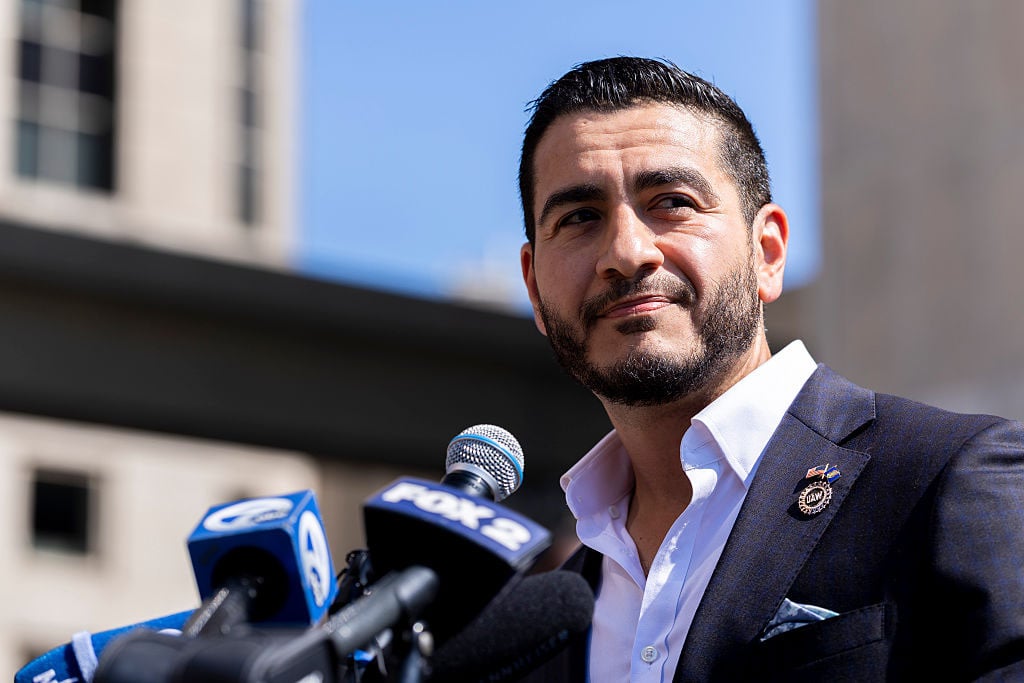
Abdul El-Sayed’s Michigan victory has forced Jewish Democrats to confront a question their party can no longer evade: How much are Jewish voters expected to tolerate in the name of defeating Donald Trump?
There comes a point when political loyalty collides with principle.
For Jewish Democrats in Michigan, that moment has arrived.
Abdul El-Sayed’s victory in the Democratic primary for U.S. Senate has created a political dilemma that reaches far beyond one candidate, one state or one election.
For decades, American Jews have been among the Democratic Party’s most dependable constituencies. They have voted Democratic, donated Democratic, organized Democratic and defended Democratic values.
Now some are being asked to support a nominee whose rhetoric about Israel, political association with Hasan Piker and response to an attack on a Michigan synagogue have caused profound concern among Jewish voters.
The alternative is Donald Trump and the possibility of continued Republican control of the Senate.
That is not much of a choice.
For Jewish Democrats, it is a political reckoning.
And this time, the Democratic Party should not assume that Jewish voters will simply fall in line.
When Condemnation Comes With an Explanation
After the attack on Temple Israel in West Bloomfield, El-Sayed condemned the violence.
But then came words that should trouble anyone concerned about antisemitism.
“Hurt people do hurt people,” El-Sayed said while discussing how events overseas can affect people in Michigan.
Think about what that means in this context.
A Jewish house of worship was attacked while children were inside, and the conversation turned toward explaining the anger that might produce such violence.
That is precisely where Jewish Americans should draw a line.
American Jews are not representatives of the Israeli government.
A Michigan synagogue is not an Israeli military installation.
Jewish children in West Bloomfield are not responsible for decisions made in Jerusalem.
When Jews are targeted in America, there should be no geopolitical asterisk attached to the condemnation.
No qualification.
No rationalization.
No “but.”
Political violence against Jews should be condemned for exactly what it is.
Period.
Hasan Piker Is Not a Footnote
Then there is Hasan Piker.
Piker has become one of America’s most prominent political streamers while generating repeated controversy through inflammatory rhetoric about the United States, Israel and Hamas.
El-Sayed says he does not agree with everything Piker has said.
But he continues to appear with him.
That matters.
Politicians cannot control every statement made by every supporter.
They can control whom they embrace.
They can control whose platforms they appear on.
They can control which political relationships they decide are worth maintaining.
For Jewish Democrats already wondering whether Zionists remain welcome in parts of the progressive movement, El-Sayed’s choices send a message.
He may not intend that message.
But Jewish voters are entitled to hear it.
Criticizing Israel Is Not the Issue
This distinction matters.
Criticism of Israel is not antisemitism.
Israel is a democracy whose own citizens argue passionately about settlements, Gaza, military policy, judicial reform, Palestinian statehood and the conduct of their government.
American Jews do the same.
The issue is not whether El-Sayed criticizes Israel.
The issue is the political worldview surrounding that criticism.
When a candidate refuses to clearly affirm Israel’s continued existence as a Jewish state, advocates ending American military assistance and maintains political alliances with figures whose rhetoric many Jews regard as deeply hostile, Jewish voters are entitled to ask difficult questions.
They are entitled to ask where criticism of Israeli policy ends and hostility toward Zionism begins.
And they are entitled to ask whether there remains room in the Democratic coalition for Jews who believe both in liberal Democratic values and in Israel’s right to exist.
Those questions cannot simply be dismissed as inconvenient.
Michigan Is a Warning to Democrats
What happens in Michigan will not stay in Michigan.
If El-Sayed wins in November, his victory will almost certainly be interpreted by the Democratic left as evidence that uncompromising opposition to Israel carries little political cost.
He will enter the United States Senate with an immediate national platform.
Activists will study his campaign.
Candidates will imitate it.
Presidential contenders will notice it.
And the battle over Israel inside the Democratic Party will accelerate heading toward 2028.
But if Jewish Democrats and other uneasy voters abandon El-Sayed and Republicans retain control of the Senate, Democrats will face another consequence.
A Republican Senate could continue advancing Trump’s nominees and legislative priorities.
That leaves Jewish Democrats confronting an extraordinarily uncomfortable question:
How much should they be expected to compromise on concerns about antisemitism and Israel in order to stop Donald Trump?
There is no easy answer.
But there is one answer Democrats should reject immediately:
Jewish voters should not simply be told to swallow their concerns and vote Democratic anyway.
Jewish Votes Are Not Democratic Property
For generations, Democrats have benefited from overwhelming Jewish support.
That history may have created a dangerous political assumption:
That Jewish voters have nowhere else to go.
That assumption is arrogant.
Jewish votes do not belong to the Democratic Party.
They do not belong to the Republican Party either.
They belong to Jewish voters.
Democrats cannot demand that Jews condemn antisemitism when it comes from the political right while minimizing rhetoric they consider threatening when it comes from the left.
Republicans, likewise, should not assume that Jewish anger toward progressive anti-Zionism automatically erases Jewish concerns about Trump.
Jewish voters should not have to choose which form of political extremism frightens them less.
They deserve something better.
El-Sayed Must Earn Their Votes
If El-Sayed wants Michigan’s Jewish Democrats to vote for him, the responsibility belongs to him.
Not to them.
He should not expect Jewish voters to support him simply because Republicans might otherwise control the Senate.
He should earn their support.
That means unequivocally separating American Jews from the actions of the Israeli government.
It means condemning attacks against Jewish institutions without explanations that can sound like rationalizations.
It means demonstrating that disagreement with Israel does not require treating Zionism itself as illegitimate.
It means taking seriously Jewish concerns about political allies whose rhetoric has caused profound offense and alarm.
And it means showing Michigan’s Jewish community that its security, religious freedom and dignity matter even when defending those principles creates friction with his own political base.
None of this requires El-Sayed to become pro-Israel.
It requires him to demonstrate that being anti-Israel does not mean being indifferent to the fears of American Jews.
That should be a very low bar for someone seeking membership in the United States Senate.
The Reckoning Has Arrived
But ultimately, this story is bigger than Abdul El-Sayed.
It is about the Democratic Party.
Democrats have spent years attempting to maintain an increasingly difficult coalition: progressives and moderates, Zionists and anti-Zionists, establishment Democrats and an activist left increasingly hostile toward Israel.
Political coalitions can survive disagreement.
They cannot survive contempt.
They cannot survive if one constituency begins to believe that its fears are taken seriously only when the person threatening them belongs to the opposing political party.
And they cannot survive if Jewish voters conclude that their place inside the coalition requires silence about antisemitism or Israel.
Jewish Democrats should not have to surrender their principles to prove their loyalty to the Democratic Party.
They should not have to ignore rhetoric they would condemn from Republicans simply because it comes from Democrats.
And they should never be told that refusing to support a candidate who has alienated them makes them responsible for the political consequences.
The burden is not on Jewish voters to explain why they are uncomfortable.
The burden is on political leaders to give them a reason not to be.
For years, Democrats could postpone this debate.
Michigan has ended that luxury.
The question now confronting the Democratic Party is brutally simple:
Does its coalition still have room for Jews who believe in progressive values and Israel’s right to exist?
Jewish Democrats are listening.
Jewish Democrats are watching.
And this time, Democrats should not assume they already know how Jewish Democrats will vote.