


The Demonstration in London: History’s Refrain and the Peril of Forgetfulness
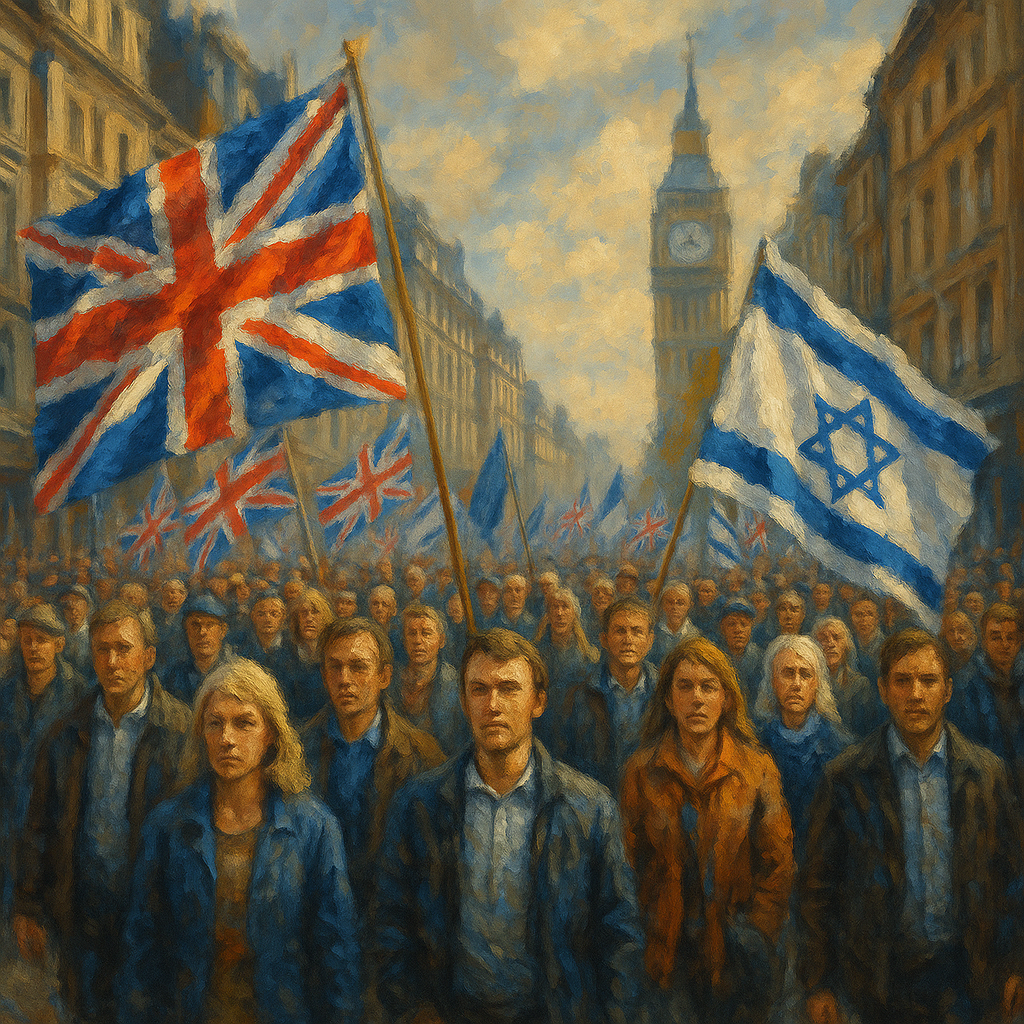
History does not repeat itself, but it rhymes, often to the point of nausea. When millions filled London’s streets on 13 September, it was easy for the political class and its media auxiliaries to dismiss the spectacle as yet another eruption of crude nationalism. But there was something else that the cameras caught, though most commentators preferred to ignore it: the flags of Britain and Israel flying side by side. It was an image that cut through the haze of slogans and accusations—two democracies bound in the understanding that sovereignty and accountability are not abstractions, but the lifeblood of survival.
To many journalists, this display was almost indecent. The Union Jack has long been treated as an embarrassment, to be tolerated only at football matches or royal weddings, and the Israeli flag is, of course, received in certain circles as nothing less than a provocation. Yet their juxtaposition spoke volumes. For those who carried them, the message was not complicated: we will not be shamed out of asserting our right to exist, nor will we yield to those who would strip us of dignity in the name of fashionable pieties.
The resonance with history is unavoidable. In the 19th century, the Chartists were ridiculed for carrying banners demanding “justice for all” when what they wanted was suffrage and representation. The Gordon Riots of 1780 were dismissed as mindless vandalism when in truth they revealed the hypocrisy of an empire that prated of liberty while practising selective emancipation. And in the 20th century, Jewish partisans who fought for survival were damned as terrorists by those too craven to acknowledge that self-defence is not a crime. The London demonstration, however discordant, stands in this lineage. The flags proclaimed that the demand for justice, for equality before the law, cannot be bludgeoned out of existence by editorial sneers.
What the demonstrators insisted upon, however inarticulately, was that sovereignty must be restored to meaning, that accountability must once again be more than an empty platitude. These are the very principles Israel has embodied since its founding, often in defiance of the same chorus of Western moralists who prefer “cycles of violence” to plain descriptions of murder and defence. That is why the Israeli flag was there, unfurled proudly beside the Union Jack: because both peoples know that weakness is not an option when enemies are unembarrassed about announcing their intention to annihilate you.
The double standard remains grotesque. Vast pro-Palestinian rallies—complete with chants for intifada and banners whitewashing Hamas—are described by the BBC and others as “protests for justice.” Yet when Britons and Jews march under their respective flags, demanding equality under the law and an end to selective blindness, they are scorned as extremists. The hypocrisy is not just tiresome; it is dangerous. Justice is either blind or it is nothing. If law enforcement, political leaders, and the media cannot treat all with the same neutrality, then they invite exactly the distrust and anger that filled the streets that day.
And what of Israel’s presence in this tableau? It was not incidental. It was a reminder that the struggle against selective justice and for national dignity is not confined to Britain. Israel is perpetually lectured on proportionality, on restraint, on the virtues of compromise, even as it buries its murdered civilians. Its very existence is measured not against its right to survive, but against whether its survival offends those who consider terrorism “resistance.” To march under the Israeli flag in London, then, was to remind the crowd—and perhaps the world—that justice and sovereignty are indivisible. If Britain squanders its own, it should not be surprised to see Israel treated the same way.
The lesson is old but must be restated. When law ceases to be an equaliser, when sovereignty is treated as negotiable, when accountability is a punchline, then societies begin to rot. Citizens lose trust, communities fracture, and demagogues prosper. The flags of Britain and Israel, fluttering together in London, proclaimed that the alternative is not despair but defiance. That the way forward is not in apologising for sovereignty but in asserting it. That justice cannot be bartered in the marketplace of political popularity, because once sold it cannot be bought back.
The 13 September march was messy, loud, and for many, unsettling. But history shows that the demand for justice rarely arrives in polite costume. Sometimes it arrives draped in flags, shouted through megaphones, and carried by those dismissed as rabble. To sneer at it is easy. To listen to it is harder. But if Britain wishes to remain more than a memory of what it once was, it will have to take seriously what those flags in the streets declared: that the rule of law must remain the great equaliser, and that sovereignty, whether British or Israeli, is not a dirty word but the first condition of freedom.