


The Design of Distrust: How Israel Became One Large Electoral School District
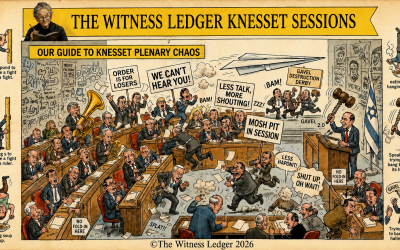
To understand why Israel’s political system seems to exist in a state of perpetual emergency, it is a mistake to start with the current slate of politicians. The ideological rivalries, the ego clashes, and the frantic midnight negotiations that dominate the headlines are merely surface symptoms. The real driver of the chaos is something much quieter, far more durable, and deeply embedded: the voting system itself. Israel’s political gridlock is not simply a failure of democratic intent, but in large measure the predictable outcome of how its electoral engine was constructed from the very beginning.
When the country held its first national elections for the Constituent Assembly in January 1949, the newly declared state was fighting for its physical survival while simultaneously absorbing hundreds of thousands of refugees and immigrants from post-war Europe and the Middle East. David Ben-Gurion and the founding leaders faced an unprecedented administrative challenge. They needed a fast, simple, and hyper-inclusive method to gather an extraordinarily fragmented population under one political roof. The population was divided by language, origin, religious observance, and radical ideological differences ranging from Marxist socialism to hardline nationalism.
To hold the fragile state together, the Provisional State Council made a fateful decision: they treated the entire geographic area of the state as one single, nationwide electoral district. Every citizen would vote for a centralized party list rather than a local representative, and every vote across the country would be dumped into a single national bucket.
Put into terms familiar to an American reader, Israel became one enormous electoral school district. Whether you lived in Haifa, Jerusalem, Tel Aviv, a kibbutz along the Lebanese border, or a small community in the Negev, there was no separate district electing its own representative. Everyone received the same national choices. Everyone’s vote went into the same nationwide calculation. And from that single pool, all 120 seats in the national legislature would ultimately be distributed.
The proportional representation model drew upon the electoral system already familiar from the institutions of the pre-state Yishuv and was particularly suited to the emergency circumstances of 1948 and 1949. The arrangement was not necessarily intended to settle the electoral question permanently. The Constituent Assembly was expected to draft a formal constitution, after which the young state could reconsider the structure of its political institutions and electoral system.
Instead, the provisional arrangement became the permanent foundation of the republic. The Constituent Assembly renamed itself the First Knesset, the promised constitution was never completed, and although proposals for regional or majoritarian elections were repeatedly advanced—including by Ben-Gurion himself—the basic nationwide proportional system survived.
The core philosophy behind this initial setup was radically democratic. Whatever the mixture of practical necessity, pre-state precedent, and political calculation behind its adoption, the system ensured that virtually every significant community, wave of immigration, and ideological niche had an opportunity to gain a seat at the national decision-making table. In a society divided among competing political, religious, ethnic, and ideological camps, proportional representation offered an important safeguard against allowing one dominant faction to permanently exclude its rivals.
However, a system engineered for broad inclusion carries a steep and unavoidable structural trade-off. By making it possible for numerous smaller groups to earn seats in the room, you make it extraordinarily difficult for a single party to command a clear majority. In the entire history of the State of Israel, across more than two dozen elections, no single political party has ever won the 61 seats required to form a government on its own. The system was constructed in a manner that makes decisive, single-party rule extraordinarily unlikely.
This brings us to the fundamental paradox that greets every Israeli inside the voting booth. In most Western presidential or constituency-based democracies, an election is a mechanism used to choose an executive or grant representatives from a particular party a mandate to govern. In Israel, an election is merely the opening whistle of an extended national bargaining session.
When a citizen steps behind the curtain on Election Day, they do not vote for an individual representative who lives in their district. They select a small paper slip printed with letters representing a national party, place it in an envelope, and drop it into a wooden box. They are not directly electing a prime minister, nor are they endorsing a localized legislative agenda. They are simply sending 120 party delegates into a crowded room to fight over the terms of a coalition deal.
The school-district analogy becomes particularly important here. Imagine that every school-board candidate in the United States ran not to represent a particular neighborhood, town, or ward, but on a single statewide list controlled by competing political organizations. Your local representative would disappear. Instead, your vote would help determine how many seats each organization received across the entire state. That is much closer to the relationship between an Israeli voter and the Knesset.
Because there are no local constituencies, members of the Knesset do not represent a specific city, region, or neighborhood. A voter in Haifa, a resident of a southern kibbutz, and an inhabitant of Jerusalem all look at the exact same ballot options. This setup creates a profound structural disconnect between citizens and their lawmakers. Knesset members are not accountable to a geographic constituency that can vote them out of office for failing to deliver local infrastructure or represent regional interests. Instead, their political futures depend heavily upon their position on a national party list. How those lists are determined varies from party to party: some use primaries, others rely upon party institutions or central committees, and still others give substantial authority to the party leadership.
Over the decades, numerous attempts were made to alter this dynamic by introducing regional elements or changing the percentage of votes a party needs to enter parliament. Israel has, in fact, changed important parts of its electoral system several times, including repeatedly raising the electoral threshold and, for a period beginning in 1996, directly electing the prime minister. Yet proposals to replace the fundamental nationwide proportional structure have repeatedly failed to command the political support necessary for such a major change. Parties operating successfully under the existing rules have powerful incentives to preserve a system upon which their own parliamentary representation depends.
Furthermore, without the stabilizing balance of a second legislative chamber or a single formal written constitution to define the boundaries of state power, the electoral system is forced to carry an unusual share of the weight of the nation’s social contract. The mechanics of the vote do not just determine who manages state ministries for a few years; they continuously re-open foundational, existential questions about the relationship between religion and the state, the limits of judicial authority, and the very identity of the republic.
What foreign observers often misinterpret as chronic political instability is, at least in part, the system functioning according to the incentives embedded within its design. The mechanics strongly favor representation and coalition government rather than the production of strong, single-party majorities capable of executing a sweeping, long-term national vision. What began as a system capable of accommodating an extraordinarily fragmented society also made it difficult for any single political tribe to gain total control.
The resulting political friction is not simply a bug in the software of Israeli democracy. It is a core feature of a political architecture whose origins lie in emergency, inclusion, compromise, and a deep reluctance to allow any single faction to dominate the state.
And now, you know why everyone is confused.
More to come….
-cartoon supplied with permission of The Witness Ledger
-for more article like this go to https://steventeplitsky.substack.com/