The Dignity of Choosing Your Own Cereal
More than twenty years ago, I asked my Uncle Sholom why Colel Chabad distributed food in a certain way.
I honestly don’t remember the details of the program itself. He probably doesn’t remember the conversation at all. But his answer stayed with me for decades.
“Just because someone is poor doesn’t mean they can’t choose what cereal they want for breakfast.”
As a child, I heard kindness in that sentence.
As an adult, I understand that what he was really talking about was dignity.
There are many organizations that feed people. Far fewer understand how humiliating it can feel to need help in the first place. Hunger is painful. But so is losing your sense of self, your privacy, your ability to choose.
That single sentence became, for me, the clearest explanation of what makes Colel Chabad different. Not just the scale of what they do, but the philosophy underneath it: people do not stop being people when they become needy.
A struggling mother still wants to buy her child’s favorite cereal.
A father still wants to walk into a supermarket without everyone knowing he cannot afford dinner.
People need dignity almost as much as they need food.
As a child, what struck me most about my uncle’s life was how exciting it seemed. Airports. Travel. Important meetings around the world.
I didn’t understand then that he wasn’t traveling because he enjoyed being away. I didn’t understand the exhaustion of carrying responsibility that never fully leaves your shoulders.
He would come home for the resting part and then leave again.
Only as an adult did I realize how much of ordinary life he quietly gave up in service of other people’s emergencies.
In 1978, the Lubavitcher Rebbe entrusted my uncle with the day-to-day operations and fundraising of Colel Chabad. And he carried that responsibility personally. Every detail mattered. Every number mattered. Every decimal point mattered.
I never once heard him complain about the weight of it.
But looking back now, I realize how much sacrifice existed quietly beneath the surface: how much family life was missed, how exhausting it must have been physically and emotionally, how impossible it is to carry responsibility for other people’s hunger and suffering year after year and ever fully put it down.
And yet somehow, in my childhood memory, he was always home for Shabbos.
What also always struck me about Colel Chabad was who they served. Need was never categorized. Help was not reserved for people who looked religious enough, connected enough, or familiar enough.
People needed help, so they were helped.
Some were religious.
Some completely secular.
Some lifelong members of the Charedi world.
Some people whose only real interaction with religious ritual came through tragedy.
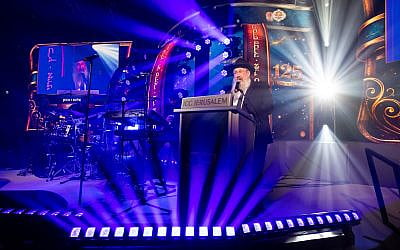
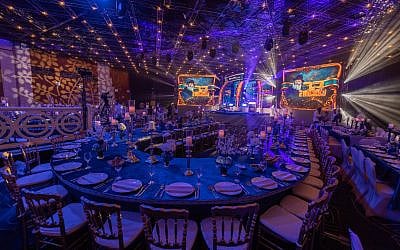
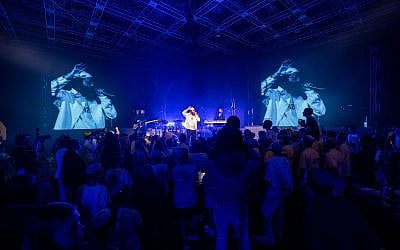
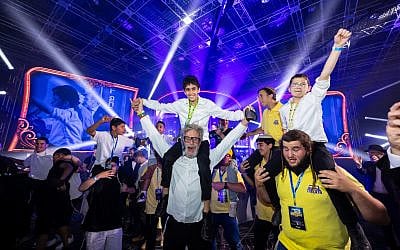
Yesterday, at Colel Chabad’s annual Bar Mitzvah celebration for 125 orphans, I saw that philosophy come alive in a way that was almost overwhelming.
Some of the boys had lost parents to illness.
Some to terror attacks.
Some to war.
Some had mothers but no fathers.
Some fathers but no mothers.
Some likely felt deeply at home in the religious atmosphere surrounding the day. Others may have encountered this level of ritual and observance only once before — at a parent’s funeral or during shiva.
And still, they all sat together.
Not flattened into one collective story, but celebrated simultaneously as individuals and as part of something larger than themselves.
As someone who works in events, I found myself watching the structure of the day almost as much as the emotions themselves. Nothing about it felt institutional, despite the staggering scale.
Every child arrived with family.
Every family had a place.
Each boy had individual photographs taken.
Each one walked to the Kotel in his own procession, surrounded by singing and dancing.
Each boy had his own aliyah.
Even later, in the massive convention hall with its marble floors, music, games, dancing, and elaborate tables, the event somehow protected the individuality of every single child.
It would have been easy for 125 boys to become a number.
Instead, each one remained a person.
At one point during the day, a young boy and his uncle quietly approached one of the organizers to say thank you. Around both of their necks hung replicas of the fallen father’s dog tags.
It was one of those moments that seemed to contain the entire event all at once: grief, pride, absence, continuity, and an entire community trying, however imperfectly, to help carry something unbearably heavy.
Another woman briefly stopped by simply to support the families celebrating that day. A widow and mother of five herself, supported by Colel Chabad through her own unimaginable reality, she came not because she had a Bar Mitzvah boy there — but because she understood what the day meant.
And maybe that is the real legacy of Colel Chabad. Not simply feeding people or clothing people or supporting people, though they do all of that on an extraordinary scale. It is the refusal to let suffering erase individuality.
Yesterday, during the celebration, I walked past a mother and son sitting quietly on the floor because they thought there was nowhere left to sit.
Before I even fully processed it, I was already moving chairs, finding them space, bringing them what they needed.
Not because I work for Colel Chabad. I don’t.
But because somewhere along the way, this instinct became part of me too.
I grew up in a family where guests were never supposed to feel uncomfortable. Where you noticed when someone felt left out. Where “going the extra mile” was not considered exceptional behavior — it was simply what decent people did.
My Bubby embodied that completely. She was endlessly proud of my uncle, not only because of the work itself, but because the Rebbe had entrusted her son with the responsibility for Chabad’s oldest active charity. To her, this was never about prestige. It was about responsibility, about service, about making people feel seen.
I used to love bringing her little “mitzvah notes” — stories about some Colel Chabad project or act of kindness I had witnessed — just to hear the pride in her voice.
Standing there yesterday, helping that mother and son find their place, I suddenly realized something:
The legacy of Colel Chabad is not only the programs themselves.
It is the creation of generations of people who instinctively believe responsibility belongs to them.
My Bubby would have understood that immediately.
Not the marble floors or the music or even the scale of the event.
She would have cared that nobody stayed sitting on the floor once they were seen.