The dog that did not bark
In my line of work, we deal in a world of binary outcomes. Either the incoming threat was intercepted or it wasn’t. There is no “we tried our best” in missile defense. If the warhead misses the target, then the system failed. Period. But as we look at the Portion of Mishpatim, we see a Torah that is trying to teach us something far more complex about the relationship between effort, results, and the messy reality of living in a neighborhood full of wolves.
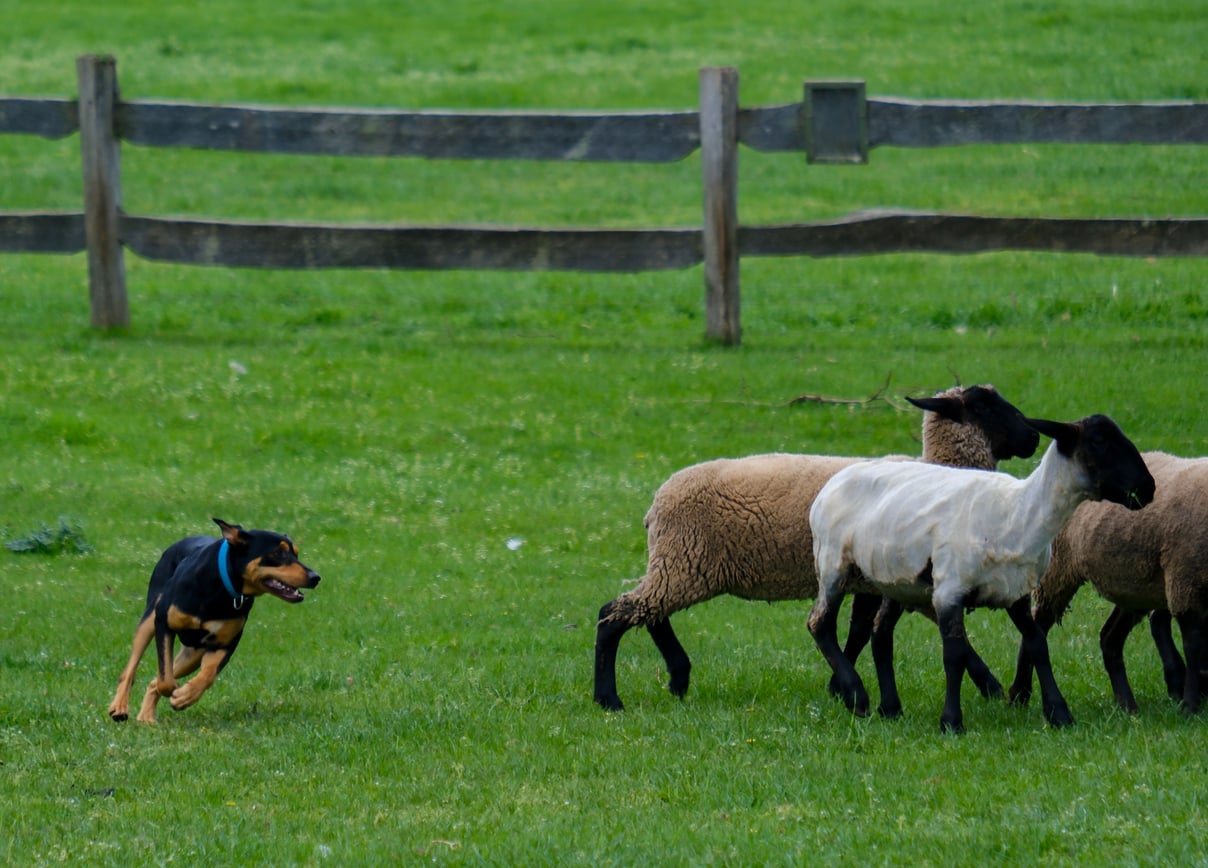
For nearly six years, my family has owned a dog named Chloe. Chloe is a “Corona dog,” adopted during that first lockdown when we were all improvising new routines to stay sane. Now, I must be frank: Chloe is not bright. This is not an insult; it is a technical specification. But Chloe has a critical function. Whenever anyone – a friend, a delivery driver, or a blowing leaf – comes near the house, she barks uncontrollably. She doesn’t investigate; she alerts. She ensures that no one in the house is asleep, just in case something is actually wrong. Chloe makes us ready. And it turns out that being the “alerter” who stands between a family and a threat is a deeply biblical role.
The story begins on the night of the final plague in Egypt. The Torah records a detail that most people gloss over [Shemot 11:7]: “But against any of the Children of Israel, not a dog will bark.” Dogs bark at almost anything, so the Torah is not just describing a quiet night; it is describing supernatural restraint. That silence mattered. Fast forward to the Portion of Mishpatim. The Torah is discussing meat from a dead animal discovered in the field. The instruction is [Shemot 22:30]: “You shall throw it to the dog.” Rashi[1] connects these two moments explicitly: Because the dogs did not bark in Egypt, they are rewarded here in the Portion of Mishpatim. Rashi’s point is that G-d does not withhold reward from any creature that performs even the smallest act of good.
But it is the Netziv[2] who takes this from a nice story to a gritty reality. The Netziv points out that the verse refers not to “a dog,” but to “the [definitive] dog (la-kelev),” specifically, the guard dog. This dog stands between the flock and the wolf. The Netziv explains that the reason we throw the meat to that dog is because that dog intervened. Even if the lamb ended up dead, even if the wolf succeeded in tearing the flesh, the dog is rewarded because it delayed, disrupted, and warned. It changed the situation enough that others could at least react.
Before we proceed, I must admit that using the Torah to describe modern geopolitical events is even more fraught with danger than using the Torah to describe scientific phenomena[3]. This is because the half-life of a geopolitical event is nearly always much shorter than even the most bizarre scientific hypothesis. Nevertheless, paraphrasing the Talmud in Tractate Berachot [62a]. “It is Torah and I must understand it,” and so we will proceed with care.
To understand the weight of the explanation of the Netziv, we must look at our own “field.” In this field, we have a Wolf. That Wolf is Iran, a predatory regime that does not just want a seat at the table; it wants to consume the flock. Then, we have the Guard Dog: the United States. And finally, there is the Owner of the flock: Israel. Now, here is where the binary of the engineer meets the complexity of the Torah. The United States is currently negotiating with the Iranians while simultaneously building an armada in the Persian Gulf. While the buildup was spurred by the brutal treatment of the Iranian government in their crackdown against demonstrators, there is no small chance that Iran and the United States will “strike a deal” that pertains only to the Iranian nuclear program, leaving Iranian missiles, proxies, and brutality off the table, and culminating in a hypothetical Witkoff-Kushner quote: “We tried. We tried to take away their ballistic missiles. We tried to rescue their citizens from the jaws of a regime that killed 30,000 people in two nights. We tried to defund Hezbollah and the Houthis. We were unsuccessful, but we tried. At least we got them to make some concessions in their nuclear program.”
As the Owner, that kind of logic simply doesn’t fly. We are the ones left holding the “dead lamb.” Those missiles are aimed at us. The Iranian regime, undeterred, will have no problem using them. The Torah understands our psychology perfectly. And so it does not say to “give” the meat to the dog; it says “throw (tashlichun) it.” Throwing is not a dignified act. It is reluctant. It is the act of an owner who is disappointed because the threat still exists and the damage is already done. The wolf is not gone. The Torah is telling us that even when we are frustrated, even when we wanted a “hero” who would eliminate the wolf entirely, we still have a moral obligation to recognize the effort of the guard dog. But, and this is crucial, the Torah also acknowledges that results matter to the owner.
This tension is highlighted by a subtle textual shift. In the Book of Exodus, the dog is mentioned and rewarded. But later, in the Book of Deuteronomy [14:21], the Torah repeats the same law about the carcass and yet the dog is nowhere to be found. There is no reward, no memory, just the law. The Netziv explains that the Book of Exodus is a book of memory. It is the book that remembers who stood where when it mattered. It evaluates moral action not only by the final outcome, but by the posture and the restraint of the actors. The Book of Deuteronomy, by contrast, is the book of structure and law. Unlike Exodus, it contains no stories, only dry law. Deuteronomy restates obligations without any of the emotional history.
When we are in the heat of the battle, in the “Book of Memory,” it is incumbent upon us to acknowledge those who did what they could do to reduce the harm, even if they could not eliminate it. We remember the midwives, Shifra and Puah[4], who did not overthrow Pharaoh but simply refused to comply with his evil. The Torah calls this the “Fear of G-d.” Their refusal to bark at Pharaoh’s command belongs to the same category as the dogs who stayed silent in Egypt. The Portion of Mishpatim is a lesson in what psychologist Lawrence Kohlberg called “moral adulthood.” Being an adult means accepting that the world is a dangerous place where outcomes are often incomplete. Being an adult means choosing responsibility even when we know we might not achieve total success.
However, for the Owner – for Israel – moral adulthood also means recognizing that we still have to deal with the wolves. We cannot live on effort alone. While we fulfill our obligation to the Guard Dog by throwing it the meat, and by doing so, recognizing the alliance and the warnings it provided, we cannot pretend that our baby lamb is not dead.
We are taught to live with this discipline: to value effort without demanding perfection, but also to never confuse a “bark” with a “victory.” Sometimes our role is to be the midwife who refuses. Sometimes it is to be the dog who does not bark, even when our must visceral instincts tell us we must. But most of the time, at least in this neighborhood, our role is to be the owner who stands guard, knowing that the wolf is going to return and knowing that, at the end of the day, we are the ones who are tasked with securing the fence. If we believe that G-d does not withhold reward from any creature, then effort matters. But for those of us who spend our lives standing in the field, we know that while silence can be a virtue, only results will keep the flock alive.
Shabbat Shalom,
Ari Sacher, Moreshet, 5786
—
Please daven for a Refu’a Shelema for Rachel bat Malka, Iris bat Chana, Shlomo ben Esther, Sheindel Devora bat Rina, Esther Sharon bat Chana Raizel, Meir ben Drora, and Hodayah Emunah bat Shoshana Rachel.
—
[1] Rabbi Shlomo Yitzchaki, known by his acronym “Rashi,” was the most eminent of the medieval commentators. He lived in northern France in the 11th century.
[2] Rabbi Naftali Tzvi Berlin, known as the Netziv, was the Dean of the prestigious Volozhn Yeshiva in Lithuania in the 19th century.
[3] See our shiur of Yitro 5786.
[4] See Shemot [1:15]