


Middle East Forum Fellow/North Africa Risk Consultant
The Dynastic Trap: Washington’s Realpolitik Gambit in Libya
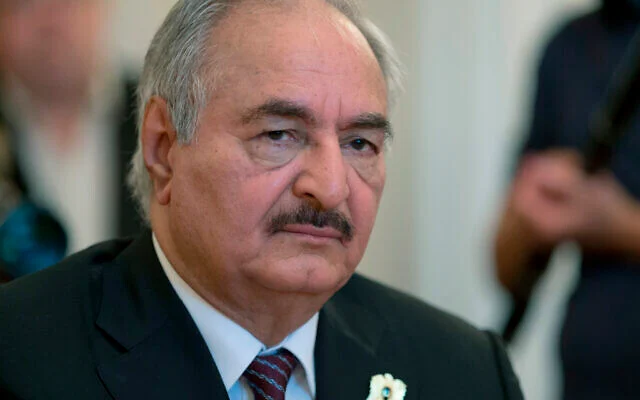
Libyan Gen. Khalifa Hifter joins a meeting in Athens, Greece, Jan. 17, 2020 (AP Photo/Thanassis Stavrakis, File)
Elevating Saddam Haftar offers temporary stabilization, but partitioning the state into family cartels invites systemic collapse.
The Logic of Transactional Stability
A decade and a half after the collapse of the Muammar Gaddafi regime, Libya has evolved from an active war zone into a highly structured ecosystem of managed instability. The formal division between the United Nations recognized Government of National Unity in Tripoli and the eastern based administration of Field Marshal Khalifa Haftar no longer represents a fluid ideological conflict. Instead, it operates as a calculated duopoly where rival factions utilize tactical crises to justify their mutual survival. Seeking to shatter this permanent transition, an aggressive diplomatic track spearheaded by United States Senior Adviser Massad Boulos has bypassed traditional, slow-moving multilateral frameworks in favor of an unapologetically transactional power sharing formula. This strategy attempts to trade macroeconomic predictability for elite political consolidation, leveraging a newly unified fiscal architecture to incentivize cooperation between the country’s two most powerful family networks.
Beneath the realpolitik veneer of this American mediation lies a volatile, top-down compromise. The proposed framework aims to install Lieutenant General Saddam Haftar, the designated heir of the eastern military apparatus, as head of an empowered Presidential Council, while allowing Abdul Hamid Dbeibah to retain his position as prime minister in Tripoli. By treating state building as a corporate restructuring negotiation between competing dynasties, Washington is gambling Libya’s long-term sovereignty on a localized elite bargain. While this approach addresses the immediate catastrophic risks of the status quo, it fundamentally miscalculates the deeper structural grievances of the Libyan body politic. By transforming state authority into liquid capital, the strategy merely modernizes the architecture of the impasse while shifting systemic risks toward a far more explosive future alignment.
The Realpolitik Case for the Family Compact
To evaluate the Boulos initiative accurately, one must first recognize the profound, immediate risks of the alternative. For years, conventional diplomacy has chased a comprehensive constitutional roadmap, an idealistic pursuit that has repeatedly stalled due to the calculated obstruction of entrenched institutional actors who benefit from state fragmentation. In the absence of a breakthrough, the status quo carried systemic vulnerabilities, including sudden central bank gridlocks, crippling currency devaluations, and recurring militia threats to shut down the vital Oil Crescent. By shifting to an economy first doctrine, current American mediation seeks to neutralize these vulnerabilities by binding the financial survival of rival elites to uninterrupted national resource production.
This strategy, quietly facilitated by regional partners like the United Arab Emirates and acknowledged by Egypt, yielded a historic milestone in April 2026: the authorization of Libya’s first unified national budget in thirteen years, a consolidated spending plan valued at 190 billion Libyan dinars. Backed by a critical allocation of 12 billion dinars to the National Oil Corporation, state oil production has subsequently surged to a decade high of nearly 1.49 million barrels per day. For the United States and European allies anxious over escalating global supply pressures, the stabilization of Libyan light-sweet crude flows represents a vital tactical asset. The synchronization of wealth distribution has temporarily strengthened the Libyan dinar on parallel markets to under seven per dollar, mitigating liquidity shortages and stabilizing domestic purchasing power. From a standpoint of pure realism, locking the Dbeibah and Haftar networks into a shared patronage matrix provides a functional buffer against immediate state collapse, satisfying international energy markets and external capitals.
The Fragility of Personalist Successions
The core vulnerability of this corporate peace, however, is its reliance on fragile, personalized pacts that lack any institutional or legal depth. By formalizing an architecture that explicitly empowers the next generation of political dynasties, the Western strategy validates an unaccountable cartel system operating above the law. History offers a stern warning against such narrow elite bargains. Regionally, the attempt to enforce dynastic succession within highly personalized networks without broad societal consensus has consistently paved the way for institutional rot and ultimate collapse. This dynamic is illustrated by the eventual unraveling of Ali Abdullah Saleh’s family patronage system in Yemen or the rigid, combustible elite pacts of post-2003 Iraq. When sovereignty is treated as an inheritable asset rather than a public mandate, the state loses its stabilizing legitimacy, transforming into a brittle vehicle for private enrichment.
Furthermore, this arrangement introduces a highly unpredictable variable by miscalculating the internal power dynamics within the eastern military command itself. The rapid concentration of political, financial, and security authorities in the hands of Saddam Haftar has generated palpable undercurrents of friction within his own family. His brothers, Khalid and Belqasim Haftar, who command parallel security units and developmental investment funds, view this individualized elevation with deep institutional skepticism. By anchoring a national stabilization strategy to a specific familial succession plan, Washington is building its policy on an exceptionally personalist foundation. If internal fractures split the eastern military command following the eventual departure of its aging patriarch, the temporary stability purchased by the Boulos deal will dissolve, leaving behind a highly weaponized, fractured security landscape without any institutional safety valves.
A critical second-order risk of this strategy is that the formalization of a family cartel structurally mutates the nature of militia engagement across the country. Instead of competing for local legitimacy or territorial buffers, armed groups are increasingly incentivized to become armed asset managers, competing for slices of the 190 billion dinar budget. This shifts the conflict from a geopolitical struggle into an aggressive battle for financial rent-seeking, completely hollowing out the technocratic independence of vital institutions like the Central Bank and the National Oil Corporation.
The Misrata Crucible and Institutional Resistance
The immediate domestic reaction to this top-down diplomacy underscores the absolute limits of external engineering in a hyper-fragmented landscape. Resistance has been particularly acute in Misrata, the historical powerhouse of western Libya’s military and merchant elite. For the leaders, revolutionary brigades, and civil society networks of Misrata, the formal elevation of Saddam Haftar represents an existential threat and an unacceptable capitulation to the forces that besieged the capital during the devastating 2019 conflict. High-level encounters between American representatives and Misratan power brokers recently concluded in public acrimony, marked by protests denouncing the initiative as a suspicious foreign deal designed to institutionalize military autocracy.
This localized resistance creates a profound security paradox for the Tripoli executive. If Prime Minister Dbeibah fully embraces the Washington compact to protect his international standing, he risks provoking an immediate mutiny among the western armed groups that form his immediate physical shield. Conversely, if he rejects the arrangement, he faces financial strangulation and potential diplomatic isolation from Western backers. This polarization is mirrored across Libya’s institutional landscape. The Presidential Council, led by Mohamed al-Menfi, has repeatedly cautioned against narrow bilateral settlements that bypass comprehensive national reconciliation, while the High Council of State has raised sharp constitutional objections to the Boulos framework. When international initiatives lack broad-based domestic buy-in, they transform the political arena into a zero-sum struggle for survival, significantly increasing the likelihood that a localized miscalculation will trigger a return to open civil conflict.
A Sovereign Paradigm for Sustainable Stabilization
Breaking Libya’s permanent transition requires a fundamental shift away from dynastic engineering and toward durable, rule-based frameworks. A realistic alternative must begin with the immediate transition of the Boulos track into a reformed, multilateral framework under the auspices of the United Nations, preventing external actors from running competing, destabilizing negotiations. Financial integration, such as the implementation of the 190 billion dinar budget, must be conditioned on strict, internationally audited transparency mechanisms, ensuring that oil windfalls are channeled into public infrastructure rather than the preservation of militia networks.
Instead of partitioning military command into permanent family fiefdoms along geographic lines, international support should focus on incremental institutional integration, building on recent tactical dialogues in Sirte to establish a unified defense doctrine. The impressive turnout in recent municipal elections conclusively demonstrates that the Libyan populace retains a powerful appetite for democratic accountability when provided with a secure, legitimate process. The current American strategy provides a temporary economic truce, but it does so by entrenching the very actors responsible for the state’s fragmentation. Until Washington and its allies realize that sustainable stability cannot be engineered through proxy cartels, Libya will remain trapped in a fragile transition, running out of time before the next inevitable descent into systemic conflict.