Professional Indian author and strategic affairs writer.
The Eighth Front: Israel’s UN Vow and India’s Multi-Aligned Tightrope
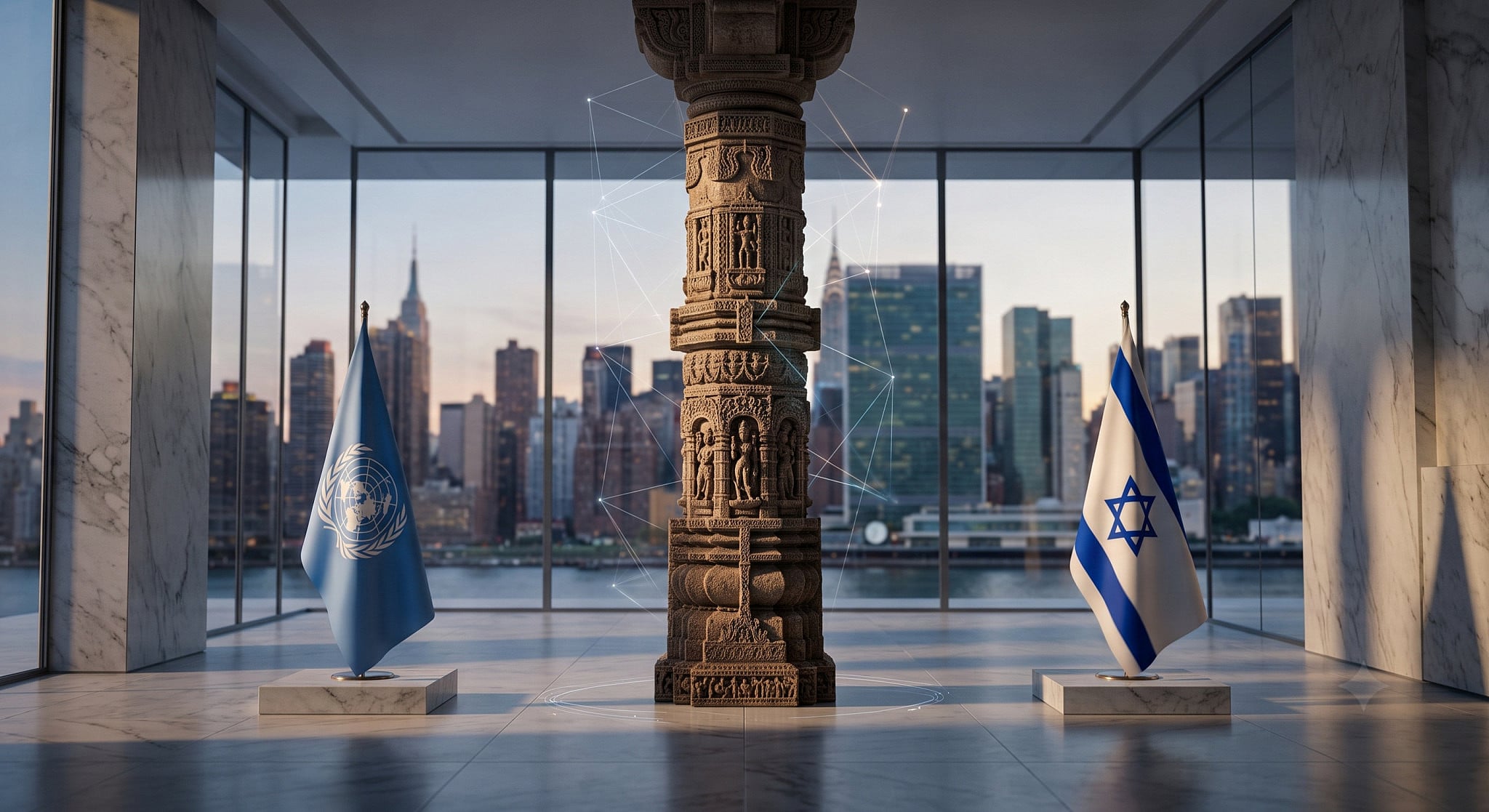
Conceptual illustration: An intricately carved Indian pillar stands anchored between the flags of the United Nations and Israel against a modern diplomatic skyline, symbolizing New Delhi's deeply rooted, multi-aligned balance amidst the growing friction of Jerusalem's 'eighth front' with international institutions. Image: AI-generated (Free for commercial use).
I watched Benjamin Netanyahu take the podium at the 81st United Nations General Assembly this week. Dozens of delegates walked out as he prepared to speak. The Israeli Prime Minister delivered a fiercely defiant address. He told the assembly that his country was fighting a war on seven military fronts. He then declared the existence of an eighth front. He called it the war for truth, fought against global media and international institutions. He accused the United Nations of staggering hypocrisy.
From my desk in India, the contrast in diplomatic styles feels vast. India helped found the United Nations. New Delhi regularly champions the voices of the Global South. Yet India also recently elevated its relationship with Israel to a Special Strategic Partnership. We are watching a severe and growing rift between Jerusalem and the international community.
India navigates this tension through strict realism. Western analysts often expect New Delhi to issue dramatic condemnations or pick permanent sides. Indian foreign policy simply does not work that way. We rely heavily on the Gulf for energy security and the livelihoods of millions of Indian expatriates. A single reckless diplomatic statement could devastate the economic reality of millions of families back home. Therefore, India maintains robust ties with Saudi Arabia, the UAE, Iran, and the Palestinian leadership, all while expanding defense and technology cooperation with Israel.
Netanyahu chose a loud, confrontational approach at the UN. India prefers quiet, pragmatic diplomacy. We avoid emotional posturing because flexibility keeps you alive in a complex neighborhood.
The widening gap between Israel and the UN reveals a larger trend. Large multinational institutions often paralyze themselves with ideological battles. This reality pushes India to prioritize minilateral alliances. Frameworks like the I2U2 group, which unites India, Israel, the United States, and the UAE, are taking center stage. These smaller coalitions focus on practical outcomes like food security and renewable energy. They bypass the theatrical politics of the General Assembly.
We are entering an era where grand international bodies struggle to maintain relevance. Pragmatic nations will increasingly rely on tight, functional networks to secure their interests. India will continue to walk its multi-aligned tightrope. We will do so quietly, efficiently, and entirely on our own terms.
Related Topics