


The Election Was a Success. But What About the Patient?

Parashat Vayishlach: Jacob Saw the Face of God in the Brother He Feared. Can Israel See It in Its Arab Citizens?
“The operation was a success. The patient died.” An old joke offers a troubling warning for our political moment. Elections can be won, opponents defeated, and governments replaced. But if victory leaves us incapable of recognizing one another as fellow citizens, what exactly have we saved?
Israel’s October elections produced a political deadlock: Netanyahu’s bloc holds 53 seats, his Jewish opponents 48, and Arab parties a historic 19. Those 19 seats raise a question far beyond coalition arithmetic: Can a democracy genuinely embrace equal citizenship while treating an entire segment of its electorate as politically illegitimate? Can we celebrate the success of an election while ignoring the voices of nearly one-sixth of those elected?
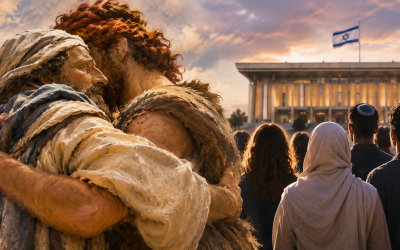
Parashat Vayishlach offers a remarkable perspective. Twenty years earlier, Jacob secured his brother’s birthright and his father’s blessing through deception. His victory cost him exile, estrangement, and years of fearing Esau’s revenge. When they finally meet, Jacob expects hostility. Instead, Esau embraces him, and they weep. Jacob responds with extraordinary words:
For seeing your face is like seeing the face of God (Genesis 33:10)
Esau is no ordinary rival. He once threatened to kill Jacob. Yet Jacob discovers the divine image in the face of the very person he has feared as a mortal enemy.
The Talmud teaches that the Torah warns us thirty-six times, concerning our treatment of the stranger (Bava Metzia 59b). Perhaps because loving those who resemble us comes naturally, while recognizing the dignity of those who differ from us requires deliberate moral effort.
And that is precisely what liberal democracy demands. In Israel, the nineteen seats won by Arab parties represent citizens whose political voice cannot be erased because their identity, history, or national aspirations make others uncomfortable. We may oppose their parties’ positions or reject particular alliances. But disagreement cannot justify treating nearly one-fifth of the Knesset as though it does not belong.
In a society shaped by generations of conflict and fear, it is easy to speak of equality in the abstract. It is considerably harder to practice it when those demanding recognition are people we have learned to fear.
Jacob and Esau embrace, then follow separate paths. Reconciliation requires neither agreement nor forgetting painful history. It begins with recognizing the humanity of those we fear.
Can we see the face of God not only in political rivals, but also in those we have been taught to regard as enemies? Can we imagine a democracy in which Arab citizens help shape our shared future rather than remain permanent outsiders?
A democracy cannot be healed while millions of its citizens are treated as a problem to be managed rather than as people who belong.
Winning an election may give us the power to govern. Recognizing the humanity of those we fear makes a country worth governing.
That is how we keep the patient alive.
May we find the courage to see the face of God even in those we have learned to fear, and the wisdom to build a future in which we all belong.
Shabbat Shalom!