


The Elephant in the Room
On Ohad Naharin’s ZŌ, and what we are not yet saying
I went to see Ohad Naharin’s ZŌ knowing something of his work, knowing something of gaga, the movement language he has spent decades building into a philosophy of the body.
At the end, a colorful elephant was inflated in the middle of the room, and I felt joy in the revelation of something hidden.
ZŌ is about the body pushed further than I had seen gaga taken before. Naharin has always believed that movement begins where language fails, but in this work he went somewhere new. The face. The voice. The eyes. The dancers were not performing feeling. They were occupied by it, moved through by something they did not entirely govern. And then they looked at us. Not the performed gaze of theater, not the fourth wall thinly pretending to hold. They looked at us the way people look when they connect truly.
We have been in this war for nearly three years now. I do not mean only the military fact of it, though that is real and ongoing and close. I mean the other war, the one happening in our families, in our societies, in the world. The one you see in the drivers on the highway who have forgotten the distance between speed and a weapon. In the argument that escalates past the point of its own logic. In the child who shakes when he hears an ambulance. In the way we have stopped trusting what we read.
Collective trauma does not announce itself. It does not come with a diagnosis or a date of onset. It settles into the body and into society the way fog settles into a valley, gradually, completely, until you can no longer see what the landscape looked like before. We are living in that fog. Most of us are not aware we are living in it. We call it by other names: fatigue, irritability, political division, the difficulty of hope. Polarization, manipulation, the endless noise of false information, an overwhelming sense of helplessness.
And then an elephant appears.
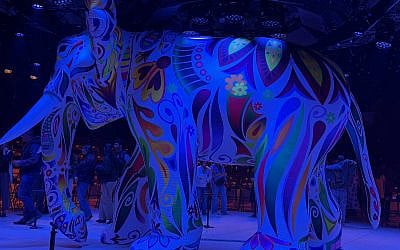
Brightly colored. Absurd. Enormous. Taking up the space that had been, until that moment, carefully managed. It was the thing we do not say at the dinner table. The grief we have agreed, collectively and without discussion, to set aside because there is always something more urgent, because the sirens are still real, because mourning cannot be completed when the threat has not ended. The elephant was all of that. And because it was colored in celebration, in festivity, it was also bearable. It was almost tender. Naharin gave us permission to look at the unspeakable thing without having to call it by its name, and to let each one of us find, in that permission, their own unspeakable.
This is what art can do that clinical language cannot. It does not pathologize. It does not fix. It offers, instead, a form of witnessing that does not require us to collapse. It says: I see what you are carrying. It is very large. You are not imagining it.
I think about gaga in this context, not only as a movement practice but as a response to exactly this kind of accumulated weight. Gaga asks the body to stop performing and start listening. To release the habitual bracing. To find the essential movement, the movement that was always there beneath the constructed one. In a society where the nervous system has been on alert for years, where the body has learned to hold itself in perpetual readiness, this is not a small invitation. It is a radical one.
This week I sat with a group of community workers from the upper Galilee. They work in villages close to the border. They have been holding others through destruction and losses I cannot fully imagine, and they have been holding themselves, which is the harder task. One of them quoted the verse I carry like a compass: ve’berachta b’haim, and you shall choose life. She said it even though there were tears. Not instead of them. Together with them. And I thought: this is the movement. Not the absence of grief and difficulty but the insistence of life inside it. Not the resolution of the wound but the refusal to let the wound become the only story.
ZŌ did not give me answers. It gave me something rarer, the sense that someone else had seen the elephant too, and had found a way to put it in the room without letting it crush everything. Naharin made it colorful. He made it strange. He made it, somehow, survivable.
That is not nothing. In a world that has forgotten what silence sounds like, it is almost everything. But seeing the elephant is only the beginning. Now we have to learn to move with it, before it moves us.