


The ELLYON Airframe Paradox
On a sweltering July morning at the Farnborough Airshow—a venue where defense contractors gather to sell multi-billion-dollar death machines while eating lukewarm lukewarm sausage rolls—Israel Aerospace Industries (IAI) unveiled its latest triumph of corporate audacity: the ELLYON.
On paper, the ELLYON is an engineering masterpiece. It is an all-in-one electronic warfare platform built to jam enemy radar, intercept radio chatter, and let artificial intelligence coordinate air strikes while the crew sits comfortably hundreds of miles away.
In reality, it is also a masterclass in geopolitical gaslighting.
Buried inside the glossy brochures handed out to diplomats was a hilarious little detail: the base airframe chosen for Israel’s next-generation electronic attack plane was the Bombardier Global 6500—a plush, ultra-long-range luxury jet manufactured on an assembly line in Montreal.
This created an immediate, delightfully awkward crisis in Ottawa. For months, Global Affairs Canada had been standing at the international podium, beating its chest about strict military export pauses to Israeli defense firms. Yet here was Israel’s premier state-owned defense contractor essentially telling the world, “Thanks for the wings, Canada! We’ll take it from here.”
The Grand Loophole Shuffle
How do you turn a polite Canadian commuter jet into an Israeli radar-frying war machine without upsetting the lawyers? You don’t break the law. You just dance around it until the law gets dizzy and falls over.
An examination of international trade regulations reveals the brilliant, three-step shell game defense contractors use to make diplomatic embargoes look like mild speed bumps:
1. The “It’s Just a Bus with Leather Seats” Defense
When a Bombardier Global 6500 rolls off the factory floor in Quebec, it isn’t a warplane. It’s a “green aircraft”—a naked, unarmored metal tube with zero jammers, zero missiles, and a very nice espresso machine. Under Canadian law, exporting a civilian jet is completely legal. It’s not a weapon; it’s high-altitude real estate.
If Ottawa won’t sell one to a defense firm directly? No problem. A third-party leasing company in Zurich buys it, passes it to a broker in Cyprus, and voilà—the plane arrives in Israel clean as a whistle.
2. Laundering the Airframe
Canada’s legal jurisdiction, inconveniently for Canadian politicians, ends at the Canadian border. Once the jet lands in Israel, IAI’s technicians pull out the power tools.
They saw open the belly, bolt massive AESA radar pods to the sides, and string miles of military-grade wiring through the cabin. Because every single piece of military hardware installed on the plane was designed, welded, and coded inside Israel, no Canadian military technology ever crossed a border.
Technically speaking, Canada just exported a bus. Israel just happened to turn it into an armored tank after it parked.
3. “We Can Always Use a Dassault”
When reporters pressed IAI on whether Canadian export restrictions would ruin their shiny new product, executives offered a response that was equal parts corporate diplomacy and a subtle middle finger: the jet on the cover is purely optional.
“The system can be integrated onto several large business jet platforms.”
— IAI Marketing Prospectus
Translation: “If Canada gets squeamish, we’ll just bolt our radar onto a Gulfstream or a French Falcon.” By making the military payload platform-agnostic, IAI proved that in the modern arms market, hardware is king, and national embargoes are just polite suggestions.
A Sales Pitch in Search of a Buyer
The punchline to the whole affair? The entire diplomatic row is over a plane that doesn’t actually exist yet.
The Bottom Line
The story of the ELLYON isn’t a dark tale of illegal arms smuggling. It’s much funnier than that. It is the story of how modern defense contractors have turned supply chain architecture into an art form—ensuring that no matter how loudly politicians preach about ethics, the arms business never misses a flight.
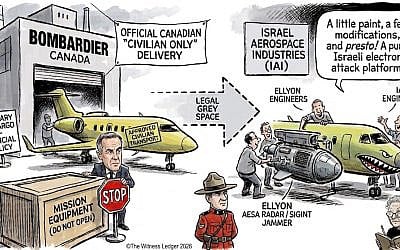
– cartoon with permission from and courtesy of The Witness Ledger
–for similar article follow me on https://substack.com/@steventeplitsky