
Looking forward
The End of Jewish Anti-Zionism
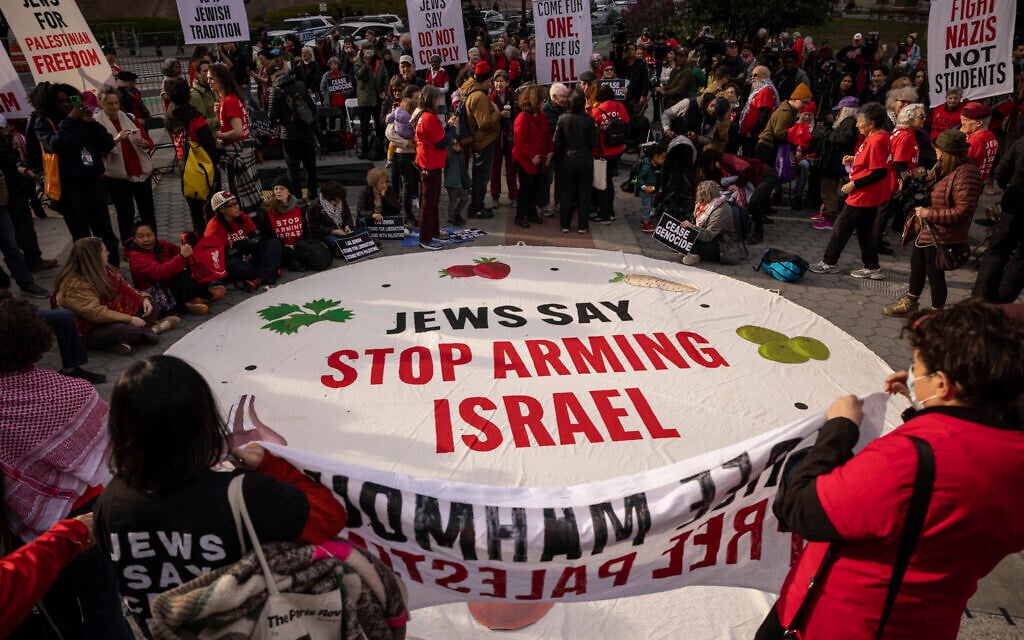
Protesters and members of the Jewish Voice for Peace gather in support of Columbia graduate student Mahmoud Khalil outside the Federal Plaza, Monday, April 14, 2025, in New York. (AP Photo/Yuki Iwamura)
What can we learn about the purpose of Jewish anti-Zionism and its pattern in history?
(This article can be thought of as Part II of a series sparked by my conversation with Peter Beinart about my book, and the responses I’ve received. I am not sure how long the series will last, so bear with me if the topic of Jewish Anti-Zionism isn’t high on your list.)
The end goal of Jewish anti-Zionists such as Peter Beinart is the transformation of Israel into a ‘State of All Its Citizens’ with an identity separate and distinct from that of the Jewish People. How this would practically happen is often described in broad brushstrokes as a copy of the South African model: Israel would naturalize all of the residents of the lands it militarily occupies (in Judea, Samaria, and Gaza), and remove or rewrite any laws which could be interpreted as giving preference to the Jews over the non-Jewish residents of the Land. As a result, a new Israel-Palestine would arise, a true liberal democracy with equal rights for all, where every resident between the River and the Sea will be free to pursue life, liberty, and happiness.
(Yes, I recognize that this is a generous interpretation of Jewish anti-Zionism, and is explicitly not what most antizionists want, which, in their own words, is for Jews to ‘go back to where they came from,’ wherever that is. My goal here is not to argue with the non-Jewish antizionists, but to deepen our understanding Jewish anti-Zionism and its desired end.)
On the face of it, it is hard to oppose this utopian vision: the Jewish People would remain in the land of their ancestors and be afforded all of the rights and responsibilities of a liberal, democratic state that would defend their individual aspirations. Jewish communities could flourish as they do on the Upper West Side of Manhattan, Jewish kids could benefit from the diversity of their regional neighbors, and non-Jews – a large part of whom may define themselves as Palestinians – will have no more objection to Jewish presence in the land because they now have equitable representation in government. Problem solved?
Not exactly. Because what Beinart and Jewish anti-Zionists seem to skip over is that liberal democracy does not end with the right to vote. Voting – and political participation – is where liberal democracy begins. And what we are learning from the various experiments in democracy around the world is that a state without a national spirit, without a shared sense of belonging, without a commonality of values, without a sense of community, polarizes, splinters, and starts to fall apart. And as they do, strongmen arise with the promise of making the political community great again, national institutions are given far-reaching power to impose an identity on the recalcitrant masses, and civil strife edges towards civil war.
Take Israel, for example, where even among the Jews we fear the risk of a civil war due to fundamental disagreements about the nature of citizenship and the legal and philosophical foundations of the State. Prior to the murderous invasion of October 7th, and in recent months when the war lowered to a simmer, citizens have taken to the streets in protests that have turned increasingly violent. Israeli Jews by and large recognize that we have lost our common narrative, and that developing a new one is the only hope we have for a common future. At this moment, only 22% of Israel’s citizens are not Jewish. Just imagine the tension, the fault lines, if one state were created wherein half of the citizens believe the other half have no right to the land at worst, and feel little to no obligation to their well-being at the best. Political strife would tear the country apart, as it is tearing at other more homogeneous countries across Europe and North America.
Were this trend against liberal democracy present in only one or two mature democracies, the Jewish anti-Zionists could be forgiven for their faith in the overriding ability of liberal institutions to overcome cultural differences within a polity. But since the trend of democratic backsliding is a global one, and its effects have hit Jewish anti-Zionists in their home countries, one needs to ask why it is that they have such faith in the chosen end of their ideology? Why do they believe that the Jews of Israel and the Arabs of Palestine will do better than the peoples of Yugoslavia? Why should the Irish have a State and not be equal British citizens?
Which is why I have come to understand Jewish anti-Zionism as yet another example of Jewish millenarianism: a messianic faith in the coming of an age beyond history, an apocalypse after which will come everlasting peace. The followers of Peter Beinart are no different in this way than those of St. Peter: they share the faith that there is a divine good that will be imposed on this earth, that can be imposed on this complicated, stiffnecked People, after which all will be well and we will see no more struggles.
Judaism rejects millenarianism, and the Jewish People have made it our mission to avoid the apocalypse. As Hillel Halkin writes in his incredible biography of Yehuda Halevi (which, as an aside, I think someone needs to turn into an epic film), Judaism is not a religion of faith; it is a commitment to action in an imperfect world. Those Jews who avoided the siren’s call of millenarianism over the ages did so because they found beauty in the daily work of making the world better. They found purpose in community action, and understood that they will only thrive if they remain in solidarity with those who share their feelings of mutual obligation and the values by which they seek to improve the world one day at a time.
Which is why Judaism is so compatible with liberal democracy, and why so many Jews in Israel joined the liberal democratic movement out of an instinctual reaction against the authoritarian overreach of our current government. Because we know what happens when strongmen seek to impose their vision of the kingdom of heaven on earth. Because we know that self-determination requires a resolute stand against coercion near and far. Which is why we who continue to fight against the military occupation do so due to our commitment to Israel and its founding ideals.
The end of Jewish anti-Zionism is, therefore, incompatible with Judaism and the Jews. Like other millenarian movements, its followers will either break off or integrate into the popular culture of their day, all while retaining a resentment to their former people who just couldn’t see the light. We who remain of the Jewish People will need to grapple with the imperfections of the Jewish State without them. And the less energy we spend fighting or arguing with them, and the more opportunities we give them to rejoin our efforts to make the world better one day at a time, the more likely we will be to achieve a peaceful resolution to the conflict we have been mired in for over a century with our fellow residents of the Land.
Related Topics
Related Posts