President of Shahvand Think Tank
The End of Masks
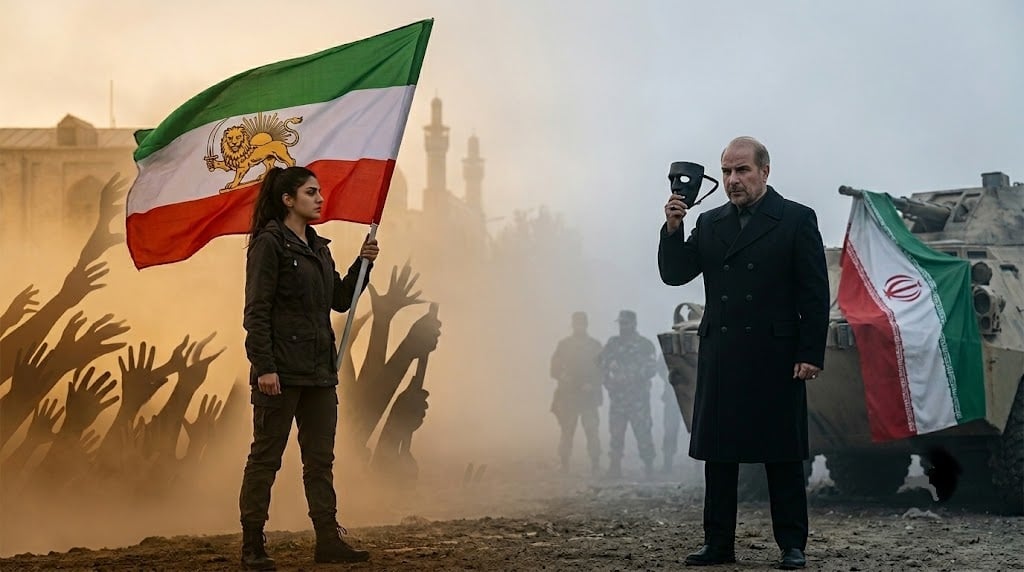
Image Source: Shahvand; The end of the masks
The Battle Over the Future of Iran
In the heart of the Lion and Sun national revolution, simultaneous with the suppression of the defenseless people of Iran by the Islamic Republic and against the backdrop of regional developments, a strategic reality has become increasingly apparent to the Iranian nation: the formation of an anti-national front that serves as a direct continuation of the political forces emerging from the 1979 revolution and anti-Iranian currents. This front operates not necessarily as a formal alliance, but as a functional convergence whose shared objective is to prevent the rise of a national, independent, and inclusive alternative for the future of Iran.
This heterogeneous yet purposeful convergence spans a spectrum from Reformists and Principalists to sections of the traditional left and certain republicans influenced by the same discourse. Abroad, a network of political and civil activists, particularly in Europe and the United States, operates under slogans such as anti-imperialism, effectively working to maintain the status quo and expending their energy to counter the genuine forces opposing the Islamic Republic. The extensive campaigns against Prince Reza Pahlavi and the Lion and Sun national movement, accompanied by a high volume of character assassination and political narrative-manufacturing, have shown that a significant portion of these currents is more concerned with preserving their historical narratives and political positions than with resolving Iran’s crises.
Nevertheless, the social reality within Iran demonstrates that despite their media presence, these currents lack broad popular backing and are gradually turning into an isolated minority. This structural weakness has rendered their behavior more aggressive, shaping a form of defensive radicalism—a state where the intensity of political attacks attempts to conceal the absence of social legitimacy. More than ever, the Iranian nation has realized that the path to victory is possible only through independence from these destructive currents and the continuity of the national will.
Paradigm Shift: From Regime Change to Revolution
The recent positions and declarations of Prince Reza Pahlavi must be analyzed within this very framework. Following the closure of all pathways for intra-structural reform, continuing a gradualist strategy no longer seemed viable, and reassessing the strategy became a necessity for the defense of Iran and Iranians—a shift that does not merely remain at the level of vocabulary but has reached the level of a political paradigm.
Within this framework, the transition from the concept of “regime change” to “revolution” acquires a fresh meaning. Revolution is a response to conditions in which a regime uses naked violence to block the final avenues of peaceful protest. The concept of the “Lion and Sun Revolution” is also introduced within this context; a space where the historical symbol of the Lion and Sun, whose background and evolution can be traced throughout the history of the flag, is presented as an alternative to the official ideology of the Islamic Republic, shifting the source of legitimacy from religious ideology to national identity. In this view, the nation of Iran becomes the primary subject of politics, rather than an ideological ummah in service of a religious government.
Prince Reza Pahlavi has similarly grounded his position on a set of clear principles. In various interviews and speeches, including his appearances with media outlets such as CBS and ABC, he has consistently emphasized four core principles: maintaining the territorial integrity of Iran, the separation of religion from state, the equality of all citizens before the law, and leaving the determination of the future political system’s form to the free vote of the people.
These same principles are emphasized on the official website of Reza Pahlavi, where he introduces himself not as a claimant to power, but as a facilitator of the transition to a democratic and secular system. These positions have been widely reflected in international media, including Iran International. From this perspective, raising the idea of a transitional government in conversations with outlets like The Economist can be understood as an effort to think ahead to the day after the collapse of the Islamic Republic and to prevent a power vacuum—a stage where civil institutions and the rule of law will replace security and ideological networks.
The Path Ahead: From National Solidarity to Political Organization
By bypassing the obstructionism of the anti-national front, the Lion and Sun national revolution is consolidating its position as an effective current within the Iranian political landscape. In many international analyses, the role of Prince Reza Pahlavi has been highlighted as a potential catalyst for the convergence of diverse opposition forces and the presentation of a democratic alternative.
Inside the country, small and flexible cells form the backbone of this movement. Actions such as writing slogans, displaying national symbols, and scattered yet continuous activities in public spaces keep the presence of this current alive and help strengthen a sense of national solidarity.
Abroad, the Iranian diaspora has entered a phase of organization and strategic discipline. The large gatherings of Iranians in various cities around the world in 2026 demonstrate that an organized and purposeful presence can yield a far greater political impact than scattered actions. Alongside this, expanding activities in the digital space and producing analytical content are gradually turning the narrative of the Lion and Sun revolution into one of the prominent discourses among Iranians.
International events, particularly the FIFA World Cup, have provided unique opportunities to project this narrative. The organized presence of Iranians holding the Lion and Sun flag around stadiums, combined with extensive media coverage of this presence, has increasingly tied this symbol to the national and democratic demands of Iranians. Published visual reports of large Iranian gatherings in various cities across the globe, along with symbolic disputes surrounding the flag during Iran’s matches, show that the Lion and Sun has become one of the most vital markers of political identity for the opponents of the Islamic Republic.
The visibility of a single flag, a single symbol, and a shared message from Iranians in different parts of the world is not merely a media event; it represents a symbolic and psychological victory for the Iranian nation. This visual convergence shows that, contrary to the official narrative of the Islamic Republic, a large segment of Iranians holds a fundamentally different vision for the country’s future. Each time this unified message resonates on the global stage, the rift between the regime’s narrative and the reality of national demands becomes clearer.
Under such conditions, the Lion and Sun national movement is gradually moving past the phase of mere protest and entering the phase of shaping an alternative political and social bloc. At this stage, the street—both inside the country and among the diaspora—is no longer just a place to voice discontent, but a platform to display social capacity, popular legitimacy, and the cohesion of forces seeking transformation. The next step in this process is the creation of political committees that can lay the necessary groundwork for the formation of a transitional government, while simultaneously serving as a tool to garner international support and recognition for an organized, national alternative.
From this perspective, the movement is currently at a stage where it aims to organize itself as an alternative political bloc—a phase where the link between domestic actions, diaspora capacities, and the stated principles for Iran’s future can provide the foundation for a new architecture of power. The ultimate success or failure of this project will depend on its ability to translate national awareness into sustainable organization, alternative institutions, and effective political action.
–
By Raghu Kondori and Behrouz Fathali
Translated by Raghu Kondori, originally published on shahvand.org
Related Posts