The Ethical Tell: Abdul El-Sayed and the Limits of Explanation
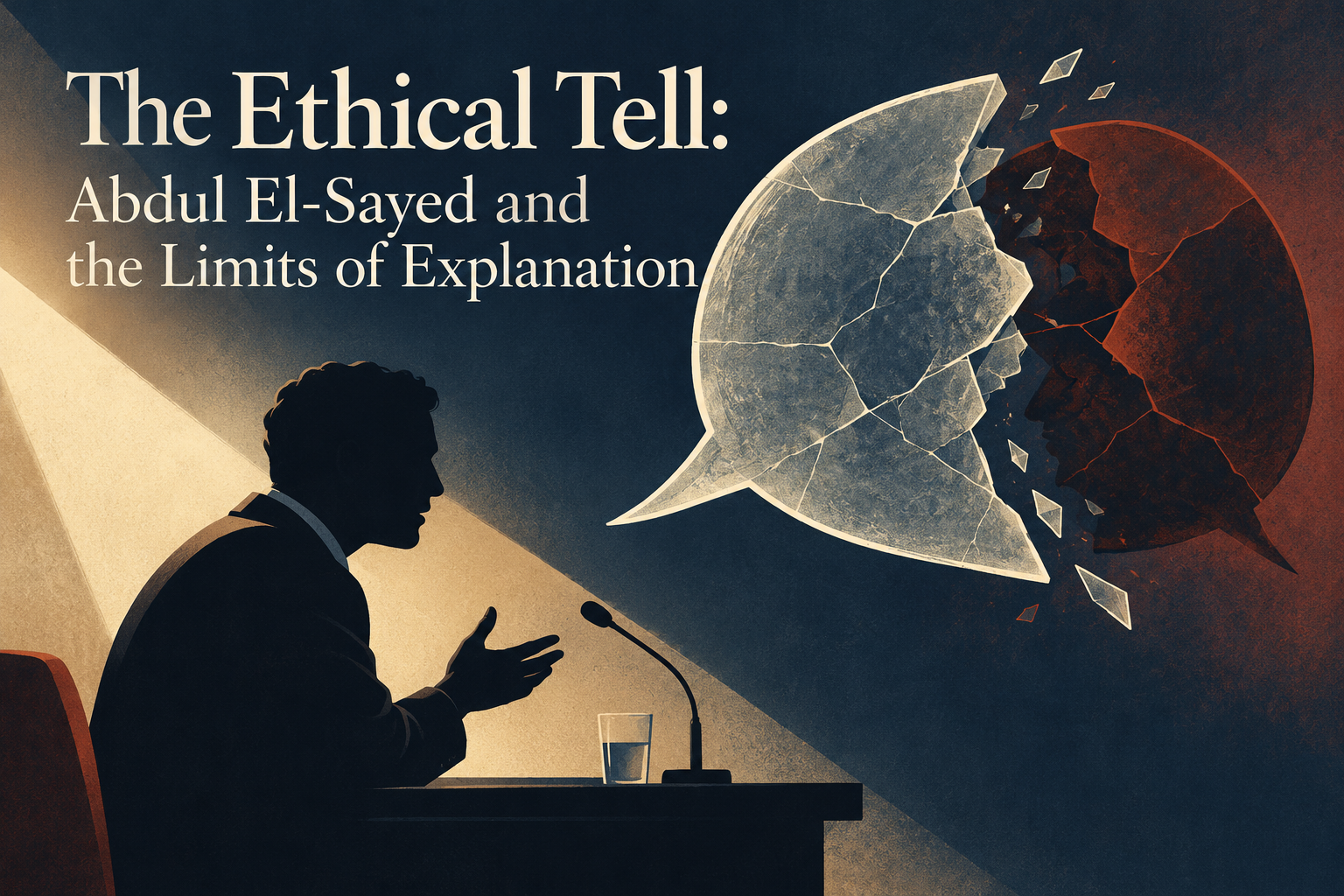
What “hurt people hurt people” can teach us about moral responsibility—and the people who seek to lead us
Ever since the attack on Temple Israel in West Bloomfield, Michigan, there is a sentence I have been unable to get out of my head: “Hurt people hurt people.”
The words were spoken by Abdul El-Sayed, a physician running for the United States Senate from Michigan. In March, a man named Ayman Ghazali drove his pickup truck into Temple Israel while approximately 150 children and staff were inside. Armed with an AK-style rifle and hundreds of rounds of ammunition, he opened fire on a security guard. According to the FBI, shortly before the attack Ghazali recorded a video expressing his intention to kill as many Jews as possible. Security guards prevented him from entering the building; one was injured, but no one inside was killed. The FBI later described Ghazali as inspired by Hezbollah.
El-Sayed condemned the attack. But in explaining it, he pointed to the fact that Ghazali had recently lost relatives in an Israeli airstrike in Lebanon, and he said, “Hurt people hurt people.” I have been turning those four words over ever since.
At first, I assumed my reaction was simply emotional. I am Jewish; the target was a synagogue. Perhaps I was responding defensively. But that explanation never quite satisfied me. The more I thought about the sentence, the more convinced I became that what disturbed me was not primarily its politics, and certainly not the proposition that suffering can produce more suffering, which is obviously true. Something else was bothering me. I began to wonder whether my discomfort had detected a moral confusion before I had the language to describe it. Once I started pulling at that thread, four seemingly compassionate words opened onto a much larger question: What happens to moral responsibility when we begin explaining the person who has done something terrible?
This is not merely a question about Abdul El-Sayed. It is a question about how we think – and, perhaps more importantly, about how we should listen to the people who aspire to lead us.
“Hurt people hurt people” has the satisfying compression of an aphorism. It sounds wise because there is wisdom in it. Anyone who has practiced medicine, raised children, studied psychology, or simply lived long enough knows that pain travels. Abused children sometimes become abusive parents. Humiliation can breed rage. Trauma changes people.
As a physician, I believe deeply in understanding causes. Medicine trains you to ask what happened before the thing you are looking at. What produced this inflammation? What preceded this symptom? What conditions allowed this disease to develop? You learn very quickly that whatever appears in front of you has a history. Human beings deserve the same curiosity. The older I get, the less interested I am in simplistic explanations of behavior. We are shaped by childhood, temperament, culture, biology, trauma, and circumstances we never chose, and understanding those forces ought to make us less self-righteous and more compassionate. But there is a peculiar danger hidden inside that compassion.
Consider an abusive husband. Suppose we discover that his father beat him mercilessly as a child. Suddenly something about the man becomes comprehensible; we may even feel compassion for the frightened child he once was. Now imagine that immediately after he beats his wife, while she is still bleeding, someone says, “Hurt people hurt people.” The sentence remains psychologically plausible. Yet it suddenly feels morally different. Why?
Because our attention has moved. A moment ago we were looking at the woman who had been beaten and the man who beat her. Now we are looking backward—at his childhood, his suffering, the forces that acted upon him. Without explicitly excusing anything, we have quietly changed the subject from what he did to what was done to him. This is where explanation can begin to shade into exculpation without anyone quite noticing.
I have come to think of this as a kind of moral laundering. The term implies neither that anyone is acting dishonestly nor that explanation is itself immoral. Moral laundering happens when an act passes through enough layers of grievance, trauma, history, and causation that something morally stark emerges looking softer around the edges. The facts doing the laundering may all be true. That is what makes it so difficult to recognize.
There is another problem with “hurt people hurt people.” It sounds almost mechanistic: a hurt occurs here, and therefore another hurt emerges there. Violence begets violence; trauma generates trauma. Sometimes it does. But sometimes it doesn’t. Hurt people become therapists and nurses. Hurt people protect their children from the violence they themselves experienced. Hurt people forgive. Hurt people decide that precisely because they know what suffering feels like, they will not inflict it on another human being. Between the first hurt and the second stands something extraordinarily important: a person.
This seems obvious until we begin constructing causal explanations of behavior. Then the person can slowly disappear. The abused child becomes the abusive father. The humiliated young man becomes the terrorist. The oppressed population becomes the violent movement. Each step becomes intelligible from the one before it, until history begins to resemble a row of falling dominoes. But morality begins precisely where the domino metaphor fails. A domino cannot decide not to fall. A human being sometimes can.
Modern philosophy has struggled endlessly with this problem under the headings of free will, determinism, and moral responsibility. We know that human choices are constrained by forces outside our control, yet our ordinary conception of morality depends on treating people as agents capable, at least to some degree, of answering for what they do. Jewish thought confronted the same problem thousands of years earlier, almost at the very beginning.
The first murder in the Bible is preceded by something surprisingly close to a psychological portrait. Cain brings an offering to God, and so does Abel. Abel’s is accepted; Cain’s is not. Cain becomes angry and dejected, and God, noticing his state, asks him why. The Torah, in other words, gives Cain context. It does not present him as a monster who materializes from nowhere. He has experienced rejection; he feels injured; something has happened inside him. Then God warns him that sin is crouching at the door, that its desire is for him, “but you can master it.” Cain goes out and kills his brother.
Afterward, God does not ask Cain what Abel did to him. He does not ask what wounds produced the violence. He asks, “What have you done?” That question may contain an entire moral philosophy. Cain’s hurt matters; God Himself acknowledges it. But the hurt does not become the author of Abel’s murder. Cain remains the author.
Centuries later, Maimonides would make freedom of choice indispensable to his understanding of repentance: if human beings cannot choose between good and evil, then commandment, accountability, and teshuvah lose their coherence. Rabbi Eliyahu Dessler developed an idea I find especially useful here, the bechirah point. Rav Dessler recognized that people do not all confront moral choices from the same starting place. One person’s effortless act may represent another person’s enormous moral victory. Our histories and circumstances matter; they help determine where the moral battle is being fought. But there is still a battle.
That insight allows us to be compassionate without surrendering the idea of agency. I can understand why something is harder for you than it is for me without concluding that what you do no longer belongs to you. In fact, there is something strangely dehumanizing about the opposite view. If I explain you entirely through what has happened to you, I have ceased to regard you as the author of your own life. You become an effect. Judaism insists that you remain a person.
Which brings me back to Michigan. Ghazali had suffered. Four relatives had reportedly been killed in an Israeli airstrike in Lebanon days before the attack, and his former wife told police that their deaths had affected him deeply. Those facts are relevant to understanding his state of mind. But Ghazali did not attack the Israeli military. He drove to a synagogue in Michigan. The Jews inside that building had not killed his relatives. The children inside had not bombed Lebanon. Temple Israel was not the Israeli government. Ghazali made that connection—and that is precisely why I find it troubling when anyone else, however compassionately, follows him across that bridge.
Temple Israel’s Rabbi Jen Lader captured the problem when she said that Michigan’s Jews “are not abstractions or stand-ins for a foreign government.” That distinction runs considerably deeper than sensitivity or timing. To say that an Israeli airstrike helps us understand why a man attacked a Michigan synagogue may be descriptively relevant to his psychology. Morally, though, we must be exceedingly careful about the connection we are making. It was the perpetrator himself who transformed Jews in Michigan into representatives of actions taken thousands of miles away, and that transformation was part of the moral pathology of the attack. Our explanations should illuminate that pathology, not inadvertently inherit its categories.
This is why “hurt people hurt people” continued to bother me. It wasn’t that Ghazali had not been hurt; he had. It was that the aphorism risks making the second act seem to follow naturally from the first. It did not. A human choice stood between them.
Months later, El-Sayed apologized, and his apology deserves to be taken seriously. He told Michigan’s Jewish Democratic Caucus, “I made a mistake,” and said his initial condemnation should have been “it, full stop.” He explained that he had been trying to provide context, but that immediately after the attack “wasn’t the time for context.” The following day, he compared his mistake to giving “the right medicine at the wrong time.”
I respect anyone willing to say, “I made a mistake.” But strangely, the apology helped me understand why the original statement had troubled me. My question was no longer simply whether it had been the wrong time for the medicine. I had begun to wonder about the medicine itself.
That question became harder to dismiss because El-Sayed had defended the underlying idea in the months before apologizing. In June, he again said it was “critical for us to understand that hurt people do hurt people.” After winning the Democratic primary in August, he was asked about the controversy and responded: “What I mean is that hurt people hurt people, that maybe if we’re serious about ending the hurt, we should stop hurting people, that’s what I mean.” None of this proves that El-Sayed intended to justify antisemitic violence. He explicitly condemned the synagogue attack as vile and antisemitic, and that matters too. But intention is not the only interesting question. The question that interests me is why this particular explanatory framework came so readily to mind.
Poker players have a word for an involuntary behavior that gives away something about the hand a player is holding: a tell. I wonder whether we have ethical tells too.
Most of what politicians tell us about their values is curated. Speeches are written and rewritten; statements are tested; advisers anticipate objections; candidates learn to express complicated moral positions in polished sentences. But occasionally events move faster than that machinery. Something terrible happens, a microphone appears, and a politician responds. In those moments, perhaps we glimpse—not a person’s entire character, which no sentence could reveal, but something about the moral associations that arise spontaneously in his mind. Where does his sympathy travel first? Where does he locate agency? Whose behavior does he contextualize? Whose suffering does he connect to whose actions? What does he feel requires explanation? And, perhaps most revealing of all: What connections seem obvious to him that may not be obvious at all?
These questions should not be reserved for Abdul El-Sayed, for Democrats, for Muslims, or for any particular political tribe. The standard is valuable only if we are willing to apply it when the person speaking belongs to our own side. Imagine a politician responding to the murder of an immigrant by immediately explaining the economic grievances of the murderer. Imagine someone responding to racial violence by discussing crimes committed by members of the victim’s racial group, or a political assassination followed immediately by an account of how provocative the victim had been. Each of these statements might contain facts. I would still want to know: Why was that the connection your mind made?
That seems to me a legitimate question to ask of anyone seeking power. It is not a verdict. A tell is evidence, not proof. People misspeak. They learn. They apologize. They also sometimes reveal something genuine before they realize they have revealed it, and the responsible citizen has to live with that ambiguity.
This is where my discomfort with El-Sayed’s words becomes more serious. Leadership is, among other things, the exercise of moral discrimination. A leader will eventually have to decide who requires protection, who bears responsibility, which grievances deserve recognition, and when context mitigates conduct and when it does not. I therefore care about the moral reflexes of someone who seeks authority—not because I expect moral perfection, but because under pressure we tend to fall back on the conceptual habits we have practiced most deeply. If someone’s reflex, when confronted with a particular kind of violence, is repeatedly to search for antecedent grievance, I want to understand that reflex. If compassion is distributed asymmetrically—if some perpetrators are immediately contextualized while others are simply condemned—I want to notice that too. And if an innocent group is folded into a grievance directed at people elsewhere simply because they share an identity, I want leaders to recognize that move instantly and resist it.
This matters especially in the case of antisemitism, because collective attribution has such a long history in Jewish life: Jews held responsible not as individuals for what they themselves have done, but as representatives of other Jews, of Jewish institutions, of Jewish power, and now of the State of Israel. That does not mean criticism of Israel is antisemitic; it plainly is not. It means that when someone attacks a synagogue in Michigan because of events in Lebanon, the moral distinction between those things should become clearer, not blurrier.
This is why I think suspicion is warranted—not suspicion in the sense of a verdict on El-Sayed’s character, but in the older and more useful sense of scrutinizing what a remark may disclose. His apology is evidence. His repeated defense of the underlying formulation is evidence too. Neither permits us to know the man completely, and neither should be discarded merely because it complicates the story. The question remains open. But it is a question worth asking.
I now think I understand why “hurt people hurt people” stayed with me. My objection was never to understanding hurt people. Quite the opposite: we should understand them more deeply. We should study trauma, history, poverty, humiliation, ideology, and every other force that shapes human behavior, because understanding causation can help us prevent suffering and perhaps interrupt cycles of violence. But understanding must not become a solvent that dissolves moral agency. “Hurt people hurt people” is only half the story. Hurt people also refuse to hurt people, and that may be one of the most important facts about us.
Between suffering and what we do with suffering lies the territory of moral life, and Judaism calls us into that territory almost from its first pages. Cain is angry. Cain is wounded. God sees all of it—and then God asks Cain what he has done. The question does not deny his suffering. It restores his humanity by insisting on his agency. Perhaps that is what I was reaching for when those four words first bothered me: I was resisting, before I could say why, the disappearance of the person between cause and consequence.
There may be a broader lesson here about the responsibilities of citizenship. We spend enormous amounts of time listening to politicians tell us what they believe. Perhaps we should spend more time listening for the moments when they aren’t telling us—the unguarded analogy, the spontaneous explanation, the person whose pain immediately captures their imagination, the causal connection they make without seeming to realize that making it is itself a moral choice. We should not turn these moments into verdicts; that would be intellectually lazy and morally unfair. But neither should we ignore them. People who seek political power ask us to trust their judgment in circumstances none of us can foresee. It seems reasonable, then, to attend not only to their declared moral principles but also to their moral reflexes.
Sometimes a reflex is merely a reflex. Sometimes it is an ethical tell. And when four words continue to trouble us months after they were spoken, perhaps the proper response is neither to condemn them reflexively nor to explain them away, but to ask why—and to keep asking until we understand what, exactly, they may be telling us.