The Europe Behind Lisbon’s Two Doors
The year 2026 marks the 40th anniversary of Portugal’s membership in the European Union (EU). The country joined what was then the European Communities (EC) on January 1, 1986, consolidating its transition from dictatorship to democracy. Four decades later, Portugal is celebrating a transformation that brought economic development, political stability, and a new sense of European belonging.
But European integration did not begin European history anew. It inherited it.
That thought accompanied me recently in Lisbon, where two cultural landmarks, a bookshop and a museum, led me to two men whose lives illuminate different aspects of the continent’s relationship with the Jewish people.
Their stories reveal something about the Europe that preceded Portugal’s accession, and the responsibilities its democratic institutions inherited.
The bookseller and the Jewish art dealer
The first is Karl Buchholz, a German bookseller and art dealer who established his business in Berlin during the 1920s. His gallery became associated with European modernism, and among his collaborators was Curt Valentin, a German Jewish art dealer who had previously worked for Alfred Flechtheim, a prominent Jewish champion of modern art driven out of Germany by Nazi persecution.
In 1937, as Valentin’s future in Germany became untenable, he emigrated to New York, where he established the Buchholz Gallery. His ties with Buchholz continued across the Atlantic.
But Buchholz’s wartime record was more troubling. In 1938, he became one of four dealers authorized by the Nazi regime to sell modern artworks confiscated from German public museums as degenerate art.
One painting illustrates this. Paul Klee’s “Around the Fish,” painted in 1926, belonged to Dresden’s Gemäldegalerie until the Nazis confiscated it in 1937. In 1939, it was consigned to Buchholz in Berlin, passed through Valentin’s New York gallery, and was acquired by the Museum of Modern Art that April.
The painting had been removed from a public museum, not confiscated from a Jewish private collector. But its journey demonstrates how Nazi cultural persecution became entangled with the international art market.
The assistance Buchholz provided Valentin and the dealings they subsequently conducted were intertwined. The New York gallery, which carried Buchholz’s name, also became a major outlet for artworks confiscated by the Nazi regime. What enabled a Jewish dealer to rebuild his career abroad was simultaneously sustained by a trade made possible by Nazi cultural policies.
In 1943, following restrictions on his work in Germany, Buchholz opened a bookshop in Lisbon. Today, on Rua Duque de Palmela, its three floors retain the character of a literary refuge, with wooden panelling, a spiral staircase, and shelves devoted to literature, philosophy, and history. Its inviting surroundings offer little indication of the questions raised by its founder’s past. The name above the entrance carries a story larger than the books inside.
The collector and the Jewish family
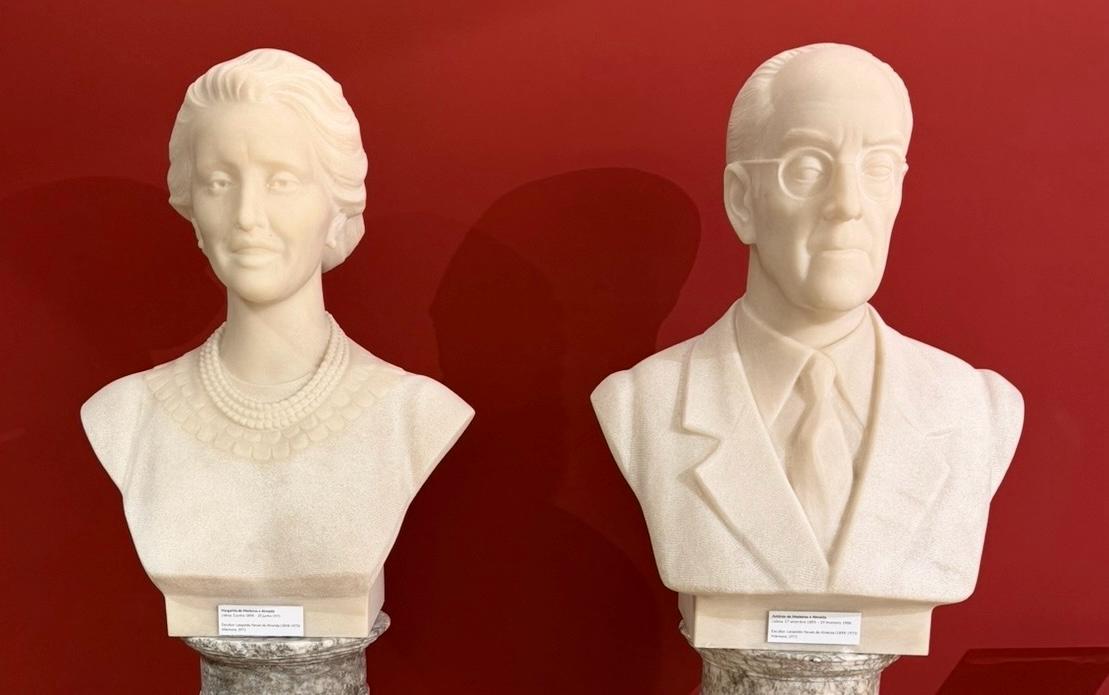
The second landmark is the Medeiros e Almeida Museum, housed in the former Lisbon residence of António de Medeiros e Almeida, a Portuguese businessman who assembled an extraordinary collection of European and Asian decorative arts.
The house preserves the atmosphere of a wealthy private home. Its furnished rooms, porcelain, paintings, and remarkable clocks invite visitors to admire the tastes and achievements of their former owner. Among the objects on display is a desk he used while managing the Bensaúde group. Its significance extends beyond craftsmanship into another part of his biography.
Medeiros e Almeida maintained close ties with the Bensaúde family, leading Jewish entrepreneurs originating from the Azores.
In 1941, amid fears of a possible German invasion of Portugal, Vasco Elias Bensaúde entrusted him with the management of the family’s companies, transferring part of his ownership stake to him. Bensaúde subsequently sought refuge in the Azores and then the United States.
After the war, Medeiros e Almeida returned the transferred stake to the family, although he continued managing the companies for many years. Theirs was an enduring commercial partnership, not merely a favor in a crisis.
At a time when Jewish property across Europe was being seized, a Jewish businessman entrusted part of his family’s economic future to a friend who was not Jewish. That trust was honored.
Medeiros e Almeida was also a member of Portugal’s economic elite who sympathized with the authoritarian Estado Novo. His friendship with Bensaúde, therefore, cannot be read as evidence of democratic conviction. It was a personal commitment that deserves recognition on its own terms.
Neither story is simple. Buchholz’s career and Medeiros e Almeida’s conduct arose from different circumstances, but together they reveal how much of the Jewish experience remains embedded in places not ordinarily associated with Jewish memory.
The Europe we choose to remember
For Israelis, at a time when relations with European governments are strained, it is tempting to read the continent through the experience of Jewish persecution. That history remains indispensable. But it is not the entirety of the Jewish experience in Europe. Nor should remembering those who offered protection become an excuse for overlooking those who profited from persecution. Holding both together makes our understanding of Europe more complete.
Recognition need not begin with grand declarations. The Buchholz bookshop could explain its founder’s role in the Nazi art market alongside its celebrated literary history. The Medeiros e Almeida Museum, which has already documented the Bensaúde episode in its research, could make that story more visible to visitors. A carefully researched panel, a fuller label beside a desk, or a few additional lines in an exhibition could bring these stories into public view.
Forty years after Portugal joined the EC, its transformation deserves celebration. But belonging to Europe involves more than membership, shared institutions, or economic prosperity. It also means accepting responsibility for the past that the European integration project inherited.
Buchholz and Medeiros e Almeida left behind very different legacies. Their names survive in two Lisbon landmarks, neither dedicated to Jewish memory, yet both carrying fragments of it.
Sometimes Europe’s Jewish past is waiting behind the door of an ordinary bookshop. Sometimes inside an elegant collector’s home.
And sometimes, to understand the Europe we celebrate, we need only open those doors.