


Sr. Geopolitical Analyst & Author
The EU’s Dated Policies Fueled Tehran’s War on Israel
 Kaja Kallas, the EU’s High Representative for Foreign and Security Affairs, emphatically stated, concerning the United States-Israel-Iran War, that “This is not our war.” Yet, according to Ali Safavi, a member of the NCRI’s Foreign Affairs Committee, he asserted that Europe “caused this war” through their policy of appeasement.
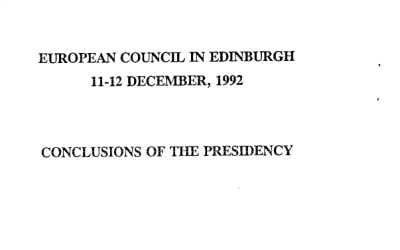
The EU’s Iran policy dates back to the 1992 Edinburgh Summit when France, Germany, and Italy greatly benefited from their trade with Iran and wanted to maintain the economic benefit; thus, the policy of appeasement was birthed in the words:
“Given Iran’s importance in the region, the European Council reaffirms its belief that a dialogue should be maintained with the Iranian Government. This should be a critical dialogue which reflects concern about Iranian behavior and calls for improvement in a number of areas, particularly human rights…”
This became EU protocol and part of the acquis communautaire that the yet future EEAS was to follow. In the next decades, Iran discovered it could infiltrate and influence EU politics against Israel and in favor of the JCPOA. It achieved this via access to a Spanish television station, Spanish and French political parties, and by placing their experts in think tanks such as the European Council on Foreign Relations.
Josep Borrell took the helm of the EEAS in December of 2019, and he hailed from the very political party in Spain that Iran funded. At the onset of the October 7 attacks, Borrell, acting as Iran’s apparatus, stopped Ursula von der Leyen from halting aid to the Palestinian Authority, factions of which participated in the attacks, and he defended UNRWA and the JCPOA while attacking Israel’s actions. Moreover, he protected the IRGC from being branded as a terrorist organization in the EU, which it clearly was. His mantra was that Israel had the right to defend itself, but in accordance with international law. This very statement was antisemitic because it is never declared that any other nation has the right to defend itself; that right is unspoken for all others. By feeling he needed to grant permission to Israel, Borrell revealed that he placed Israel below other nations, treating its sovereignty as a conditional gift rather than an inherent right.
The EU’s policy contributed to the worldwide flood of anti-Israel protests and disinformation after October 7, and Josep Borrell added to this fire. Recently, with 40,000 dead protesters at the hands of the IRGC, the EU under the direction of the EEAS and Kaja Kallas finally designated the IRGC as a terrorist organization. Moreover, writers such as myself and others are pointing at the flaws in EU infrastructure which allowed this; this policy procedure must be changed. As I pointed out, the protocol for Israel dates to the 1980 Venice Declaration and this, too, is dated.
The European Union is becoming a formidable global player, topping the charts in trade with its 78 trade pacts, and a more recent one in the works that will essentially help rewrite the rules for world trade. But if the EU wants to be a geopolitical player, decisions made by the Council that are 34 years old in the case of Iran and 46 years regarding Israel are not going to be effective in a rapidly changing multipolar order. Rather, the EU needs to follow the example of the United States and establish a strategic brain akin to the US Bureau of Intelligence if it wants to lend positive influence instead of aiding fascist theocracies due to its policies.
All of this is elaborated on in my recent book titled, EU Two-State Policy: A Monument to a Bygone Era.