


Middle East Forum Fellow/North Africa Risk Consultant
The EU’s New Migration Pact Will Make Libya’s Factions Richer and Entrenched
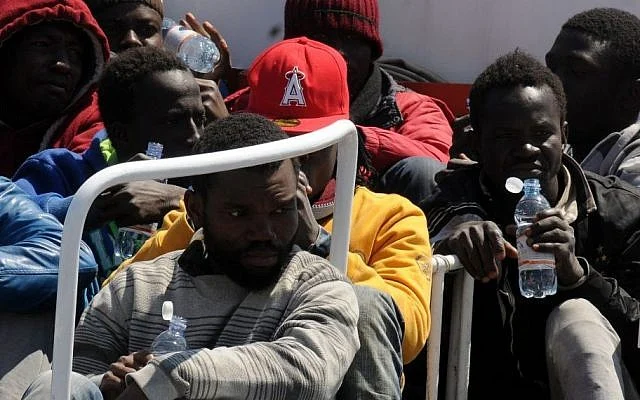
Illustrative photo of migrants arriving at Palermo's harbor, Italy, after being rescued at sea, April 15, 2015. (AP/Alessandro Fucarini)
The European Union’s new Pact on Migration and Asylum entered into force on June 12, and Brussels is already treating it as a bureaucratic achievement. It is, instead, a mechanism for subsidizing Libya’s permanent civil war.
The logic runs as follows. European migration externalization requires a partner capable of intercepting boats before they reach EU waters. In Libya, that means identifying a credible interlocutor, an entity with enough coastline authority to absorb EU funds and perform migration control on Brussels’s behalf. The problem is that no single Libyan actor controls the coast. There are militias in Zawiya that profit from smuggling, the Government of National Unity (GNU) in Tripoli that holds nominal authority over western Libya, and the Libyan National Army (LNA) under Khalifa Haftar that dominates the east. The EU’s demand for a migration partner does not simplify this picture. It complicates it by placing a cash prize on the table for whichever faction can most convincingly perform sovereignty.
This is not a hypothetical. The EU’s previous externalization arrangements with Libyan actors, formalized through the 2017 Malta Declaration and subsequent Italy-Libya memorandums, channeled hundreds of millions of euros toward the Libyan Coast Guard, an entity with documented ties to the same smuggling networks it was nominally paid to disrupt. What those funds actually purchased was the institutional consolidation of militias operating under official insignia. The EU understood this, documented it repeatedly in its own migration reports, and continued the payments anyway, because the alternative was boats arriving in Lampedusa.
The new Pact institutionalizes this logic at scale. It creates mandatory border procedure mechanisms, faster returns, and expanded external partnerships. Each of these components requires external states to absorb returned migrants and police departure zones. For Libya, that translates to EU demand for a functional migration apparatus. And since no unified Libyan state exists, European demand will default to whichever actor most plausibly performs state functions at the shoreline, regardless of whether that actor has any interest in actual Libyan unification.
What makes this particularly damaging is that Libya is currently displaying the outward signs of economic coherence while remaining structurally fragmented beneath the surface. In April, the GNU and the Haftar-aligned eastern government announced a unified national budget for the first time in years. Oil production reached 1.43 million barrels per day, a ten-year high. To observers hoping for convergence, these figures suggest momentum. They should not be read that way.
Libya’s oil revenues and its political arrangements have never moved in the same direction simultaneously. The National Oil Corporation has operated across factional lines as a functional institution precisely because both sides agreed to extract revenue without demanding the other’s political submission. The April budget agreement reflects a similar logic: a tactical consensus on revenue sharing, not a structural commitment to reintegration. When EU migration money begins flowing through whatever entity Brussels designates as its Libyan partner, it creates a new revenue stream that neither faction will want to share. That is a recipe for competition, not consolidation.
There is a model for how this ends. Turkey’s 2016 migration deal with the EU was presented as a crisis solution. It has since become a permanent lever that Ankara uses to extract concessions on everything from visa liberalization to EU accession talks. Libya’s factions are watching. The faction that secures EU migration partnership status gains not just immediate funds but long-term geopolitical leverage, the ability to threaten Brussels with a migration surge whenever it wants a political concession. Fragmentation in Libya is already instrumentalized. EU migration money will simply make it more lucrative.
Washington has a narrow window to intervene constructively. The Massad Boulos framework gives the United States a relationship with both the GNU and LNA spheres that Brussels lacks, but American leverage is only meaningful if it activates something the EU has entirely ignored: the Libyan people themselves. Libya’s civil society organizations, tribal councils outside the militia economy, professional networks, and youth movements that have repeatedly challenged both Tripoli’s corruption and Benghazi’s authoritarianism represent a political constituency that no faction fully controls. That constituency is the only force with a structural interest in making fragmentation politically costly rather than financially rewarding. Libyans have been permanent objects of externally negotiated arrangements that enrich their oppressors. That cannot continue.
Washington should use the Boulos framework to insist that any political roadmap incorporating EU migration arrangements include verifiable civil society participation benchmarks that precede funding disbursement, not follow it. Brussels will not consult Libyans before it signs its migration partnership. It will find whichever faction performs sovereignty most convincingly and write the check. If Washington does not make Libyan popular legitimacy a condition of American diplomatic backing before that happens, the militia economy will have a permanent European subsidy attached to it, and the Libyan people will have been negotiated around once again.