
Learning The Lessons Of History
The False Equivalency
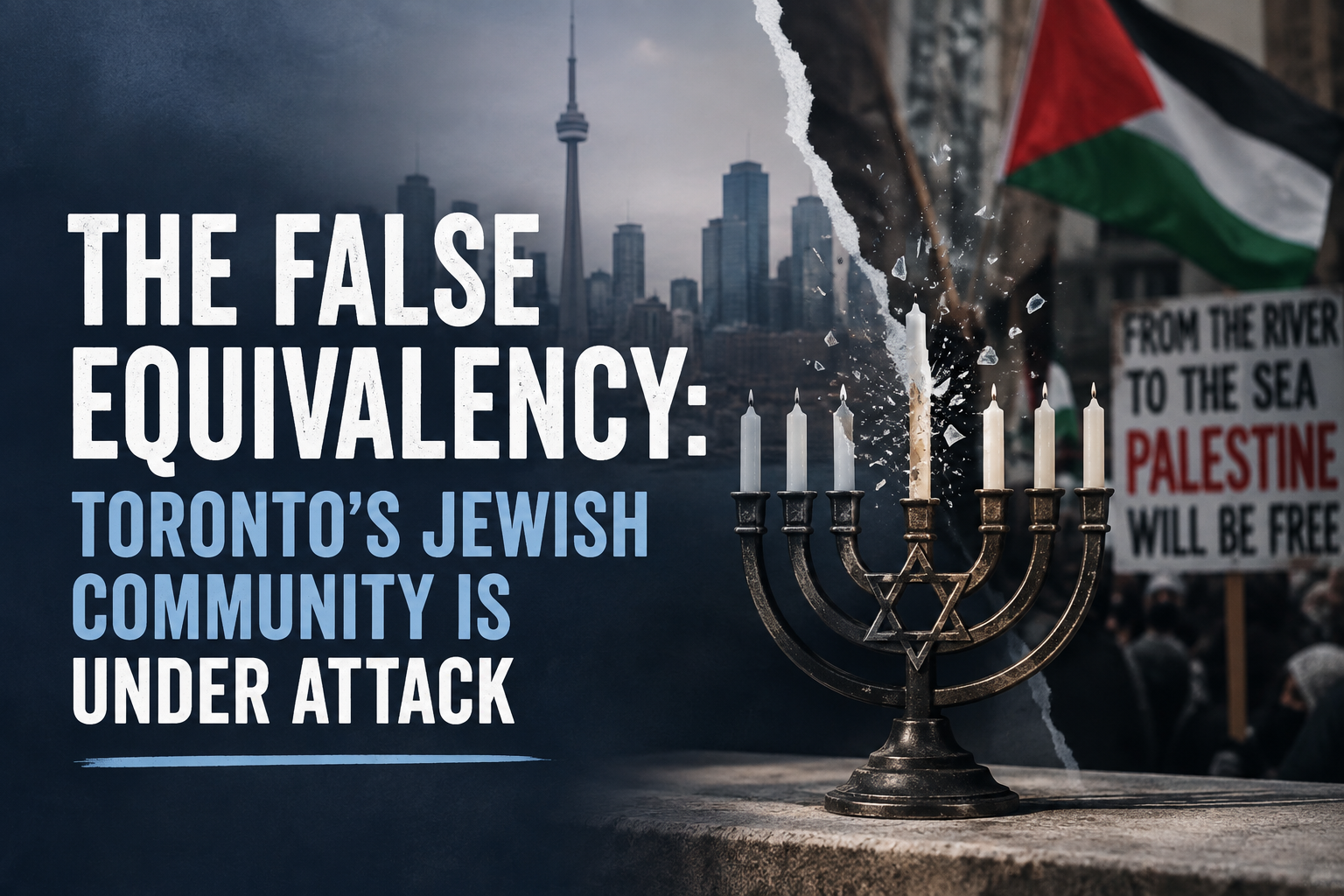
There is an uncomfortable reality in Canada today that deserves to be stated plainly. Since October 7, 2023, Toronto’s Jewish community has experienced an extraordinary and sustained level of hostility, intimidation and hate.
Synagogues and Jewish schools have required heightened security. Jewish businesses and institutions have been targeted. Demonstrations have taken place outside Jewish community facilities and in neighbourhoods with significant Jewish populations, while police resources have repeatedly been deployed to protect Jewish institutions and community events.
This is not simply a matter of perception. There is measurable evidence demonstrating that Jewish Canadians are experiencing a level of police-reported hate crime that is profoundly disproportionate to the community’s size.
And yet, whenever this subject is raised, there seems to be an almost reflexive effort to establish an equivalency — to immediately point to hatred directed at other communities, particularly Muslims.
Anti-Muslim hatred is real, reprehensible and deserving of unequivocal condemnation. Canada has experienced horrific examples of it, and Muslim Canadians have every right to expect the same protection, security and respect as every other Canadian.
But acknowledging Islamophobia does not require us to pretend that every community is experiencing the same threat environment at the same frequency or intensity. The available evidence does not support that conclusion.
The Numbers Tell an Extraordinary Story
The raw numbers are troubling enough. The per-capita numbers are even more revealing.
According to Statistics Canada’s latest data, there were 943 police-reported hate crimes targeting Jewish people in 2024. There were 230 targeting Muslims.
To understand the significance of those numbers, however, they need to be considered in relation to population.
The 2021 Census counted approximately 335,295 Canadians identifying their religion as Jewish, representing about 0.9% of Canada’s population. By comparison, approximately 1,775,715 Canadians identified as Muslim, representing approximately 4.9% of the population.
Using those Census populations as denominators, the 2024 figures translate to approximately:
-
281 police-reported hate crimes per 100,000 Jewish Canadians
-
13 police-reported hate crimes per 100,000 Muslim Canadians
That means that, on this population-adjusted measure, the rate of police-reported hate crime targeting Jewish Canadians was approximately 22 times the corresponding rate targeting Muslim Canadians.
The comparison becomes even more striking when expressed another way. Jewish Canadians represented less than 1% of the Canadian population in the 2021 Census, yet accounted for roughly seven out of every ten police-reported hate crimes motivated by religion in 2024.
That is an extraordinary disparity.
It does not mean that anti-Muslim hate crime is unimportant. It means that the scale of antisemitic targeting relative to the size of Canada’s Jewish population is exceptionally high.
How Does That Compare With Other Minority Communities?
It is possible to place the Jewish figures in a broader Canadian context, although this comparison requires some caution because Statistics Canada classifies hate-crime motivations differently.
Jewish and Muslim targeting is reported primarily under religion, while Black, South Asian and Arab or West Asian targeting is reported under race or ethnicity. These categories are therefore not perfectly interchangeable, and individuals may belong to more than one group.
Nevertheless, the population-adjusted figures provide useful context.
Statistics Canada’s 2021 Census counted approximately 1.55 million Black Canadians. Statistics Canada’s revised data recorded 890 police-reported hate crimes targeting Black people in 2024. Using the Census population as an approximate denominator produces a rate of roughly 58 incidents per 100,000 Black Canadians.
For South Asian Canadians, the Census population was approximately 2.57 million, while 324 police-reported hate crimes targeted South Asians in the revised 2024 data. That represents approximately 13 incidents per 100,000 people.
For Arab and West Asian Canadians, Statistics Canada recorded 312 police-reported hate crimes in 2024. The 2021 Census separately counted approximately 694,000 Arab Canadians and 360,000 West Asian Canadians. Combining those populations for an approximate comparison produces a denominator of roughly 1.05 million people, or approximately 30 police-reported hate crimes per 100,000 people.
Against those approximate population-adjusted measures, the Jewish figure of approximately 281 per 100,000 stands apart.
Put differently, using these Census denominators, the 2024 rate of police-reported hate crime targeting Jewish Canadians was approximately:
-
22 times the Muslim rate
-
nearly 5 times the Black rate
-
more than 9 times the combined Arab/West Asian rate
-
more than 22 times the South Asian rate
These comparisons should not be interpreted as precise measures of an individual’s probability of becoming a victim. Police-reported hate-crime statistics measure reported incidents motivated by hatred toward identified groups, not individual victimization rates, and the Census populations come from 2021 rather than 2024.
But as indicators of the relative concentration of reported hate crime against communities of very different sizes, the numbers are difficult to dismiss.
October 7 Changed the Environment
The change was not gradual. Statistics Canada identified a substantial increase in police-reported hate crimes targeting both Jewish and Muslim populations during October, November and December 2023.
Compared with the average monthly number recorded from January 2021 through September 2023, the monthly average during the final three months of 2023 was 251% higher for Jewish populations. The average increased from approximately 45 incidents per month during the earlier period to 159 per month during those final three months.
Muslim Canadians also experienced a serious increase. Their monthly average rose from approximately 11 incidents to 32 during the same period, an increase of 185%.
That fact matters because it demonstrates that the deterioration in the environment following October 7 was not confined to one community. Both Jewish and Muslim Canadians experienced substantial increases in hate crime.
But recognizing that fact does not erase the scale of what subsequently confronted Jewish Canadians.
During 2024, the monthly average targeting Jewish populations remained approximately 69% above the January 2021–September 2023 baseline. The corresponding Muslim figure remained approximately 68% above its earlier baseline.
The percentage increases were therefore remarkably similar during 2024, but they were occurring from very different absolute levels and against communities of very different population sizes.
That distinction matters.
The Latest Numbers Show the Problem Has Not Disappeared
Statistics Canada’s newest national data, released in July 2026, provide another important piece of context.
In 2025, police reported 788 hate crimes targeting Jewish people and 204 targeting Muslims. The Jewish number declined from the revised 943 incidents recorded in 2024, but it remained dramatically above the levels seen only a few years earlier.
For perspective, Statistics Canada recorded 492 Jewish-targeted hate crimes in 2021 and 527 in 2022. The number then surged to 959 in 2023, remained at a revised 943 in 2024, and stood at 788 in 2025.
A decline from an extraordinary peak should not be confused with a return to normal.
The 2025 figure remained approximately 50% higher than in 2022, the last full calendar year before October 7.
The data therefore suggest something more consequential than a brief spike immediately following October 7. They point to a sustained elevation in the number of police-reported hate crimes targeting Jewish Canadians.
Protest Is Not the Issue
Canada is a democracy, and people have every right to criticize Israel. They have the right to demonstrate against the Israeli government, advocate for Palestinians, demand changes in Canadian foreign policy and express political opinions with which others may strongly disagree.
That right should be defended.
The problem arises when political protest migrates from Parliament, legislatures, consulates and other legitimate political venues into spaces where ordinary Jewish Canadians live, worship, attend school, work or gather.
A synagogue is not the Israeli government. A Jewish school is not the Israeli government. A Jewish-owned business is not the Israeli government, and a Jewish community centre is not the Israeli government.
Canadian Jews walking through their neighbourhoods are not representatives of the Israeli government either.
When anger over the conduct of a foreign government is transferred to Canadian citizens because they are Jewish, the distinction between political protest and intimidation becomes impossible to ignore.
The Search for Equivalency Can Obscure Risk
There is an understandable instinct among responsible people to be even-handed, and normally that instinct is valuable. But even-handedness does not require mathematical symmetry where none exists.
If one community is experiencing a particularly high concentration of threats, vandalism, harassment or hate crime, saying so is not an attack on another community. It is an assessment of evidence.
In security risk management, we would never intentionally distort a threat assessment because acknowledging that one asset faces greater exposure than another might appear unfair. We examine frequency, capability, intent, vulnerability and consequences, and then allocate resources according to the risk.
Community safety deserves the same intellectual discipline.
The objective should not be to determine which community deserves our sympathy. Every community targeted by hatred deserves protection.
The objective should be to understand where threats are concentrated so that governments, police services, institutions and communities can respond appropriately.
This Is Not a Competition Between Victims
None of this should become a competition over which community has suffered more. Canada has witnessed horrific anti-Muslim violence, including the 2017 Quebec City mosque attack and the 2021 murder of members of the Afzaal family in London, Ontario. Those crimes must never be minimized or forgotten.
Nor should statistics ever be used to suggest that an individual victim matters less because another group experiences a higher rate of victimization. Every hate crime represents an attack not only on its immediate victim but on the principle that Canadians should be able to live openly as members of their communities without intimidation.
The point is therefore not that antisemitism matters and Islamophobia does not. Both matter.
The point is that acknowledging one form of hatred should not require us to manufacture statistical equivalence with another.
We Need to Be Able to State Facts
There is a danger when society becomes so concerned about appearing balanced that it becomes reluctant to describe an imbalance when the evidence demonstrates one.
Jewish Canadians represented approximately 0.9% of Canada’s population in the 2021 Census. Yet in 2024, they were the targets of approximately 70% of police-reported hate crimes motivated by religion.
Using the most recent revised Statistics Canada data and the 2021 Census population as a denominator, that represents approximately 281 reported incidents for every 100,000 Jewish Canadians.
No responsible analysis of Canada’s hate-crime environment should ignore that degree of disproportionality.
There are limitations to the data. Not every hate crime is reported to police. Census populations change over time. Hate-crime classifications overlap, and a police-reported hate crime is an incident rather than a measure of the number of individual people victimized.
Those limitations should be acknowledged because accuracy matters.
But they do not erase what the available evidence shows.
Canada can condemn antisemitism and Islamophobia simultaneously. We can recognize anti-Black racism, anti-Asian hatred and every other form of identity-based violence without pretending that every community faces an identical threat at every moment in time.
In fact, taking hatred seriously requires precisely the opposite approach.
We must be willing to examine the evidence, identify where threats are concentrated and respond accordingly.
Right now, the evidence demonstrates that Canada’s Jewish community is experiencing a level of police-reported hate crime profoundly disproportionate to its size.
That fact should not be exaggerated.
It should not be minimized either.
It should simply be acknowledged.
Related Topics
Related Posts