The Family Erased
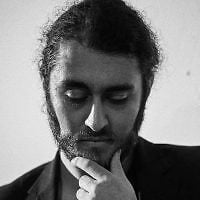
My name is Johnathan Orlianski. My family name was once spelled Orliansky, before it was changed after my family arrived in Israel in the 1970s.
I live in Israel. I am the great-grandson of Rabbi Zalman Orliansky, author of Machaze Abraham, and of Rachel Hirshovitz Orliansky, who was murdered at Kaušėnai, Lithuania, in July 1941.
I knew the names. I did not know the story. Until I watched J’Accuse! and read Silvia Foti’s Storm in the Land of Rain, I did not understand what had happened to my family in Plungė.
Silvia Foti, Grant Gochin, and Michael Kretzmer forced me to look at the place where my family was not only murdered, but erased. Foti is the granddaughter of Jonas Noreika. Gochin filed the litigation. Kretzmer made the film.
My great-grandparents lived at Vaižganto 9, on the corner of Sinagogų gatvė — Synagogue Street — in Plungė. Zalman Orliansky was a prodigy from Ragala and Telz. He emigrated to Mexico in the 1920s and died there in 1928. His widow Rachel remained in the family home with the unmarried children: the store downstairs, the living quarters upstairs, and a chess table custom-made by craftsmen for serious play.
They were Litvaks. They were a rabbi’s household. They were the kind of Jewish family Plungė was full of before July 1941: a town where Jews were not an abstraction, but neighbors, shopkeepers, students, rabbis, children, chess players, mothers, fathers, and cousins.
In July 1941 Rachel Orliansky was murdered at Kaušėnai. Her daughter Rosa was murdered there with her husband Aharon Lipman and their two children, Shulamit and Zalman. Her daughter Doba was murdered there too. Her son Leib-Arie’s first wife, Sosele, was murdered there with her mother and four younger sisters.
Leib-Arie escaped. My grandfather Berel escaped. Five siblings had emigrated before the war: Minna, Sarah, and Haya to Palestine, Yitzhak to Mexico, and Ebert to South Africa. Two of them, Ebert and Yitzhak, died abroad before the war began.
Of the household at Vaižganto 9 in July 1941, seven were murdered. The chess table stayed in the house. It later ended up in the Noreika family’s possession.
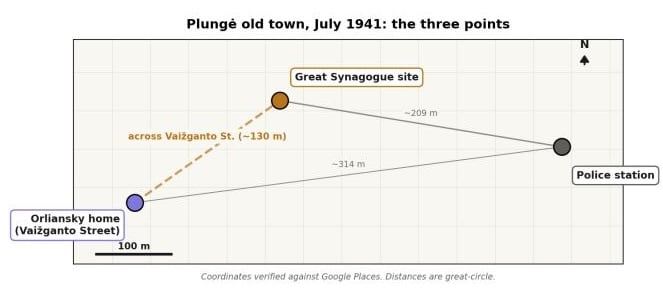
In July 1941 Jonas Noreika and his family moved into my great-grandmother’s house. His daughter was a small child. The Great Synagogue stood across the street. The police station stood nearby. The geography is simple enough to see on a map, and terrible enough to understand at once: the Jews of Plungė were imprisoned within sight of the homes from which they had been driven.
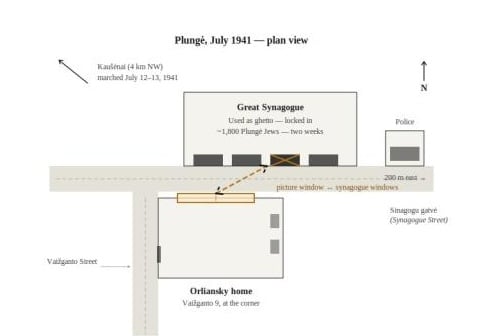
Through July 1941, about 1,800 Jews of Plungė and the surrounding area were forced into the synagogue. The Kaušėnai memorial record states that they were kept there for about two weeks without food and in terrible sanitary conditions before being marched to the killing site. Other survivor and memorial accounts describe beatings, humiliation, rape, the burning of Torah scrolls, and the dead lying among the living.
I cannot say what my great-grandmother saw with certainty. I was not there. But the distance tells its own truth. The home was across the street. The synagogue was not somewhere else. The prison and the stolen home were in the same small field of vision. A woman held in that synagogue did not have to imagine what had happened to her life. She could look across the street and know.
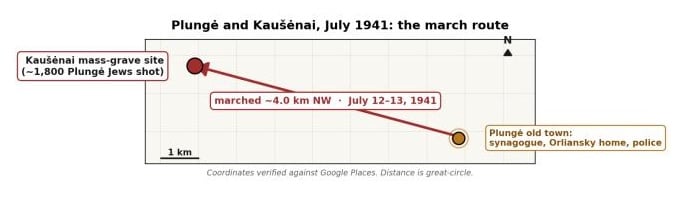
Then she was marched northwest to Kaušėnai and shot. So were her daughters, her son-in-law, her grandchildren, and her daughter-in-law’s family. I learned the names first. Only later did I learn the route.
My grandfather Berel was twenty years old in July 1941. He was not in Plungė. He survived the war by routes I do not fully know. He reached Israel in 1973 and lived another five years. He never spoke to my father about his mother, his sisters, his nieces, his nephew, or his sister-in-law at Kaušėnai. The survivors did not speak. By the time my generation began to want to know, everyone who had carried the story was gone. The silence had a cost. It almost erased me from this story.
Noreika did not stop in Plungė. By August 1941 he had been appointed Šiauliai District Chief. On August 22, 1941, he signed Order No. 962. The order required Jews in the Šiauliai district to be moved to the Žagarė ghetto by August 29 and required inventories of Jewish property. Silvia Foti has also preserved and published documents from the Noreika archive. The signature is not a rumor. It is a document.
In Šiauliai itself, Jews were forced into two cramped ghettos, Kaukazas and Ežero-Trakų. The ghetto was fenced in September 1941. Three days later came the first Akcija: forty-seven Jewish children, about 150 elderly and ill Jews, and about fifty members of the Jewish intelligentsia were taken to the Gubernijos forest and shot. At Kužiai, about a thousand Jews were shot into pits. At Žagarė, on October 2, 1941, 633 Jewish men, 1,107 Jewish women, and 496 Jewish children were shot into an L-shaped pit: 2,236 people in a single morning.
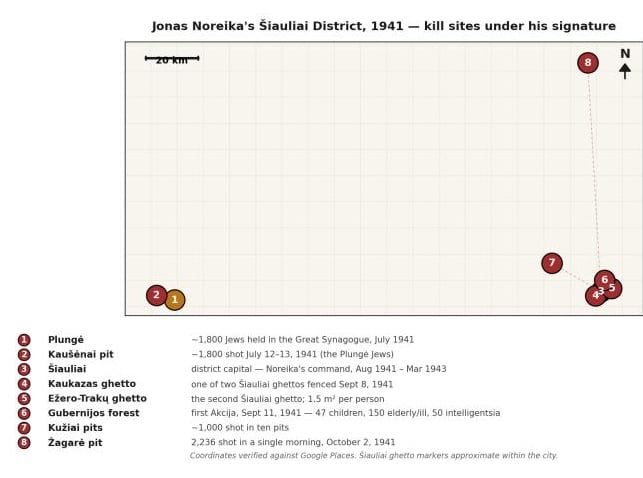
I did not want to know any of this. The granddaughter of the man who signed the order is the one who helped me understand it. I had to read the record more than once before I could absorb it. What broke me was not only the deaths. There are always deaths in Holocaust history. What broke me was the proximity: my family’s house, the synagogue, the police station, the march route, the pit. It was not distant. It was a neighborhood.
In 2018 Lithuania’s Genocide and Resistance Research Centre filed a court response in litigation brought by Grant Gochin over Jonas Noreika. The Centre’s response did not simply deny Grant’s interpretation. It tried to make the central question and evidence disappear. The filing addressed Silvia Foti’s testimony that Noreika lived in a Jewish home on Vaižganto Street in Plungė. The Centre answered that, according to 1942 census data, Noreika was not listed as a homeowner on Vaižganto Street.
Read that slowly. The question was whether Noreika occupied a Jewish home in 1941 while that family was being destroyed. The Centre answered with a 1942 ownership record. Ownership and occupation are not the same question. That distinction matters. The question was not whether Noreika legally owned the house in 1942. The question was whether he occupied a Jewish home in 1941, while the family who had lived there was being destroyed.
By 1942, Rachel Orliansky could not appear in an ordinary property record. She had been marched to Kaušėnai and murdered. There was no ordinary sale. There was no normal transfer. There was a stolen Jewish home, a murdered Jewish family, and a state institution answering the wrong question.
The Centre’s 2018 filing is part of the public Noreika litigation file. So is the broader record: the 2015 Genocide Centre memorandum that sanitized Noreika, Grant Gochin’s 2018 Noreika inquiry, the 2019 court decision, and the later ECHR application. I am not asking readers to accept a family legend in place of documents. I am saying the documents show how Lithuania defended a national myth by changing the question.
Grant Gochin later bought my family’s chess table from Jonas Noreika’s daughter. He could not safely take it out of Lithuania. He placed it on permanent loan at the Lost Shtetl Museum in Šeduva so it would survive. That table is not a metaphor to me. It is an object from my family’s home that passed into the family of the man whose public record Lithuania still defends. It sits today in a museum because the truth needed protection.
In September 2021 my cousin Shulamit Rabinovich, daughter of my great-uncle Leib-Arie and granddaughter of Rachel, spoke publicly about the table. Faina Kukliansky, whose own family was imprisoned in the Žagarė ghetto Noreika emptied, spoke beside her. Silvia Foti spoke. Dudu Fisher closed with Kaddish. That is how I learned to see the table: not as furniture, but as evidence.
Lithuania still honors Noreika. AJC itself once called for removal of a plaque honoring him, and Times of Israel/JTA reported on the fight over the replacement plaque. Lithuania cannot say this is obscure. It cannot say the record is unknown. The man at the center of this story is not a forgotten provincial official. He is commemorated as a national hero while the families connected to his record are left to reconstruct the dead from fragments.
I am soon to be married. A wedding should gather a family around a new beginning. In my case, part of that family was erased before it could ever stand beside me. The cousins, aunts, uncles, and elders who should have filled the room were murdered in Lithuania.
This is my first article. I wish it did not have to be about murder. I wish it could be about Rabbi Zalman Orliansky, his learning, his book, his family, his chess table, and the life his descendants built.
But Lithuania left us another inheritance: absence at the wedding table, and official honor for the man whose record helps explain why those seats are empty.
I do not accept it.