

The Fault Line Connecting Ra’anana to Manhattan
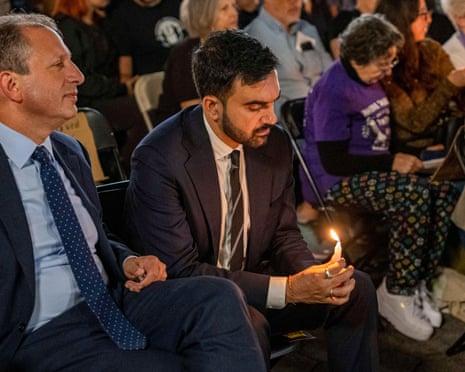
New York City Mayor Zohran Mamdani, who arrived along with Democratic congressional candidate Brad Lander to participate in the October 7th ceremony of the organization “Israelis for Peace” in Union Square, Manhattan, was met with curses and boos by protesters, many of whom were masked, waving Hezbollah flags and pictures of the arch-terrorist Yahya Sinwar.
The ceremony in which Mamdani participated was meant to honor the victims of the massacre and the casualties of the war that followed, both Israelis and Palestinians. However, for the Hamas supporters who disrupted the event and chased Mamdani on his way out, it doesn’t matter at all. For them, there is no place for acknowledging Israeli suffering, not even alongside Palestinian suffering.
The images from New York took me back to other images, from Memorial Day 2025 in Ra’anana, when far-right rioters attacked the attendees of the Israeli-Palestinian joint Memorial Day ceremony held at a Reform synagogue in the city. They attacked not only with words but also with stones, sticks, and blows.
The masked men waving the picture of the arch-terrorist Sinwar in New York and the incited and violent mob in Ra’anana are two sides of the same coin. Both refuse to acknowledge the other’s suffering; in their world, there is one absolute justice, and anyone who challenges it is, in their view, an enemy.
But there is a difference between the extremists in Israel and those in New York. In Israel, they receive support from a large part of the political system; in New York, they are an extreme minority that has not received any support even among the anti-Israel socialist faction in the Democratic Party. In Israel, those protesters received support not only from political figures, including the head of the Likud branch in the city, with many others’ silence serving as implicit agreement, but also from the Israeli government itself. However, it does not strive to remember the Israeli victims, and it fights against anyone who dares to mention the Palestinian victims, with the number one “enemy” in this context being Zohran Mamdani.
When Israel’s ambassador to the UN, Danny Danon, calls Mamdani “a dangerous man, a Hamas supporter,” just because he dared to include Palestinian victims in a post he published on the occasion of the October 7th commemoration and to mention alongside Hamas’s crimes what he believes were Israeli war crimes, he is actually backing those extremists in Ra’anana and across Israel who, in their view, not only deny the existence of Palestinian suffering but also consider anyone who dares to mention it an enemy and a “Hamas supporter.”
The ability to recognize the suffering of citizens on the other side, to ask questions, and to engage in critical thinking connects the human and important ceremonies in Ra’anana and Manhattan. The blind hatred, the dehumanization of the other side, and the support for terror and killing are what connect the violent protesters who sought to thwart the existence of both ceremonies.
As a society, we need to clarify our position. Do we acknowledge and mourn Palestinian suffering alongside remembering our loved ones in New York and Ra’anana, rather than being in an isolated place of denial wrapped in righteous but sometimes inaccurate slogans?
The first position will only deepen the international isolation we are experiencing. The second position is not only more correct and just, but it also has the potential to open a door for cooperation with large public groups around the world, who, on the one hand, are repulsed by Israeli propaganda slogans, but on the other hand, have witnessed the suffering caused here on October 7 and, since then, are simply demanding that this suffering be recognized as part of a broader narrative.
The October 7th event in New York highlighted the fault line between the sane and the haters. The more we isolate the haters from within, the more we can connect with sane voices around the world, even if they are critical, including Mamdani.