The First Father We Cannot Understand
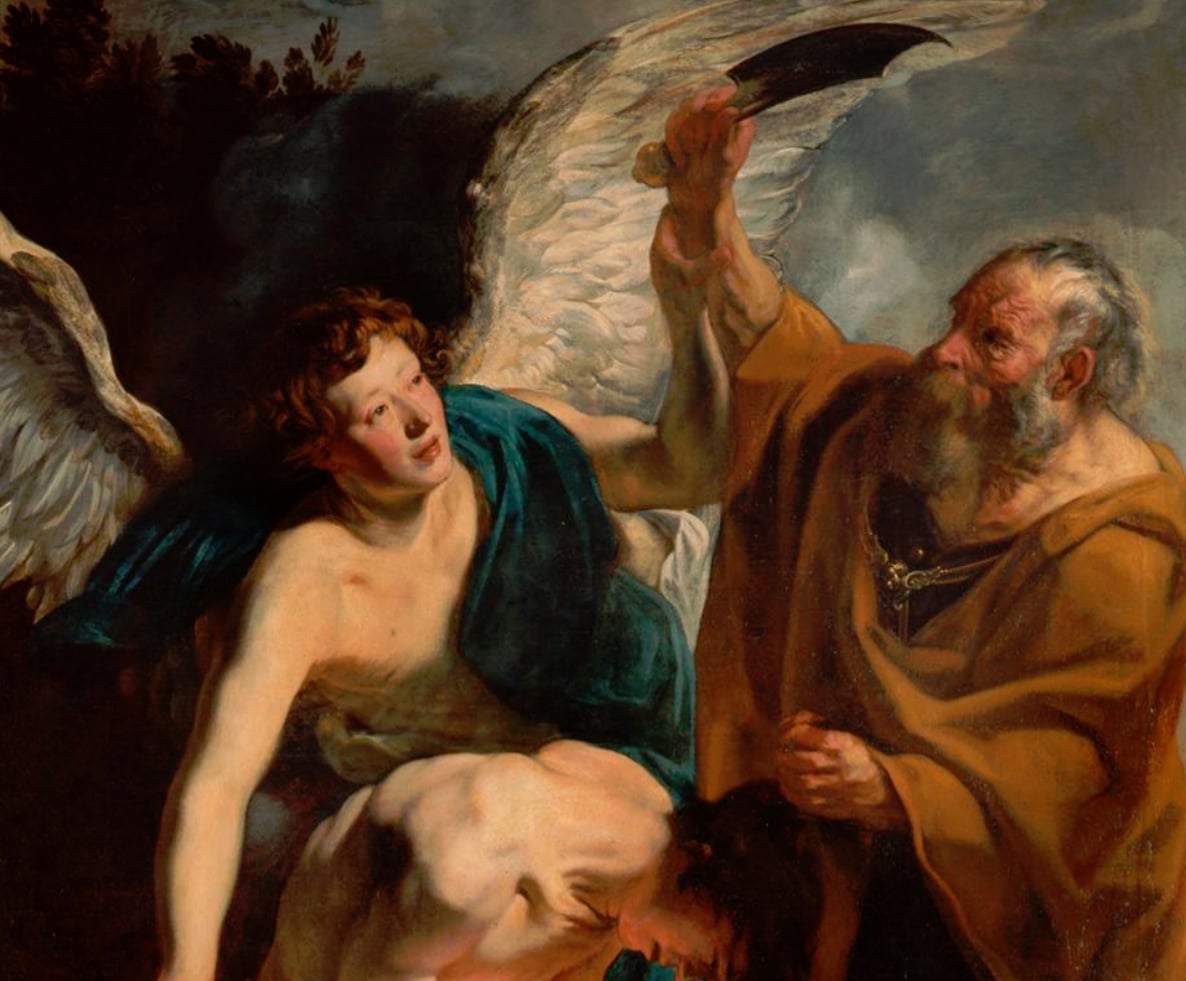
On Father’s Day we tell stories of devotion, responsibility, and love, and we honor those who accompanied us, taught us, and bore responsibility for the generations to come. Yet there is something worth pausing over in the fact that the most foundational father in Western culture is not a figure easy to celebrate in such terms.
Few figures have enjoyed the standing Abraham holds. Judaism calls him “Abraham our father,” Christianity regards him as the father of faith, and Islam counts him among its most important spiritual forefathers and names him “the friend of God.” For thousands of years Jews, Christians, and Muslims have returned to him, and each tradition has found in him a source of inspiration and authority. And yet the story most identified with him is also one of the most troubling ever written.
The Binding of Isaac refuses to settle comfortably with our moral intuitions. A father who heeds the command to offer up his son, and who rises in the morning to carry it out without a word of protest, is not a figure who fits easily with our conceptions of parenthood, responsibility, or love. Over the generations, the story has drawn countless interpretations. Some saw in it a test of faith. Others stressed that in the end, Isaac was spared, as though the happy ending softens the dread along the way. Some read it as a protest against child sacrifice, while others saw it as a tale of absolute obedience. All these readings, each in its own way, seek to make Abraham comprehensible.
In the nineteenth century, the Danish philosopher Søren Kierkegaard offered an entirely different reading. In his book Fear and Trembling, published in 1843 under the pen name Johannes de Silentio, “John the Silent,” he sought not to resolve the difficulty but to preserve it. The very choice of name hints at the argument. Some things cannot be said, and silence is the faithful response to them.
To sharpen the point, Kierkegaard sets against Abraham the tragic hero of the ancient world. Agamemnon sacrifices his daughter so the Achaean fleet may sail for Troy. Jephthah sacrifices his daughter on account of a vow. In each case, the deed is terrible, but it is a deed that can be understood. The tragic hero gives up what is dear to him for a greater good: the people, the state, the ideal. He remains within the realm of the ethical even as he breaks the heart, and the community can weep with him because it understands his reasoning.
Abraham is not a tragic hero. His singularity arises precisely from the fact that his act cannot be justified through morality itself. There is no public benefit here, no fleet awaiting the wind, no universal moral principle he can present to others and say, “Look, this is why I acted as I did.” Abraham acts out of a direct and wholly private relation to God, one that cannot be fully translated into the moral language shared among human beings. If Agamemnon can explain himself to every Greek, Abraham cannot explain himself even to Sarah. He goes alone.
From this is born one of Kierkegaard’s most famous concepts: the teleological suspension of the ethical, the possibility that the obligation to the absolute may, in rare moments, stand above the general moral obligation. And this is no mere theoretical possibility but an existential dread, which is why the book bears its title.
But here lies the step that is easy to miss. Abraham does not merely give up Isaac the way the tragic hero gives up. Kierkegaard distinguishes between the knight of infinite resignation and the knight of faith. The knight of resignation gives up his son forever, makes peace with the loss in nobility, and consoles himself with eternity, a heroism one can understand. Abraham does something incomprehensible. He raises the knife and at the very same time believes, in complete faith, that he will receive Isaac back, not in the world to come but here. He gives up everything and in that very instant expects to receive everything, “by virtue of the absurd.” The two movements, the relinquishing and the holding fast, occur at once. This is the heart of the paradox, and it is what Kierkegaard admits he himself cannot do. He can admire Abraham. Understand him he cannot.
Kierkegaard does not ask us to imitate Abraham. If every person were entitled to claim that he acts in the name of a higher command, human society would collapse. Precisely for this reason, Abraham remains a paradox rather than an exemplar.
The modern reader tends to choose between two comfortable responses. Some see Abraham as a hero of faith and hurry to justify him. Others see him as a fanatic who nearly murdered his son in the name of a voice he heard, and hurry to condemn him. Kierkegaard rejects both, because both do the very same thing. They dispel the discomfort and let us walk away from the story calm, holding a clear position. Kierkegaard wants us to remain awake, for the moment we manage to explain Abraham fully, we have lost what makes him so troubling and so important a figure.
Two hundred years after Fear and Trembling was written, the question Kierkegaard poses seems more relevant than ever. We live in an age of explanations. On social media, in politics, in the press, and even in our personal lives, we are expected to justify ourselves ceaselessly. Not merely to hold a position but to argue for it. Not merely to choose but to explain the choice. In many ways this is an achievement of modern society. Transparency, criticism, and public debate are preferable to an authority that need give no account of itself.
And yet Abraham continues to trouble us because he marks the limits of the language of justification itself. He represents the possibility that there are dimensions of human life that cannot be fully translated into public language because the individual, in certain moments, stands before something that cannot be converted into the universal. Love is one example, faith another. At times loyalty, vocation, or deep commitment also resist reduction to a system of reasons. We can describe them, argue over them, even criticize them, but we cannot always exhaust them through argument. “The individual is higher than the universal,” Kierkegaard writes, perhaps the most dangerous sentence in the book, and also the most precise concerning how we experience the great moments of our lives.
Perhaps this is why he still haunts the Western imagination thousands of years after his story was written. Not because he offers an answer to the great questions of existence, but because he refuses to provide one.
On Father’s Day we tend to celebrate the fathers we understand. But the first father of the monotheistic tradition reminds us of something else entirely: the limits of understanding itself. Thousands of years after his story was written, we are still arguing over him, justifying him, condemning him, and trying to interpret him anew. Perhaps this is the mark of a truly foundational figure. Not that it ceases to provoke questions, but that it continues to provoke them even when we imagine we have already found the answers.