The farmer stood on the hillside and surveyed the land before him.
Before planting a single tree or vine, he had to understand the ground. Would olive trees thrive in the rocky limestone soil? Would the hillside hold or shed the winter rains? A poor decision could cost years.
The work was slow and demanding. Stones had to be cleared, many of them becoming the terraces that would hold the precious topsoil in place through winter rains and long, dry summers. Then came the planting and the long wait. Olive trees could take years before yielding a worthwhile crop. The vines matured sooner, yet demanded constant pruning and care. Spring blossom carried hope, but wind, drought or hail could still destroy what had begun so promisingly.
The farmer could prepare the soil, build the terraces and tend the orchard, but the harvest itself remained in the hands of Hashem.
Even when the trees began to bear fruit, the farmer still had to wait. For three years, the produce was forbidden as Orlah. In the fourth, it was sanctified as Neta Revai. Only in the fifth year could he finally enjoy the harvest as his own.
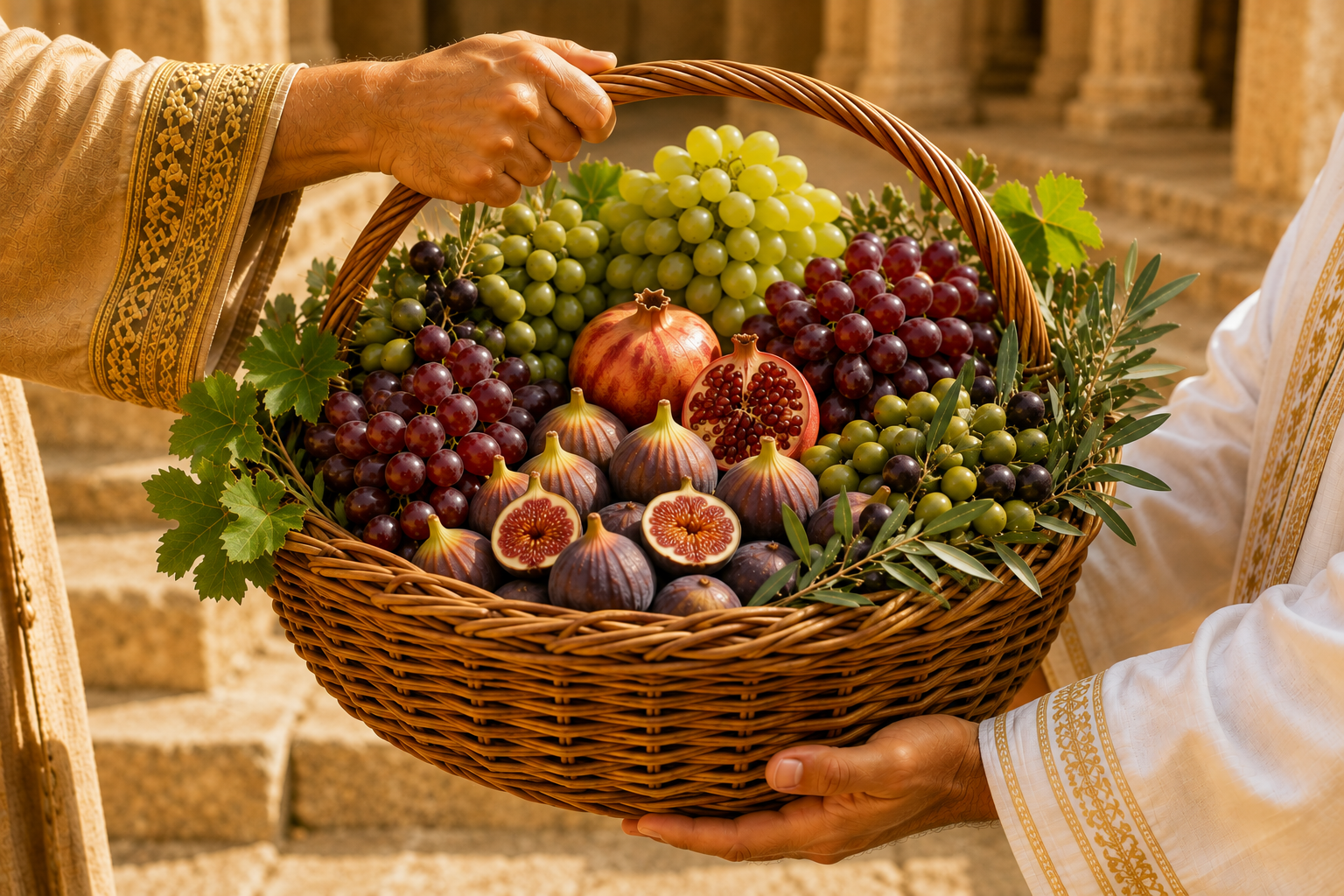
When the first fruits began to appear, the Torah asked something more. The Mishnah records that when the farmer first saw a fig beginning to ripen, a cluster of grapes forming, or a pomegranate starting to mature, he tied a reed around it and declared:
הֲרֵי אֵלּוּ בִּכּוּרִים Behold, these are Bikkurim.
(Mishnah Bikkurim 3:1)
From that moment, the fruits were set aside for Hashem, though they could not yet be brought to Jerusalem. The Rambam explains that they could be designated as Bikkurim even before they had fully ripened; once they matured, they were picked.
At last, the farmer stood in the courtyard of the Beit HaMikdash, a woven basket resting gently in his hands. Inside lay the first ripe fruits from his orchard and vineyard.
He lowered the basket before the Kohen.
“I lifted my eyes to the hills and sought the place You had prepared for me. You led me to rocky ground where olive trees would one day take root and to the slopes where vines would flourish beneath the warmth of the sun.
You gave strength to my hands to clear the stones and build the terraces. You sent the early and later rains in their appointed time. You watched over the blossom while I waited in hope for the work of my hands to bear fruit.
When the first fruit appeared, I marked it and set it aside for You.
And now, Hashem, I stand before You with the first of the blessings You have bestowed upon me. I give thanks for the land, the rain, the harvest, and every blessing that flows from Your hand.”
Those would have been fitting words.
But the Torah asks something different of him.
Standing before the Kohen, he begins:
אֲרַמִּי אֹבֵד אָבִי My father was a wandering Aramean…
(Devarim 26:5)
After years of labour, waiting and uncertainty, the farmer begins not with his own story, but with the story of his people.
The harvest did not begin with the farmer standing in the Temple. Nor did it begin when he planted his first tree.
It began generations earlier—with a promise made to Avraham, a people redeemed from Egypt, and a land given by Hashem.
The farmer knew what it had taken to grow the fruit. The Torah now asks him to remember what it had taken for him to be there to grow it.
By returning with the first fruits year after year, gratitude becomes more than a response to abundance. It becomes a discipline of the heart.
In offering his first fruit, memory became gratitude.
שבת שלום
שמואל
About the Author
Sam writes on faith, Jewish identity, geopolitics, and the enduring covenant between the Jewish people and the Land of Israel. Living between the UK and Israel, he explores renewal, sovereignty, and the forces shaping the journey home.