Won't Be Silent
The Future Isaac Asimov Refused to Imagine
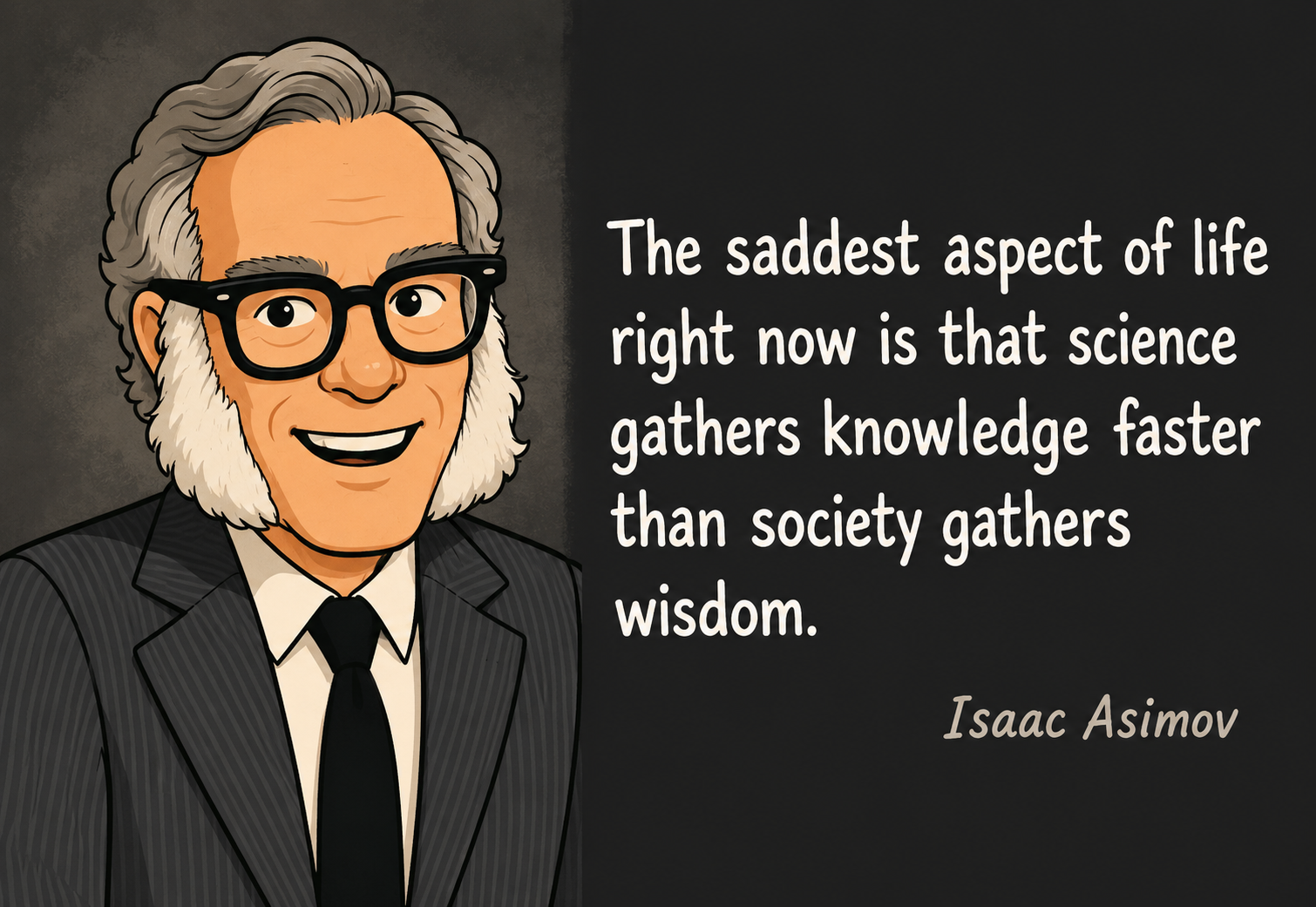
Image: ChatGPT
And the Life Lesson This Brilliant Man Could Have Learned From Me
After an amazing week visiting my sisters and their kids — back in the warmth of my New Jersey childhood home — I’m writing this from 30,000 feet in the air, headed back to my home away from home in Los Angeles.
Sadly, I just missed the rally organized by End Jew Hatred in front of Gracie Mansion — something Isaac Asimov would have disapproved of.
For some ungodly reason, I’ve been thinking about him lately.
Maybe it’s because of all this talk about AI and robots — the world Asimov imagined hasn’t been realized since it’s living up to his own words, “The saddest aspect of life right now is that science gathers knowledge faster than society gathers wisdom.”
As small worlds go, Asimov once lived next door to my sister Rita on Central Park West. When Rita gave birth to her daughter, he wrote her a poem — a lovely, generous gesture from a remarkable neighbor and human being.
The more I’ve revisited his life and work, the more I understand just how brilliant he was. But I’ve also come to believe that when it came to Jewish survival, he fundamentally misunderstood the world as it actually is. He even questioned whether the State of Israel was a good idea back in 1948.
Regardless of his atheism, secularism, or distance from tradition, Isaac Asimov was a Jew. The world doesn’t care how detached a Jew becomes from his peoplehood. In this game of chance, the Jews are chosen alright — chosen to be persecuted whether they like it or not. Even the brilliant ones like Asimov.
What we’re seeing now play out in the streets and in our universities is the new mental strain of antisemitism they call anti-Zionism — as if the rebranding changes anything — it’s simply the latest mutation of the crippling mind virus called Jew hatred. Nothing new here. The slogans change. The scapegoats evolve. The pathos remains astonishingly consistent.
And none of us are exempt from it.
Not me.
Not Isaac — and those bright lights still with us.
Not my sister’s daughter.
Perhaps being Jewish is the only thing Isaac Asimov and I truly had in common. I’m a college dropout living hand to mouth. He was one of the greatest intellectuals of the twentieth century — wildly successful, endlessly prolific, a man who imagined every possible future.
And yet for all his brilliance, I’m not sure he ever fully understood the oldest story of all — antisemitism. The denial is palpable.
Asimov envisioned a future where science and rational thinking would eventually dissolve the tribal instincts that make human beings destroy one another. Religion, nationalism, ethnic identity — he believed humanity could ultimately outgrow all of it and unite under one civilization guided by reason and knowledge.
That’s the entire premise of the Foundation series: shortening humanity’s dark ages through pure applied logic.
Humanity as one species.
One project.
One future.
I can understand why he wanted to believe it.
I even envy it because I, too, live in my own version of la la land.
History has not been kind to Jews who mistake acceptance for permanence.
Asimov was deeply uncomfortable with Jewish particularism. He resisted Zionism for most of his life and genuinely believed the answer to antisemitism was for Jews to dissolve into the broader human family — to become less visibly Jewish, less distinct, less separate.
He thought Jewish visibility itself made Jews vulnerable and the answer was less Jewishness, not more.
Whereas I believe the exact opposite. My philosophy is called The Theory of Relatability — the idea that survival depends on strengthening bonds between people who share moral clarity, memory, values, and mutual responsibility. Finding common ground among like hearts and minds so nobody stands alone when history inevitably turns dark again.
For years I suffered from what I eventually came to understand as ESC: Emotional and Spiritual Cancer of Assimilation.
And I don’t use the word cancer lightly. Like an undetectable cancer, assimilation can spread quietly while convincing you everything is fine. It disconnects people from memory, identity, self-preservation, and eventually reality itself. It teaches people to reject the very structures that protect them because they’ve been conditioned to see rootedness, loyalty, and historical memory as embarrassments rather than survival tools.
Not every case is terminal. Many are. Thankfully mine wasn’t.
You can see versions of ESC everywhere now — people voting against their own interests, defending ideologies that openly despise them, mistaking moral confusion for sophistication, believing history’s rules no longer apply to them.
Those propagandized Jews who voted for Zohran Mamdani, for instance.
The symptoms vary. The detachment is always the same.
It wasn’t until Nazis marched openly in Charlottesville in August 2017 that I experienced my first real dose of clarity and understood how spiritually disconnected I had become from my own Jewish identity and how desperately I needed to heal my brain.
October 7 shattered whatever lingering illusions remained. And what has followed is a groundswell of Jews rediscovering not only their connection to Zionism, but belonging itself — along with Christian Zionists and those who understand the premise — survival requires solidarity, memory, and courage —not denial.
Here’s the tragic irony:
Asimov spent his life imagining civilizations capable of surviving collapse.
Entire systems designed to preserve knowledge through chaos.
And yet he never fully applied that same urgency to the civilization that produced him.
His people, who emigrated to America with hope for a better future.
Ironically, the Asimov Foundation was for everyone except the Jews.
And I think he was wrong in the most heartbreaking way imaginable.
Because hatred doesn’t care how brilliant you are.
It doesn’t care how assimilated you become.
It doesn’t care how universal your ideals are.
It never has.
Related Topics